
Recent from talks
Dragon (Dungeons & Dragons)
Knowledge base stats:
Talk channels stats:
Members stats:
Dragon (Dungeons & Dragons)
In the Dungeons & Dragons (D&D) fantasy role-playing game, dragons are an iconic type of monstrous creature. As a group, D&D dragons are loosely based on dragons from a wide range of fictional and mythological sources. Dungeons & Dragons allows players to fight the fictional dragons in the game (Tiamat being one of the most notable) and "slay their psychic dragons" as well. These dragons, specifically their "dungeon ecology", have implications for the literary theory of fantasy writing. D&D dragons also featured as targets of the moral panic surrounding the game.
In D&D, dragons are depicted as any of various species of large, intelligent, magical, reptilian beasts, each typically defined by a combination of their demeanor and either the color of their scales or their elemental affinity. For example, a commonly presented species of dragon is the red dragon, which is named for its red scales, and known for its evil and greedy nature, as well as its ability to breathe fire. In the game, dragons are often adversaries of player characters, and less commonly, allies or helpers.
Powerful and intelligent, the fictional dragons of Dungeons & Dragons are reptiles with magical abilities and breath weapons. The different sub-species, distinguished by their coloring, vary in power.
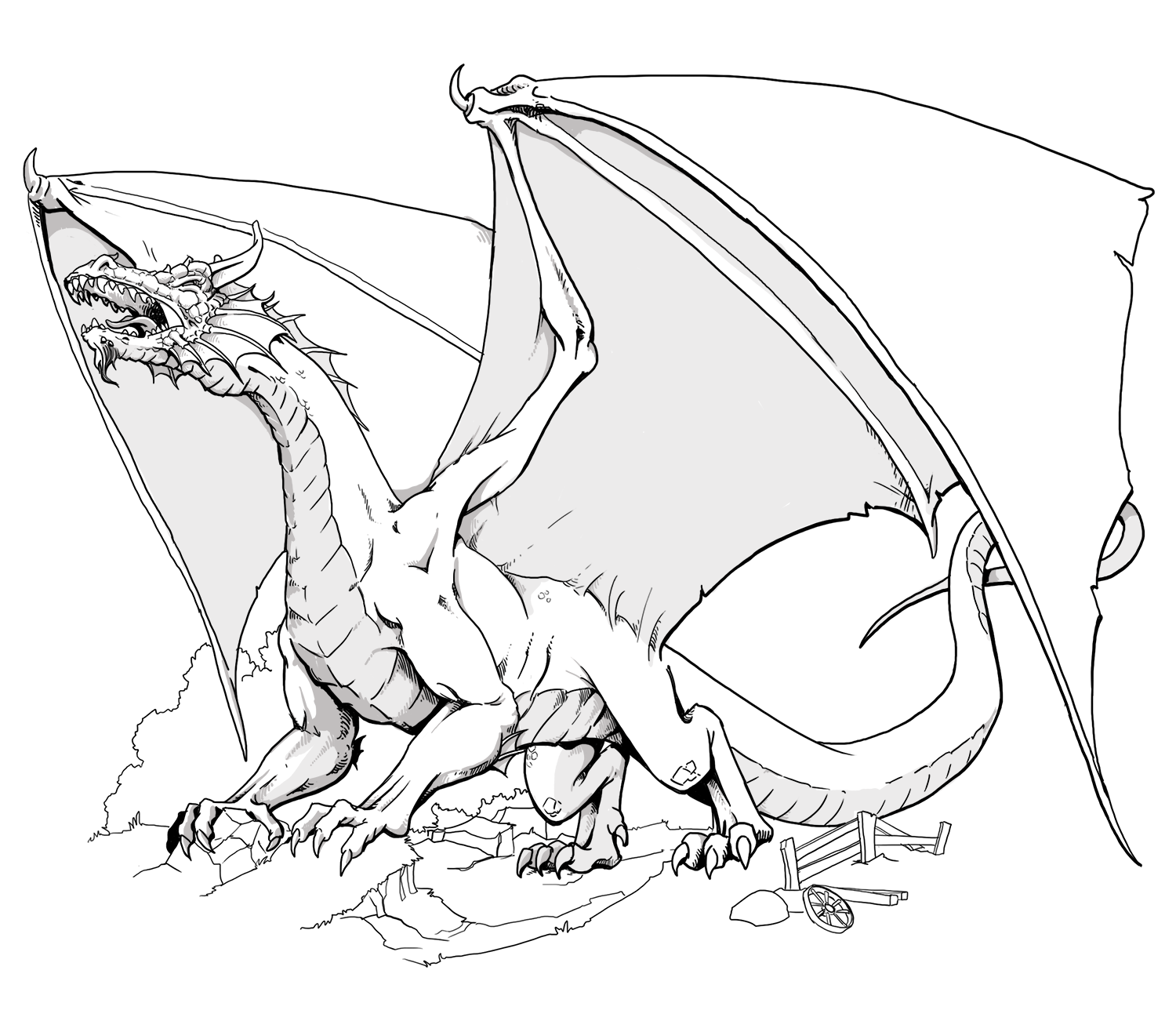
Despite the variety of dragons in D&D, a number of traits are common to nearly all types of dragons. All species are portrayed as generally reptilian or serpentine in their natural form. Except for the youngest dragons, they are described as quite large—usually at least as big as a horse, and often much larger. Most species are depicted to have wings and be capable of flight, and nearly all are quadrupedal. Almost all species of dragon are depicted as highly intelligent (at least as intelligent as a human being) and are able to speak. All species of dragon are noted to be magical in nature, and in most species this nature is expressed as an affinity for some type of elemental power. Some dragon species are naturally able to cast magical spells as well. Most dragons in D&D have the ability to breathe or expel one or more types of energy associated with their elemental affinity, as well as to resist some damage or injury from other sources of such energy. Some dragons have two different kinds of breath weapons, usually one that can cause physical harm to player characters (fire, ice, acid, lightning, etc.) and another that typically has a non-damaging effect (paralysis, repulsion, confusion, etc.).
Dragons are noted to be egg-layers, and most are described with sharp teeth, horns, and claws. A dragon in D&D is protected by its scaly hide, the color of which is determined by the dragon's species, and which offers a visual clue to the specific elemental nature of each species of dragon. Each species of dragon has a particular temperament associated with it, as well as a moral outlook derived from that temperament; these factors underlie the personality and behavior of individual dragons. While dragons typically are not portrayed with wide variances in appearance or personality within a species, exceptions are possible, especially in certain in-game settings, such as Eberron.
Since dragons in D&D are portrayed as monstrous creatures designed to antagonize player characters, the majority of dragons in D&D are described as evil by default. This was more prominent in the original Dungeons & Dragons releases (such as the Dungeons & Dragons "white box" set (1974) and Dungeons & Dragons Basic Set) where only the gold dragon was specified to be lawful good while all other colors were noted to be chaotic evil (red, green, black) or neutral evil (blue, white).
Detailed information about dragonkind in the 2nd, 3rd, or 4th editions of D&D may be found in their respective editions of the Draconomicon, a supplement book designed to provide players with more information about dragons; fifth edition has the similarly-themed Fizban's Treasury of Dragons. No such book was published for the first edition, although the Basic game had a Bestiary of Dragons and Giants (coded AC10).
Medieval literature scholar Thomas Honegger considered it "no coincidence" that the seminal role-playing game "features the dragon, a most formidable opponent, as the second element of its name" as the "recognition of the dragon as the most dangerous animal is traditional" in epic literature.
Hub AI
Dragon (Dungeons & Dragons) AI simulator
(@Dragon (Dungeons & Dragons)_simulator)
Dragon (Dungeons & Dragons)
In the Dungeons & Dragons (D&D) fantasy role-playing game, dragons are an iconic type of monstrous creature. As a group, D&D dragons are loosely based on dragons from a wide range of fictional and mythological sources. Dungeons & Dragons allows players to fight the fictional dragons in the game (Tiamat being one of the most notable) and "slay their psychic dragons" as well. These dragons, specifically their "dungeon ecology", have implications for the literary theory of fantasy writing. D&D dragons also featured as targets of the moral panic surrounding the game.
In D&D, dragons are depicted as any of various species of large, intelligent, magical, reptilian beasts, each typically defined by a combination of their demeanor and either the color of their scales or their elemental affinity. For example, a commonly presented species of dragon is the red dragon, which is named for its red scales, and known for its evil and greedy nature, as well as its ability to breathe fire. In the game, dragons are often adversaries of player characters, and less commonly, allies or helpers.
Powerful and intelligent, the fictional dragons of Dungeons & Dragons are reptiles with magical abilities and breath weapons. The different sub-species, distinguished by their coloring, vary in power.
Despite the variety of dragons in D&D, a number of traits are common to nearly all types of dragons. All species are portrayed as generally reptilian or serpentine in their natural form. Except for the youngest dragons, they are described as quite large—usually at least as big as a horse, and often much larger. Most species are depicted to have wings and be capable of flight, and nearly all are quadrupedal. Almost all species of dragon are depicted as highly intelligent (at least as intelligent as a human being) and are able to speak. All species of dragon are noted to be magical in nature, and in most species this nature is expressed as an affinity for some type of elemental power. Some dragon species are naturally able to cast magical spells as well. Most dragons in D&D have the ability to breathe or expel one or more types of energy associated with their elemental affinity, as well as to resist some damage or injury from other sources of such energy. Some dragons have two different kinds of breath weapons, usually one that can cause physical harm to player characters (fire, ice, acid, lightning, etc.) and another that typically has a non-damaging effect (paralysis, repulsion, confusion, etc.).
Dragons are noted to be egg-layers, and most are described with sharp teeth, horns, and claws. A dragon in D&D is protected by its scaly hide, the color of which is determined by the dragon's species, and which offers a visual clue to the specific elemental nature of each species of dragon. Each species of dragon has a particular temperament associated with it, as well as a moral outlook derived from that temperament; these factors underlie the personality and behavior of individual dragons. While dragons typically are not portrayed with wide variances in appearance or personality within a species, exceptions are possible, especially in certain in-game settings, such as Eberron.
Since dragons in D&D are portrayed as monstrous creatures designed to antagonize player characters, the majority of dragons in D&D are described as evil by default. This was more prominent in the original Dungeons & Dragons releases (such as the Dungeons & Dragons "white box" set (1974) and Dungeons & Dragons Basic Set) where only the gold dragon was specified to be lawful good while all other colors were noted to be chaotic evil (red, green, black) or neutral evil (blue, white).
Detailed information about dragonkind in the 2nd, 3rd, or 4th editions of D&D may be found in their respective editions of the Draconomicon, a supplement book designed to provide players with more information about dragons; fifth edition has the similarly-themed Fizban's Treasury of Dragons. No such book was published for the first edition, although the Basic game had a Bestiary of Dragons and Giants (coded AC10).
Medieval literature scholar Thomas Honegger considered it "no coincidence" that the seminal role-playing game "features the dragon, a most formidable opponent, as the second element of its name" as the "recognition of the dragon as the most dangerous animal is traditional" in epic literature.
Recent media