
Recent from talks
Clyde Workers' Committee
Knowledge base stats:
Talk channels stats:
Members stats:
Clyde Workers' Committee
The Clyde Workers Committee was formed to campaign against the Munitions Act. It was originally called the Labour Withholding Committee. The leader of the CWC was Willie Gallacher, who was jailed under the Defence of the Realm Act 1914 together with John Muir for an article in the CWC journal The Worker criticising the First World War.
The committee originated in a strike in February 1915 at G. & J. Weir. Due to labour shortages during the war, the company had employed some workers from America, but were paying them more than the Scottish staff. The shop stewards at the factory organised a walk-out in support of equal pay, and more factories joined the dispute over the next few weeks, until workers at 25 different factories were on strike.
Most of the workers were members of the Amalgamated Society of Engineers (ASE), but the union leadership, both locally and nationally, opposed the strike. In order to defend the strike, about two hundred shop stewards and supporters formed the informal Central (or Clyde) Labour Withholding Committee, which was constituted as the Clyde Workers' Committee in October 1915.
The committee met weekly, and included numerous people who later became prominent socialists and communists. These included Gallacher, Tom Bell, David Kirkwood, John Maclean, Arthur MacManus, Harry McShane and Jimmy Maxton. Many of the leading figures were members of the Socialist Labour Party (SLP), but others were involved with the British Socialist Party, the Independent Labour Party, or had no previous political involvement, the general approach being broadly.
The initial demands for higher pay were largely successful, and the committee took up the matter of high rents - an influx of workers to staff the factories producing war materials had pushed up rents. Opposition to this was led by a group of working-class women, including Mary Barbour, Mary Burns Laird, Helen Crawfurd, Agnes Dollan and Mary Jeff, and culminated in a rent strike of 25,000 tenants by October 1915. The committee threatened to call a general strike on the matter, and the government responded by introducing the national Rent Restriction Act.
The committee called for joint control of factories by workers and management, ultimately leading to the overthrow of the wage system, to produce industrial democracy. It was suspicious of the full-time leadership of the trade unions, and passed a resolution stating that they would only support them when their own committee decisions concorded. Although Maclean, James D. MacDougall and Peter Petroff urged the group to adopt a policy opposing the war, the SLP members refused to allow discussion of this, preferring to stick solely to industrial and democratic matters.
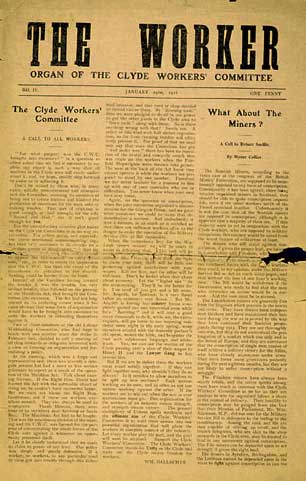
In order to propagate their views, the committee published a weekly newspaper, The Worker, edited by John William Muir.
In December 1915, David Lloyd George and Arthur Henderson, leading figures in the Liberal Party and Labour Party, travelled to Glasgow to address a meeting of workers at St Andrew's Hall. This was poorly received, particularly by supporters of Maclean, who barracked the speakers. Press accounts of the meeting were officially censored, but two local socialist newspapers, Forward and Maclean's own publication, Vanguard, were either unaware of this or unwilling to co-operate. In response, the government banned the two publications and seized copies of their current issues. On 2 February, The Worker was also banned, on the grounds that it had printed an article by Maclean entitled "Should the workers arm?", even though the article had concluded that they should not. Police raided the SLP offices where the paper was produced and broke the printing presses, and arrested Maclean, Gallacher, Muir and Walter Bell.
Hub AI
Clyde Workers' Committee AI simulator
(@Clyde Workers' Committee_simulator)
Clyde Workers' Committee
The Clyde Workers Committee was formed to campaign against the Munitions Act. It was originally called the Labour Withholding Committee. The leader of the CWC was Willie Gallacher, who was jailed under the Defence of the Realm Act 1914 together with John Muir for an article in the CWC journal The Worker criticising the First World War.
The committee originated in a strike in February 1915 at G. & J. Weir. Due to labour shortages during the war, the company had employed some workers from America, but were paying them more than the Scottish staff. The shop stewards at the factory organised a walk-out in support of equal pay, and more factories joined the dispute over the next few weeks, until workers at 25 different factories were on strike.
Most of the workers were members of the Amalgamated Society of Engineers (ASE), but the union leadership, both locally and nationally, opposed the strike. In order to defend the strike, about two hundred shop stewards and supporters formed the informal Central (or Clyde) Labour Withholding Committee, which was constituted as the Clyde Workers' Committee in October 1915.
The committee met weekly, and included numerous people who later became prominent socialists and communists. These included Gallacher, Tom Bell, David Kirkwood, John Maclean, Arthur MacManus, Harry McShane and Jimmy Maxton. Many of the leading figures were members of the Socialist Labour Party (SLP), but others were involved with the British Socialist Party, the Independent Labour Party, or had no previous political involvement, the general approach being broadly.
The initial demands for higher pay were largely successful, and the committee took up the matter of high rents - an influx of workers to staff the factories producing war materials had pushed up rents. Opposition to this was led by a group of working-class women, including Mary Barbour, Mary Burns Laird, Helen Crawfurd, Agnes Dollan and Mary Jeff, and culminated in a rent strike of 25,000 tenants by October 1915. The committee threatened to call a general strike on the matter, and the government responded by introducing the national Rent Restriction Act.
The committee called for joint control of factories by workers and management, ultimately leading to the overthrow of the wage system, to produce industrial democracy. It was suspicious of the full-time leadership of the trade unions, and passed a resolution stating that they would only support them when their own committee decisions concorded. Although Maclean, James D. MacDougall and Peter Petroff urged the group to adopt a policy opposing the war, the SLP members refused to allow discussion of this, preferring to stick solely to industrial and democratic matters.
In order to propagate their views, the committee published a weekly newspaper, The Worker, edited by John William Muir.
In December 1915, David Lloyd George and Arthur Henderson, leading figures in the Liberal Party and Labour Party, travelled to Glasgow to address a meeting of workers at St Andrew's Hall. This was poorly received, particularly by supporters of Maclean, who barracked the speakers. Press accounts of the meeting were officially censored, but two local socialist newspapers, Forward and Maclean's own publication, Vanguard, were either unaware of this or unwilling to co-operate. In response, the government banned the two publications and seized copies of their current issues. On 2 February, The Worker was also banned, on the grounds that it had printed an article by Maclean entitled "Should the workers arm?", even though the article had concluded that they should not. Police raided the SLP offices where the paper was produced and broke the printing presses, and arrested Maclean, Gallacher, Muir and Walter Bell.
Recent media