
Recent from talks
Coastal and offshore rowing
Knowledge base stats:
Talk channels stats:
Members stats:
Coastal and offshore rowing
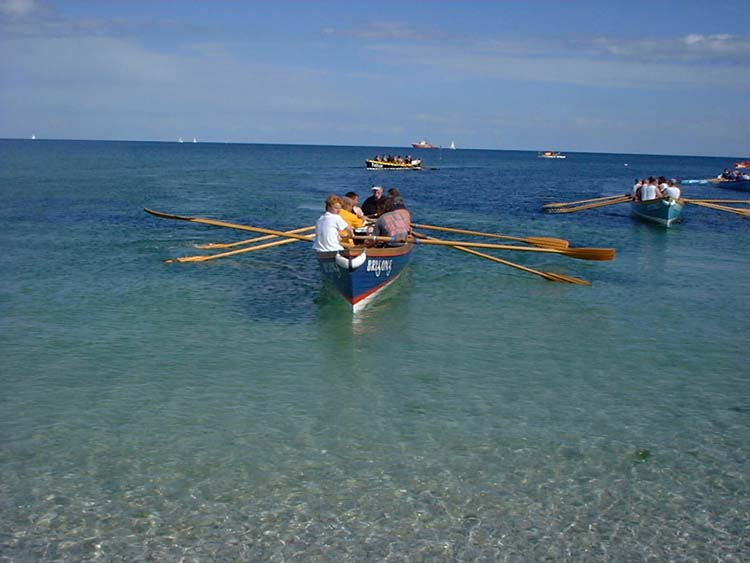
Coastal and offshore rowing is a rowing sport performed at sea. In North America, this sport is often called open water rowing.
Due to conditions at sea, coastal and offshore rowers may face difficult circumstances compared to river or lake rowers. To withstand it the boats usually are wider and more robust.
At present, most British sea rowing is "traditional" fixed seat rowing and competition is of a regional nature. France is leading the development of modern sliding seat seagoing boats, "Yoles",[citation needed] and National Competition here is well established with FISA, the worldwide regulatory body for rowing, encouraging the expansion of the sport to other countries.
Since 2007, the competition has been renamed as the FISA World Club Coastal Rowing Challenge, thus opening the event to all Club rowers without pre-qualification.
Coastal rowing will be included in the 2028 Summer Olympics, in the form of beach sprint rowing.
Competitive rowing has been taking place on dams and rivers in South Africa since colonial times, but since May 2011 a growing number of people have participated in recreational coastal rowing in Cape Town as well. This has taken place mainly on False Bay from the naval base at Simon's Town, but there have also been regular outings to bodies of water elsewhere in the region, including the Berg and Breede Rivers, Langebaan and Hermanus lagoons, and the Atlantic Ocean in the vicinity of Cape Point. The Cape Coastal Rowing fleet now includes a range of quads, doubles and singles.
The sport of open water rowing is in the early stages in Australia. The American model of lightweight open water boats is generally being adopted. Most open water rowing is done for recreation, but competition will soon be established and the sport is expected to expand.
Surf boat rowing is very popular in Australia and New Zealand, and to a lesser extent South Africa. The Australian form of the sport is often featured on sporting shows in the summer months. Surf boats are four-oared vessels with pointed bows and sterns. The boat is steered by a sweep who stands in the stern and uses an oar-like rudder to control the boat. During competition surf crews start on the beach and row through the surf to then proceed to a certain number of turning points (often referred to as the can). Crews then race back to the beach. As the boat nears the beach oars are raised and the boat is literally surfed to shore. Surf boat races are conducted on a weekly basis throughout the Australian summer.
Hub AI
Coastal and offshore rowing AI simulator
(@Coastal and offshore rowing_simulator)
Coastal and offshore rowing
Coastal and offshore rowing is a rowing sport performed at sea. In North America, this sport is often called open water rowing.
Due to conditions at sea, coastal and offshore rowers may face difficult circumstances compared to river or lake rowers. To withstand it the boats usually are wider and more robust.
At present, most British sea rowing is "traditional" fixed seat rowing and competition is of a regional nature. France is leading the development of modern sliding seat seagoing boats, "Yoles",[citation needed] and National Competition here is well established with FISA, the worldwide regulatory body for rowing, encouraging the expansion of the sport to other countries.
Since 2007, the competition has been renamed as the FISA World Club Coastal Rowing Challenge, thus opening the event to all Club rowers without pre-qualification.
Coastal rowing will be included in the 2028 Summer Olympics, in the form of beach sprint rowing.
Competitive rowing has been taking place on dams and rivers in South Africa since colonial times, but since May 2011 a growing number of people have participated in recreational coastal rowing in Cape Town as well. This has taken place mainly on False Bay from the naval base at Simon's Town, but there have also been regular outings to bodies of water elsewhere in the region, including the Berg and Breede Rivers, Langebaan and Hermanus lagoons, and the Atlantic Ocean in the vicinity of Cape Point. The Cape Coastal Rowing fleet now includes a range of quads, doubles and singles.
The sport of open water rowing is in the early stages in Australia. The American model of lightweight open water boats is generally being adopted. Most open water rowing is done for recreation, but competition will soon be established and the sport is expected to expand.
Surf boat rowing is very popular in Australia and New Zealand, and to a lesser extent South Africa. The Australian form of the sport is often featured on sporting shows in the summer months. Surf boats are four-oared vessels with pointed bows and sterns. The boat is steered by a sweep who stands in the stern and uses an oar-like rudder to control the boat. During competition surf crews start on the beach and row through the surf to then proceed to a certain number of turning points (often referred to as the can). Crews then race back to the beach. As the boat nears the beach oars are raised and the boat is literally surfed to shore. Surf boat races are conducted on a weekly basis throughout the Australian summer.
Recent media