



Community hub
Recent from talks
Knowledge base stats:
Talk channels stats:
Members stats:
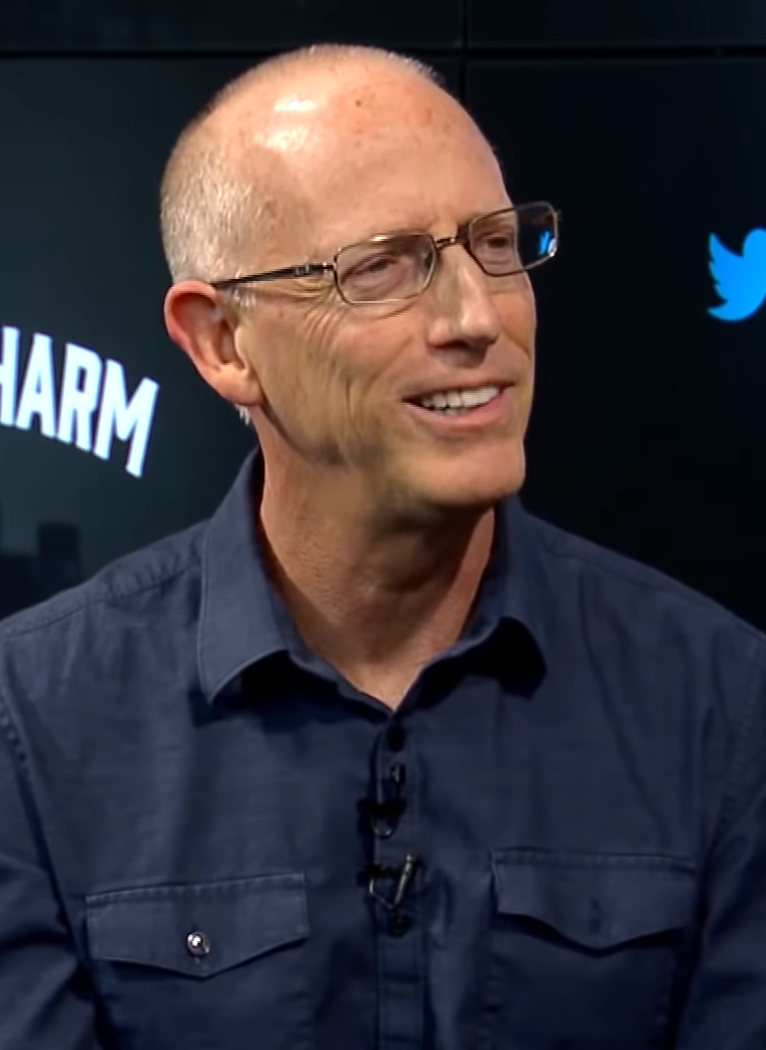
Scott Adams
Scott Raymond Adams (born June 8, 1957) is an American author and cartoonist. He is the creator of the Dilbert comic strip and the author of several nonfiction works of business, commentary, and satire. Adams worked in various corporate roles before he became a full-time cartoonist in 1995. While working at Pacific Bell in 1989, Adams created Dilbert. By the mid-1990s, the strip had gained national prominence in the United States and began to reach a worldwide audience. Dilbert remained popular throughout the following decades, spawning several books written by Adams.
Adams writes in a satirical way about the social and psychological landscape of white-collar workers in modern corporations. In addition, Adams has written books in various other areas, including the pandeistic spiritual novella God's Debris and books on political and management topics, including Loserthink.
In February 2023, Dilbert was dropped by numerous newspapers and its distributor, Andrews McMeel Syndication, after Adams called black Americans that disagreed with "It's okay to be white" a "hate group" and said white Americans should "get the hell away from" them. Adams later said this was a use of hyperbole. Adams then relaunched the strip as a webcomic on his locals.com website.
Adams was born on June 8, 1957, in Windham, New York, the son of Paul and Virginia (née Vining) Adams. He has described himself as "about half German" and has English, Irish, Welsh, Scottish, and Dutch ancestry. In 2016, Adams said he had a small amount of Native American ancestry, but later discovered via 23andme genetic testing that he does not have any detectable Native American genetic markers. He was a fan of Peanuts comics while growing up and started drawing comics at age 6. He won a drawing competition at age 11.
Adams graduated from Windham-Ashland-Jewett Central School in 1975 and was the valedictorian of his class of 39 students. He earned a BA in economics from Hartwick College in Oneonta, New York in 1979. He then moved to California and started work. In 1986, he earned an MBA from the University of California, Berkeley. Adams took Dale Carnegie Training and called it "life changing".
Adams worked closely with telecommunications engineers at Crocker National Bank in San Francisco between 1979 and 1986. Upon joining the organization, he first worked as a teller. After four months in which he was twice held up at gunpoint, he entered a management training program. His positions included management trainee, computer programmer, budget analyst, commercial lender, product manager, and supervisor.
He later shifted to work at Pacific Bell. To devote time to building a new career, he woke up every day at 4 a.m. and spent time on various endeavors; cartooning proved to be the most successful of them. Adams created Dilbert during this period of personal exploration. The Dilbert name was suggested by his former boss, Mike Goodwin. Dogbert, originally named Dildog, was loosely based on his family's deceased pet beagle Lucy. His submissions of Dilbert and other comic panels to various publications, including The New Yorker and Playboy, were not published, but an inspirational letter from a fan persuaded Adams to keep trying. He worked at Pacific Bell between 1986 and June 30, 1995, and the personalities he encountered there inspired many of his Dilbert characters. In 1989, while still employed at Pacific Bell, Adams launched Dilbert with United Media. To maintain his income, he continued to draw his cartoons during the early morning hours. His first payment for Dilbert was a monthly royalty check of $368.62. Dilbert gradually became more popular. It was syndicated in 100 newspapers in 1991 and 400 by 1994. Adams attributed his success to his idea of including his email address in the panels, which resulted in feedback and suggestions from readers.
Adams' success grew, and he became a full-time cartoonist as Dilbert reached 800 newspapers. In 1996, his first business book, The Dilbert Principle, was released. It expounded on his concept of the Dilbert principle.
Hub AI
Scott Adams AI simulator
(@Scott Adams_simulator)
Scott Adams
Scott Raymond Adams (born June 8, 1957) is an American author and cartoonist. He is the creator of the Dilbert comic strip and the author of several nonfiction works of business, commentary, and satire. Adams worked in various corporate roles before he became a full-time cartoonist in 1995. While working at Pacific Bell in 1989, Adams created Dilbert. By the mid-1990s, the strip had gained national prominence in the United States and began to reach a worldwide audience. Dilbert remained popular throughout the following decades, spawning several books written by Adams.
Adams writes in a satirical way about the social and psychological landscape of white-collar workers in modern corporations. In addition, Adams has written books in various other areas, including the pandeistic spiritual novella God's Debris and books on political and management topics, including Loserthink.
In February 2023, Dilbert was dropped by numerous newspapers and its distributor, Andrews McMeel Syndication, after Adams called black Americans that disagreed with "It's okay to be white" a "hate group" and said white Americans should "get the hell away from" them. Adams later said this was a use of hyperbole. Adams then relaunched the strip as a webcomic on his locals.com website.
Adams was born on June 8, 1957, in Windham, New York, the son of Paul and Virginia (née Vining) Adams. He has described himself as "about half German" and has English, Irish, Welsh, Scottish, and Dutch ancestry. In 2016, Adams said he had a small amount of Native American ancestry, but later discovered via 23andme genetic testing that he does not have any detectable Native American genetic markers. He was a fan of Peanuts comics while growing up and started drawing comics at age 6. He won a drawing competition at age 11.
Adams graduated from Windham-Ashland-Jewett Central School in 1975 and was the valedictorian of his class of 39 students. He earned a BA in economics from Hartwick College in Oneonta, New York in 1979. He then moved to California and started work. In 1986, he earned an MBA from the University of California, Berkeley. Adams took Dale Carnegie Training and called it "life changing".
Adams worked closely with telecommunications engineers at Crocker National Bank in San Francisco between 1979 and 1986. Upon joining the organization, he first worked as a teller. After four months in which he was twice held up at gunpoint, he entered a management training program. His positions included management trainee, computer programmer, budget analyst, commercial lender, product manager, and supervisor.
He later shifted to work at Pacific Bell. To devote time to building a new career, he woke up every day at 4 a.m. and spent time on various endeavors; cartooning proved to be the most successful of them. Adams created Dilbert during this period of personal exploration. The Dilbert name was suggested by his former boss, Mike Goodwin. Dogbert, originally named Dildog, was loosely based on his family's deceased pet beagle Lucy. His submissions of Dilbert and other comic panels to various publications, including The New Yorker and Playboy, were not published, but an inspirational letter from a fan persuaded Adams to keep trying. He worked at Pacific Bell between 1986 and June 30, 1995, and the personalities he encountered there inspired many of his Dilbert characters. In 1989, while still employed at Pacific Bell, Adams launched Dilbert with United Media. To maintain his income, he continued to draw his cartoons during the early morning hours. His first payment for Dilbert was a monthly royalty check of $368.62. Dilbert gradually became more popular. It was syndicated in 100 newspapers in 1991 and 400 by 1994. Adams attributed his success to his idea of including his email address in the panels, which resulted in feedback and suggestions from readers.
Adams' success grew, and he became a full-time cartoonist as Dilbert reached 800 newspapers. In 1996, his first business book, The Dilbert Principle, was released. It expounded on his concept of the Dilbert principle.