



Community hub
Recent from talks
Knowledge base stats:
Talk channels stats:
Members stats:
Collective animal behavior
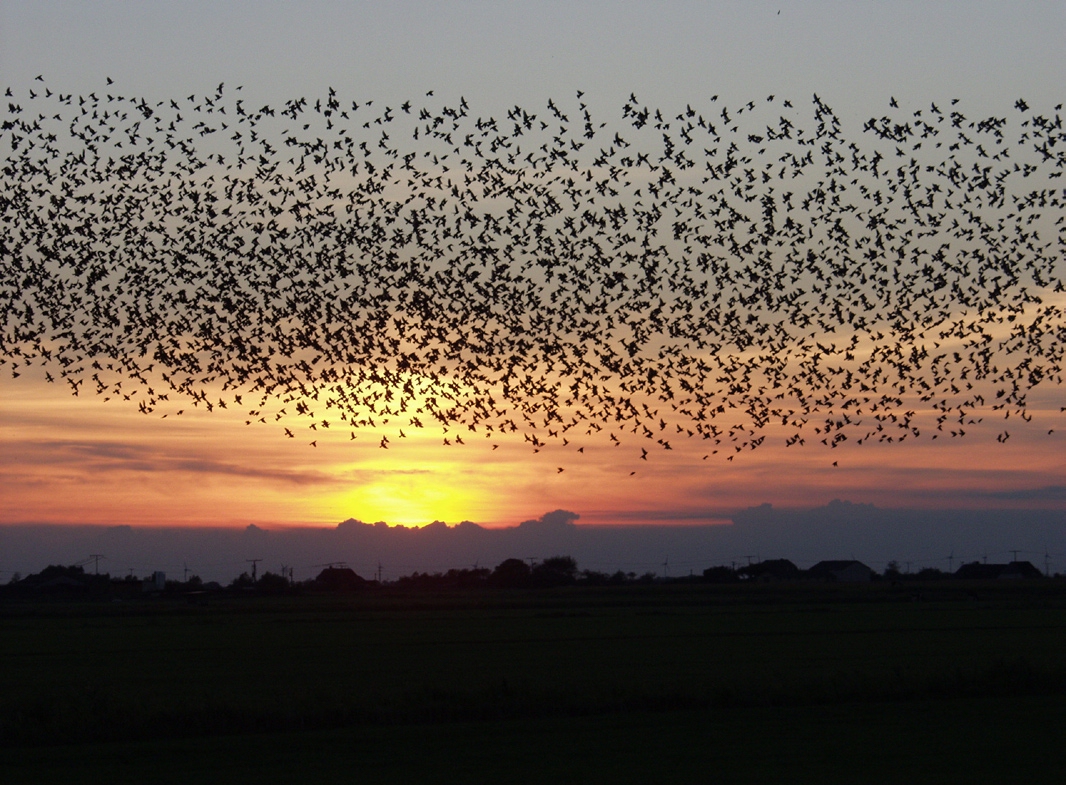
Collective animal behaviour is a form of social behavior involving the coordinated behavior of large groups of similar animals as well as emergent properties of these groups. This can include the costs and benefits of group membership, the transfer of information, decision-making process, locomotion and synchronization of the group. Studying the principles of collective animal behavior has relevance to human engineering problems through the philosophy of biomimetics. For instance, determining the rules by which an individual animal navigates relative to its neighbors in a group can lead to advances in the deployment and control of groups of swimming or flying micro-robots such as UAVs (Unmanned Aerial Vehicles).
Examples of collective animal behavior include:
The basis of collective animal behaviour originated from the study of collective phenomena; that is, repeated interactions among individuals that produce large scale patterns. The foundation of collective phenomena originates from the idea that collective systems can be understood from a set of techniques. For example, Nicolis and Prigogine (1977) employed the use of non-linear thermodynamics to help explain similarities between collective systems at different scales. Other studies aim to use physics, mathematics and chemistry to provide frameworks to study collective phenomena.
Many functions of animal aggregations have been proposed. These proposed functions may be grouped into the four following categories: social and genetic, anti-predator, enhanced foraging, and increased locomotion efficiency.
Support for the social and genetic function of aggregations, especially those formed by fish, can be seen in several aspects of their behavior. For instance, experiments have shown that individual fish removed from a school will have a higher respiratory rate than those found in the school. This effect has been partly attributed to stress, although hydrodynamic factors were considered more important in this particular study. The calming effect of being with conspecifics may thus provide a social motivation for remaining in an aggregation. Herring, for instance, will become very agitated if they are isolated from conspecifics. Fish schools have also been proposed to serve a reproductive function since they provide increased access to potential mates. Some scientists have provided disadvantages to mating in aggregations by using robotic male crabs; a female is at a higher risk approaching a cluster, has the ability of comparing males, increasing mate competition.
Several anti-predator functions of animal aggregations have been proposed. One potential method by which fish schools or bird flocks may thwart predators is the 'predator confusion effect' proposed and demonstrated by Milinski and Heller (1978). This theory is based on the idea that it becomes difficult for predators to pick out individual prey from groups because the many moving targets create a sensory overload of the predator's visual channel. Milinski and Heller's findings have been corroborated both in experiment and computer simulations.
A second potential anti-predator effect of animal aggregations is the "many eyes" hypothesis. This theory states that as the size of the group increases, the task of scanning the environment for predators can be spread out over many individuals. Not only does this mass collaboration presumably provide a higher level of vigilance, it could also allow more time for individual feeding.
A third hypothesis for an anti-predatory effect of animal aggregation is the "encounter dilution" effect. Hamilton, for instance, proposed that the aggregation of animals was due to a "selfish" avoidance of a predator and was thus a form of cover-seeking. Another formulation of the theory was given by Turner and Pitcher and was viewed as a combination of detection and attack probabilities. In the detection component of the theory, it was suggested that potential prey might benefit by living together since a predator is less likely to chance upon a single group than a scattered distribution. In the attack component, it was thought that an attacking predator is less likely to eat a particular animal when a greater number of individuals are present. In sum, an individual has an advantage if it is in the larger of two groups, assuming that the probability of detection and attack does not increase disproportionately with the size of the group.
Hub AI
Collective animal behavior AI simulator
(@Collective animal behavior_simulator)
Collective animal behavior
Collective animal behaviour is a form of social behavior involving the coordinated behavior of large groups of similar animals as well as emergent properties of these groups. This can include the costs and benefits of group membership, the transfer of information, decision-making process, locomotion and synchronization of the group. Studying the principles of collective animal behavior has relevance to human engineering problems through the philosophy of biomimetics. For instance, determining the rules by which an individual animal navigates relative to its neighbors in a group can lead to advances in the deployment and control of groups of swimming or flying micro-robots such as UAVs (Unmanned Aerial Vehicles).
Examples of collective animal behavior include:
The basis of collective animal behaviour originated from the study of collective phenomena; that is, repeated interactions among individuals that produce large scale patterns. The foundation of collective phenomena originates from the idea that collective systems can be understood from a set of techniques. For example, Nicolis and Prigogine (1977) employed the use of non-linear thermodynamics to help explain similarities between collective systems at different scales. Other studies aim to use physics, mathematics and chemistry to provide frameworks to study collective phenomena.
Many functions of animal aggregations have been proposed. These proposed functions may be grouped into the four following categories: social and genetic, anti-predator, enhanced foraging, and increased locomotion efficiency.
Support for the social and genetic function of aggregations, especially those formed by fish, can be seen in several aspects of their behavior. For instance, experiments have shown that individual fish removed from a school will have a higher respiratory rate than those found in the school. This effect has been partly attributed to stress, although hydrodynamic factors were considered more important in this particular study. The calming effect of being with conspecifics may thus provide a social motivation for remaining in an aggregation. Herring, for instance, will become very agitated if they are isolated from conspecifics. Fish schools have also been proposed to serve a reproductive function since they provide increased access to potential mates. Some scientists have provided disadvantages to mating in aggregations by using robotic male crabs; a female is at a higher risk approaching a cluster, has the ability of comparing males, increasing mate competition.
Several anti-predator functions of animal aggregations have been proposed. One potential method by which fish schools or bird flocks may thwart predators is the 'predator confusion effect' proposed and demonstrated by Milinski and Heller (1978). This theory is based on the idea that it becomes difficult for predators to pick out individual prey from groups because the many moving targets create a sensory overload of the predator's visual channel. Milinski and Heller's findings have been corroborated both in experiment and computer simulations.
A second potential anti-predator effect of animal aggregations is the "many eyes" hypothesis. This theory states that as the size of the group increases, the task of scanning the environment for predators can be spread out over many individuals. Not only does this mass collaboration presumably provide a higher level of vigilance, it could also allow more time for individual feeding.
A third hypothesis for an anti-predatory effect of animal aggregation is the "encounter dilution" effect. Hamilton, for instance, proposed that the aggregation of animals was due to a "selfish" avoidance of a predator and was thus a form of cover-seeking. Another formulation of the theory was given by Turner and Pitcher and was viewed as a combination of detection and attack probabilities. In the detection component of the theory, it was suggested that potential prey might benefit by living together since a predator is less likely to chance upon a single group than a scattered distribution. In the attack component, it was thought that an attacking predator is less likely to eat a particular animal when a greater number of individuals are present. In sum, an individual has an advantage if it is in the larger of two groups, assuming that the probability of detection and attack does not increase disproportionately with the size of the group.