
Recent from talks
Colour wheel theory of love
Knowledge base stats:
Talk channels stats:
Members stats:
Colour wheel theory of love
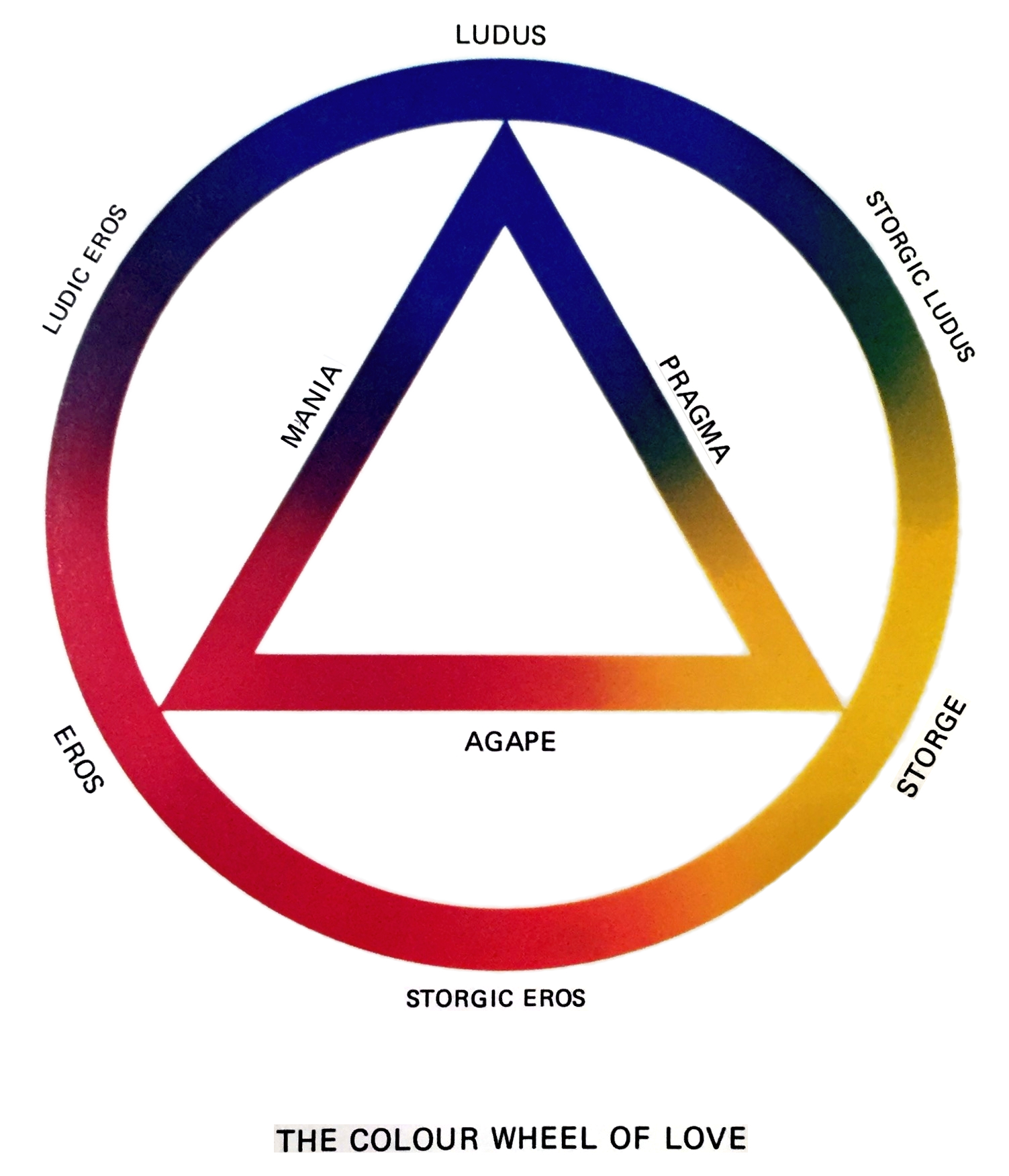
The colour wheel theory of love is an idea created by the Canadian psychologist John Alan Lee that describes six love styles, using several Latin and Greek words for love. First introduced in his book Colours of Love: An Exploration of the Ways of Loving (1973), Lee defines three primary, three secondary, and nine tertiary love styles, describing them in the traditional colour wheel. The three primary types are called Eros, Ludus, and Storge, and the three secondary types are called Mania, Pragma, and Agape.
Eros focuses on the sexual life, Ludus on the playful life, and Storge on the serious life. For the secondary types, Mania (Eros & Ludus) is characterized by obsession and overattachment, Agape (Eros & Storge) by altruism and trust, and Pragma (Ludus & Storge) by realism and practicality.
Eros is the Greek term for romantic, passionate, or sexual love, from which the term erotic is derived. Lee describes Eros as a passionate physical and emotional love feeling of wanting to satisfy, create sexual contentment, security, and aesthetic enjoyment for each other, it also includes creating sexual security for the other by striving to forsake options of sharing one's intimate and sexual self with outsiders. It is a highly sensual, intense, passionate style of love. Erotic lovers choose their lovers by intuition or "chemistry". They are more likely to say they fell in love at first sight than those of other love styles.
Erotic lovers view marriage as an extended honeymoon, and sex as the ultimate aesthetic experience. An erotic lover can be perceived as a "hopeless romantic". The erotic lover wants to share and know everything about their loved one and often thinks of their partner in an idealized manner. The erotic lover's reaction to criticism from their partner is one of hurt and intense pain. The erotic lover's reaction to separation from the partner is agony and despair. Those of other love styles may see erotic lovers as unrealistic, or trapped in a fantasy.
The advantage of erotic love is that the hormones and emotions cause lovers to bond with each other, and feelings of lust and feelings of love alternatively reinforce each other. It is very relaxing for the person doing it. It affords a sense of security to both partners who recognize and see sexual complementation in each other and a sense of life's purpose. It requires both partners to accord validity to each other's sexual feelings, work on sustaining interest and maintain the sexual health of the relationship. A disadvantage is the possibility of the decay in attraction and the danger of living in a fantasy world. In its extreme, Eros can resemble naivety. A partner not as sexually inclined may also feel one's physical body being taken for granted and may perceive the Eros lover as looking for carnal gratification.
Lee's recognizable traits:
Ludus means "game" or "school" in Latin. Lee uses the term to describe those who see love as a desire to want to have fun with each other, to do activities indoor and outdoor, tease, indulge, and play harmless pranks on each other. The acquisition of love and attention itself may be part of the game.
Ludic lovers want to have as much fun as possible. When they are not seeking a stable relationship, they rarely or never become overly involved with one partner and often can have more than one partner at a time, in other words, a school of partners. They do not reveal their true thoughts and feelings to their partner(s), especially if they think they can gain some kind of advantage over their partner(s). The expectation may also be that the partner(s) should also be similarly minded. If a relationship materializes it will be about having fun and indulging in activities of varying degrees of learnedness together.
Hub AI
Colour wheel theory of love AI simulator
(@Colour wheel theory of love_simulator)
Colour wheel theory of love
The colour wheel theory of love is an idea created by the Canadian psychologist John Alan Lee that describes six love styles, using several Latin and Greek words for love. First introduced in his book Colours of Love: An Exploration of the Ways of Loving (1973), Lee defines three primary, three secondary, and nine tertiary love styles, describing them in the traditional colour wheel. The three primary types are called Eros, Ludus, and Storge, and the three secondary types are called Mania, Pragma, and Agape.
Eros focuses on the sexual life, Ludus on the playful life, and Storge on the serious life. For the secondary types, Mania (Eros & Ludus) is characterized by obsession and overattachment, Agape (Eros & Storge) by altruism and trust, and Pragma (Ludus & Storge) by realism and practicality.
Eros is the Greek term for romantic, passionate, or sexual love, from which the term erotic is derived. Lee describes Eros as a passionate physical and emotional love feeling of wanting to satisfy, create sexual contentment, security, and aesthetic enjoyment for each other, it also includes creating sexual security for the other by striving to forsake options of sharing one's intimate and sexual self with outsiders. It is a highly sensual, intense, passionate style of love. Erotic lovers choose their lovers by intuition or "chemistry". They are more likely to say they fell in love at first sight than those of other love styles.
Erotic lovers view marriage as an extended honeymoon, and sex as the ultimate aesthetic experience. An erotic lover can be perceived as a "hopeless romantic". The erotic lover wants to share and know everything about their loved one and often thinks of their partner in an idealized manner. The erotic lover's reaction to criticism from their partner is one of hurt and intense pain. The erotic lover's reaction to separation from the partner is agony and despair. Those of other love styles may see erotic lovers as unrealistic, or trapped in a fantasy.
The advantage of erotic love is that the hormones and emotions cause lovers to bond with each other, and feelings of lust and feelings of love alternatively reinforce each other. It is very relaxing for the person doing it. It affords a sense of security to both partners who recognize and see sexual complementation in each other and a sense of life's purpose. It requires both partners to accord validity to each other's sexual feelings, work on sustaining interest and maintain the sexual health of the relationship. A disadvantage is the possibility of the decay in attraction and the danger of living in a fantasy world. In its extreme, Eros can resemble naivety. A partner not as sexually inclined may also feel one's physical body being taken for granted and may perceive the Eros lover as looking for carnal gratification.
Lee's recognizable traits:
Ludus means "game" or "school" in Latin. Lee uses the term to describe those who see love as a desire to want to have fun with each other, to do activities indoor and outdoor, tease, indulge, and play harmless pranks on each other. The acquisition of love and attention itself may be part of the game.
Ludic lovers want to have as much fun as possible. When they are not seeking a stable relationship, they rarely or never become overly involved with one partner and often can have more than one partner at a time, in other words, a school of partners. They do not reveal their true thoughts and feelings to their partner(s), especially if they think they can gain some kind of advantage over their partner(s). The expectation may also be that the partner(s) should also be similarly minded. If a relationship materializes it will be about having fun and indulging in activities of varying degrees of learnedness together.
Recent media