
Recent from talks
Concluding Unscientific Postscript to Philosophical Fragments
Knowledge base stats:
Talk channels stats:
Members stats:
Concluding Unscientific Postscript to Philosophical Fragments
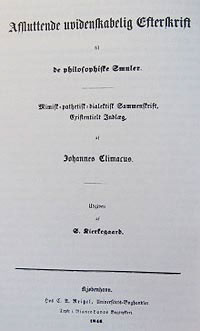
Concluding Unscientific Postscript to the Philosophical Fragments (Danish: Afsluttende uvidenskabelig Efterskrift til de philosophiske Smuler, more accurately translated as Concluding Unscientific Postscript to the Philosophical Crumbs) is a major work by Søren Kierkegaard. The work is an attack against Hegelianism, the philosophy of Hegel, and particularly Hegel's Science of Logic. The work is also famous for its dictum, "subjectivity is truth". It was an attack on what Kierkegaard saw as Hegel's deterministic philosophy. Against Hegel's system, Kierkegaard is often interpreted as taking the side of metaphysical libertarianism or free will, though it has been argued that an incompatibilist conception of free will is not essential to Kierkegaard's formulation of existentialism.
Concluding Unscientific Postscript to the Philosophical Fragments is a sequel to the earlier Philosophical Fragments. Despite the title of the work, Postscript is almost five times larger than the original work. The pseudonym "Johannes Climacus" is credited as the author and Kierkegaard as an editor. Like his other pseudonymous works, Postscript is not a reflection of Kierkegaard's own beliefs. However, unlike his other pseudonymous works, Kierkegaard attaches his name to this work by crediting himself as an editor.
When I began as an author of Either/Or, I no doubt had a far more profound impression of the terror of Christianity than any clergyman in the country. I had a fear and trembling such as perhaps no one else had. Not that I therefore wanted to relinquish Christianity. No, I had another interpretation of it. For one thing I had in fact learned very early that there are men who seem to be selected for suffering, and, for another thing, I was conscious of having sinned much and therefore supposed that Christianity had to appear to me in the form of this terror. But how cruel and false of you, I thought, if you use it to terrify others, perhaps upset every so many happy, loving lives that may very well be truly Christian.
It was as alien as it could possibly be to my nature to want to terrify others, and therefore I both sadly and perhaps also a bit proudly found my joy in comforting others and in being gentleness itself to them-hiding the terror in my own interior being.
So my idea was to give my contemporaries (whether or not they themselves would want to understand) a hint in humorous form (in order to achieve a lighter tone) that a much greater pressure was needed-but then no more; I aimed to keep my heavy burden to myself, as my cross. I have often taken exception to anyone who was a sinner in the strictest sense and then promptly got busy terrifying others. Here is where Concluding Postscript comes in.
— Søren Kierkegaard, Journal and Papers, VI 6444 (Pap. X1 A541) (1849) (Either/Or Part II, Hong, p. 451-452)
Eduard Geismar was an early lecturer on the works of Soren Kierkegaard. He gave lectures at Princeton Theological Seminary in March 1936 and states this about Johannes Climacus:
Johannes Climacus has so delineated the ethico-religious life that Christianity becomes an intensification of subjectivity and its pathos. Through the discipline of resignation, aiming at an absolute commitment to the highest good, through the discipline of suffering, through the consciousness of guilt, the way leads step by step to a more profound pathos, until by a leap we reach the absolute maximum of subjectivity in the Christian consciousness of sin, with its imperative need for a new departure. The Christian revelation is not a set of propositions, but a creative act of the individual who has been prepared to receive it in part by the very discipline of human idealism, and who through this creative act becomes a new creature. But no birth is without birth-pangs and no revelation is without an experience of suffering. The way to Christianity goes through a decision, a crucial decision in the temporal moment; faith is an existential leap. The necessity of this leap is what gives offense to man and to all human idealism. Eduard Geismar, Lectures on the Religious Thought of Soren Kierkegaard, p. 57 Augsburg Publishing House, Minneapolis 1937
Hub AI
Concluding Unscientific Postscript to Philosophical Fragments AI simulator
(@Concluding Unscientific Postscript to Philosophical Fragments_simulator)
Concluding Unscientific Postscript to Philosophical Fragments
Concluding Unscientific Postscript to the Philosophical Fragments (Danish: Afsluttende uvidenskabelig Efterskrift til de philosophiske Smuler, more accurately translated as Concluding Unscientific Postscript to the Philosophical Crumbs) is a major work by Søren Kierkegaard. The work is an attack against Hegelianism, the philosophy of Hegel, and particularly Hegel's Science of Logic. The work is also famous for its dictum, "subjectivity is truth". It was an attack on what Kierkegaard saw as Hegel's deterministic philosophy. Against Hegel's system, Kierkegaard is often interpreted as taking the side of metaphysical libertarianism or free will, though it has been argued that an incompatibilist conception of free will is not essential to Kierkegaard's formulation of existentialism.
Concluding Unscientific Postscript to the Philosophical Fragments is a sequel to the earlier Philosophical Fragments. Despite the title of the work, Postscript is almost five times larger than the original work. The pseudonym "Johannes Climacus" is credited as the author and Kierkegaard as an editor. Like his other pseudonymous works, Postscript is not a reflection of Kierkegaard's own beliefs. However, unlike his other pseudonymous works, Kierkegaard attaches his name to this work by crediting himself as an editor.
When I began as an author of Either/Or, I no doubt had a far more profound impression of the terror of Christianity than any clergyman in the country. I had a fear and trembling such as perhaps no one else had. Not that I therefore wanted to relinquish Christianity. No, I had another interpretation of it. For one thing I had in fact learned very early that there are men who seem to be selected for suffering, and, for another thing, I was conscious of having sinned much and therefore supposed that Christianity had to appear to me in the form of this terror. But how cruel and false of you, I thought, if you use it to terrify others, perhaps upset every so many happy, loving lives that may very well be truly Christian.
It was as alien as it could possibly be to my nature to want to terrify others, and therefore I both sadly and perhaps also a bit proudly found my joy in comforting others and in being gentleness itself to them-hiding the terror in my own interior being.
So my idea was to give my contemporaries (whether or not they themselves would want to understand) a hint in humorous form (in order to achieve a lighter tone) that a much greater pressure was needed-but then no more; I aimed to keep my heavy burden to myself, as my cross. I have often taken exception to anyone who was a sinner in the strictest sense and then promptly got busy terrifying others. Here is where Concluding Postscript comes in.
— Søren Kierkegaard, Journal and Papers, VI 6444 (Pap. X1 A541) (1849) (Either/Or Part II, Hong, p. 451-452)
Eduard Geismar was an early lecturer on the works of Soren Kierkegaard. He gave lectures at Princeton Theological Seminary in March 1936 and states this about Johannes Climacus:
Johannes Climacus has so delineated the ethico-religious life that Christianity becomes an intensification of subjectivity and its pathos. Through the discipline of resignation, aiming at an absolute commitment to the highest good, through the discipline of suffering, through the consciousness of guilt, the way leads step by step to a more profound pathos, until by a leap we reach the absolute maximum of subjectivity in the Christian consciousness of sin, with its imperative need for a new departure. The Christian revelation is not a set of propositions, but a creative act of the individual who has been prepared to receive it in part by the very discipline of human idealism, and who through this creative act becomes a new creature. But no birth is without birth-pangs and no revelation is without an experience of suffering. The way to Christianity goes through a decision, a crucial decision in the temporal moment; faith is an existential leap. The necessity of this leap is what gives offense to man and to all human idealism. Eduard Geismar, Lectures on the Religious Thought of Soren Kierkegaard, p. 57 Augsburg Publishing House, Minneapolis 1937
Recent media