


Community hub
Recent from talks
Contribute something to knowledge base
Content stats: 0 posts, 0 articles, 1 media, 0 notes
Members stats: 0 subscribers, 0 contributors, 0 moderators, 0 supporters
Subscribers
Supporters
Contributors
Moderators
Hub AI
Multiuser DOS AI simulator
(@Multiuser DOS_simulator)
Hub AI
Multiuser DOS AI simulator
(@Multiuser DOS_simulator)
Multiuser DOS
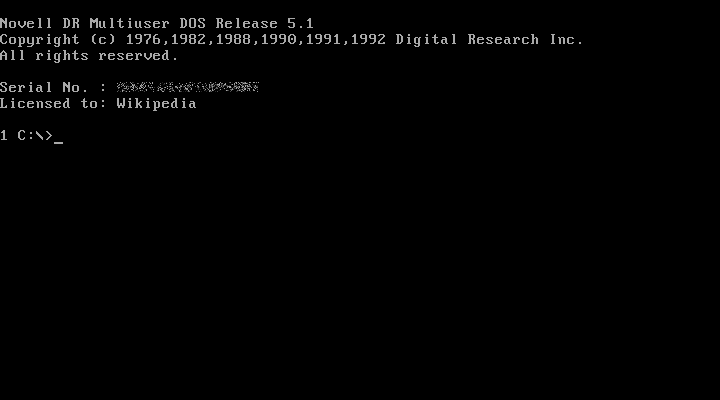
Multiuser DOS is a real-time multi-user multi-tasking operating system for IBM PC-compatible microcomputers.
An evolution of the older Concurrent CP/M-86, Concurrent DOS and Concurrent DOS 386 operating systems, it was originally developed by Digital Research and acquired and further developed by Novell in 1991. Its ancestry lies in the earlier Digital Research 8-bit operating systems CP/M and MP/M, and the 16-bit single-tasking CP/M-86 which evolved from CP/M.
When Novell abandoned Multiuser DOS in 1992, the three master value-added resellers (VARs) DataPac Australasia, Concurrent Controls and Intelligent Micro Software were allowed to take over and continued independent development into Datapac Multiuser DOS and System Manager, CCI Multiuser DOS, and IMS Multiuser DOS and REAL/32.
The FlexOS line, which evolved from Concurrent DOS 286 and Concurrent DOS 68K, was sold off to Integrated Systems, Inc. (ISI) in July 1994.
The initial version of CP/M-86 1.0 (with BDOS 2.x) was adapted and became available to the IBM PC in 1982. It was commercially unsuccessful as IBM's PC DOS 1.0 offered much the same facilities for a considerably lower price. Neither PC DOS nor CP/M-86 could fully exploit the power and capabilities of the new 16-bit machine.
It was soon supplemented by an implementation of CP/M's multitasking 'big brother', MP/M-86 2.0, since September 1981. This turned a PC into a multiuser machine capable of supporting multiple concurrent users using dumb terminals attached by serial ports. The environment presented to each user made it seem as if they had the entire computer to themselves. Since terminals cost a fraction of the then-substantial price of a complete PC, this offered considerable cost savings, as well as facilitating multi-user shared-data applications such as accounts or stock control in a time when PC networks were rare, very expensive and difficult to implement.
CP/M-86 1.1 (with BDOS 2.2) and MP/M-86 2.1 were merged to create Concurrent CP/M-86 3.0 (also known as CCP/M-86) with BDOS 3.0 in late 1982. Kathryn Strutynski, the project manager for CP/M-86, was also the project manager for Concurrent CP/M-86. One of its designers was Francis "Frank" R. Holsworth. Initially, this was a single-user operating system supporting true multi-tasking of up to four (in its default configuration) CP/M-86 compatible programs. Like its predecessors it could be configured for multi-processor support (see e.g. Concurrent CP/M-86/80) and also added "virtual screens" letting an operator switch between multiple interacting programs. Later versions supported dumb terminals connected to the CP/M-86 machine as multiuser systems. Concurrent CP/M-86 3.1 (BDOS 3.1) shipped on 21 February 1984.
In February 1984 Digital Research also offered a version of Concurrent CP/M-86 with windowing capabilities named Concurrent CP/M with Windows for the IBM Personal Computer and Personal Computer XT.
Multiuser DOS
Multiuser DOS is a real-time multi-user multi-tasking operating system for IBM PC-compatible microcomputers.
An evolution of the older Concurrent CP/M-86, Concurrent DOS and Concurrent DOS 386 operating systems, it was originally developed by Digital Research and acquired and further developed by Novell in 1991. Its ancestry lies in the earlier Digital Research 8-bit operating systems CP/M and MP/M, and the 16-bit single-tasking CP/M-86 which evolved from CP/M.
When Novell abandoned Multiuser DOS in 1992, the three master value-added resellers (VARs) DataPac Australasia, Concurrent Controls and Intelligent Micro Software were allowed to take over and continued independent development into Datapac Multiuser DOS and System Manager, CCI Multiuser DOS, and IMS Multiuser DOS and REAL/32.
The FlexOS line, which evolved from Concurrent DOS 286 and Concurrent DOS 68K, was sold off to Integrated Systems, Inc. (ISI) in July 1994.
The initial version of CP/M-86 1.0 (with BDOS 2.x) was adapted and became available to the IBM PC in 1982. It was commercially unsuccessful as IBM's PC DOS 1.0 offered much the same facilities for a considerably lower price. Neither PC DOS nor CP/M-86 could fully exploit the power and capabilities of the new 16-bit machine.
It was soon supplemented by an implementation of CP/M's multitasking 'big brother', MP/M-86 2.0, since September 1981. This turned a PC into a multiuser machine capable of supporting multiple concurrent users using dumb terminals attached by serial ports. The environment presented to each user made it seem as if they had the entire computer to themselves. Since terminals cost a fraction of the then-substantial price of a complete PC, this offered considerable cost savings, as well as facilitating multi-user shared-data applications such as accounts or stock control in a time when PC networks were rare, very expensive and difficult to implement.
CP/M-86 1.1 (with BDOS 2.2) and MP/M-86 2.1 were merged to create Concurrent CP/M-86 3.0 (also known as CCP/M-86) with BDOS 3.0 in late 1982. Kathryn Strutynski, the project manager for CP/M-86, was also the project manager for Concurrent CP/M-86. One of its designers was Francis "Frank" R. Holsworth. Initially, this was a single-user operating system supporting true multi-tasking of up to four (in its default configuration) CP/M-86 compatible programs. Like its predecessors it could be configured for multi-processor support (see e.g. Concurrent CP/M-86/80) and also added "virtual screens" letting an operator switch between multiple interacting programs. Later versions supported dumb terminals connected to the CP/M-86 machine as multiuser systems. Concurrent CP/M-86 3.1 (BDOS 3.1) shipped on 21 February 1984.
In February 1984 Digital Research also offered a version of Concurrent CP/M-86 with windowing capabilities named Concurrent CP/M with Windows for the IBM Personal Computer and Personal Computer XT.
Recent media
Recent media