
Recent from talks
4477th Test and Evaluation Squadron
Knowledge base stats:
Talk channels stats:
Members stats:
4477th Test and Evaluation Squadron
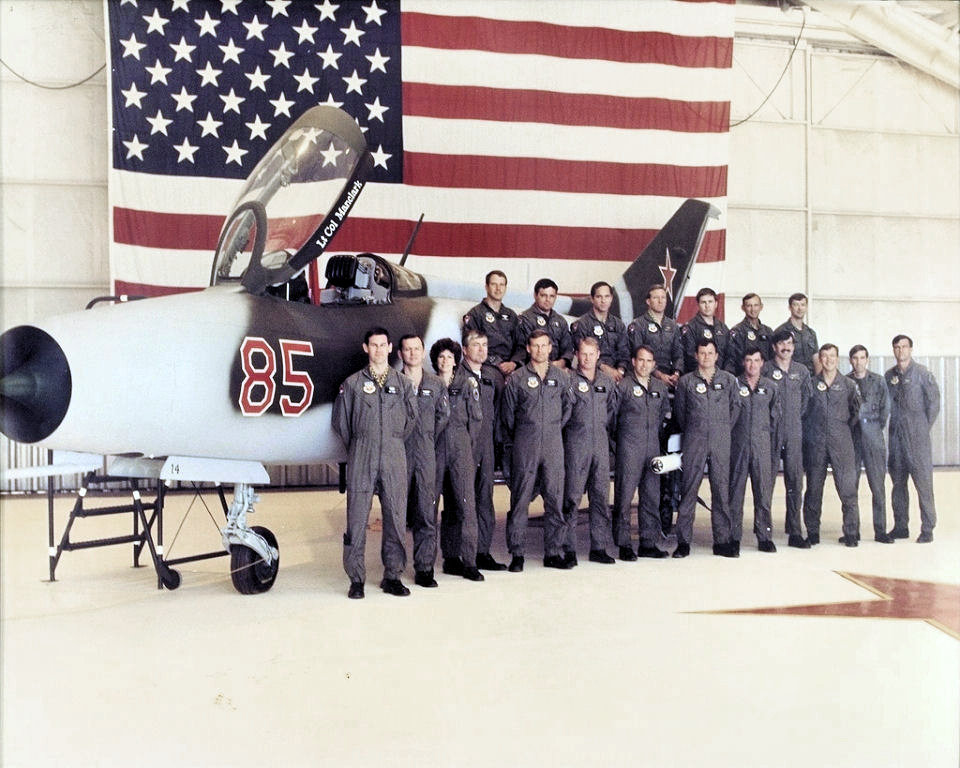
The 4477th Test and Evaluation Squadron (4477 TES) was a squadron in the United States Air Force under the claimancy of the Tactical Air Command (TAC). It is currently inactive. The product of Project Constant Peg, the unit was created to expose the tactical air forces to the flight characteristics of fighter aircraft used by the Soviet Union during the Cold War. The declassified history of the squadron shows that it operated MiG-17s, MiG-21s and MiG-23s between 1977 and 1988, but it was not formally disbanded until July 1990.
The mission of Constant Peg was to train Air Force, United States Navy and United States Marine Corps pilots and weapon systems officers, in air combat tactics against these foreign aircraft and was instrumental in the re-development of dissimilar air combat training (DACT) methods developed after the Vietnam War. Today's USAF aggressor training squadrons can symbolically trace their histories back to the 4477th, as well as the paint motifs on their aircraft, which were used by the aircraft of the squadron in the 1970s and 1980s.
The longest continuing United States classified military airplane program is the testing and evaluation of Foreign Aircraft Technology. During the Cold War, secret test flying of Mikoyan-and-Gurevich Design Bureau (MiG) and other Soviet aircraft was an ongoing mission dating back to the acquisition of the first Soviet-built Yakovlev Yak-23 in 1953. This effort has continued to the present day. Unlike the other "black" airplane programs, such as the Have Blue, Lockheed U-2, or Lockheed SR-71 Blackbird, Foreign Aircraft Technology operations still remain classified. Despite the declassification of the Constant Peg program in 2006, the evaluation of foreign aircraft likely continues.
It is not known exactly the actual number or types of aircraft involved, where they came from, or the complete history of the program. It is estimated that in 1985 the USAF had 26 MiGs (MiG-21s and MiG-23s as MiG-17s had already been phased out) and by the end of the program USAF had mainly MiG-21s.
It is known that the activities of the 4477th Test and Evaluation Squadron brought about a fundamental change in United States Air Force and United States Navy / United States Marine Corps air combat tactics. They revitalized the art of dogfighting at a time when it had seemingly been nearly forgotten. The knowledge gained from testing the aircraft the squadron flew was reflected in the success of United States air operations during the Vietnam War, as well as the founding of the Air Force's Red Flag program and the United States Navy's TOPGUN school.
In the 1950s in the United States, with the development of air-to-air missiles, such as AIM-4 Falcon, AIM-7 Sparrow III, and AIM-9 Sidewinder, the paradigm for the new generation of jet fighters was that dog-fighting was obsolete. The U.S. Navy's F4H Phantom II (later redesignated F-4) was the first fighter designed from the start without cannon. The air-to-air training given to new Navy and Marine Corps F-4 crews was extremely limited. It involved about ten flights and provided little useful information. By 1964, few in the Navy and Marine Corps were left to carry on the tradition of classic dogfighting.
Then came the Vietnam War. The early years showed the faith placed in missiles was terribly in error. Between 1965 and the bombing halt in 1968, the USAF had a 2.15 to 1 kill ratio. The U.S. Navy was doing slightly better with a 2.75 to 1 rate. For roughly every two North Vietnamese Mikoyan-Gurevich MiG-17s or MiG-21s shot down, an American F-4 Phantom II, F-105 Thunderchief, or F-8 Crusader would be lost. Crucially, the percentage of United States fighters being lost in air-to-air combat was growing. During 1966, only 3 percent of U.S. aircraft were lost to MiGs. This rose to 8 percent in 1967, then climbed to 22 percent for the first three months of 1968.
The emphasis on air-to-air missile interception meant the fighter combat crews had only the sketchiest knowledge of dogfighting. Originally conceived as a naval fleet air defense aircraft, and later adapted as an Air Force fighter-bomber, the design of the F-4 made it ill-suited for a tight-turning dogfight. In contrast to the lighter MiG-17, the F-4 was large and heavy. When a tight turn was made, the F-4 would lose energy and airspeed. The MiG-17's superior turning capability then allowed it to close to gun range. All too often, hits from the MiG-17's "outmoded" cannons would then destroy the F-4.
Hub AI
4477th Test and Evaluation Squadron AI simulator
(@4477th Test and Evaluation Squadron_simulator)
4477th Test and Evaluation Squadron
The 4477th Test and Evaluation Squadron (4477 TES) was a squadron in the United States Air Force under the claimancy of the Tactical Air Command (TAC). It is currently inactive. The product of Project Constant Peg, the unit was created to expose the tactical air forces to the flight characteristics of fighter aircraft used by the Soviet Union during the Cold War. The declassified history of the squadron shows that it operated MiG-17s, MiG-21s and MiG-23s between 1977 and 1988, but it was not formally disbanded until July 1990.
The mission of Constant Peg was to train Air Force, United States Navy and United States Marine Corps pilots and weapon systems officers, in air combat tactics against these foreign aircraft and was instrumental in the re-development of dissimilar air combat training (DACT) methods developed after the Vietnam War. Today's USAF aggressor training squadrons can symbolically trace their histories back to the 4477th, as well as the paint motifs on their aircraft, which were used by the aircraft of the squadron in the 1970s and 1980s.
The longest continuing United States classified military airplane program is the testing and evaluation of Foreign Aircraft Technology. During the Cold War, secret test flying of Mikoyan-and-Gurevich Design Bureau (MiG) and other Soviet aircraft was an ongoing mission dating back to the acquisition of the first Soviet-built Yakovlev Yak-23 in 1953. This effort has continued to the present day. Unlike the other "black" airplane programs, such as the Have Blue, Lockheed U-2, or Lockheed SR-71 Blackbird, Foreign Aircraft Technology operations still remain classified. Despite the declassification of the Constant Peg program in 2006, the evaluation of foreign aircraft likely continues.
It is not known exactly the actual number or types of aircraft involved, where they came from, or the complete history of the program. It is estimated that in 1985 the USAF had 26 MiGs (MiG-21s and MiG-23s as MiG-17s had already been phased out) and by the end of the program USAF had mainly MiG-21s.
It is known that the activities of the 4477th Test and Evaluation Squadron brought about a fundamental change in United States Air Force and United States Navy / United States Marine Corps air combat tactics. They revitalized the art of dogfighting at a time when it had seemingly been nearly forgotten. The knowledge gained from testing the aircraft the squadron flew was reflected in the success of United States air operations during the Vietnam War, as well as the founding of the Air Force's Red Flag program and the United States Navy's TOPGUN school.
In the 1950s in the United States, with the development of air-to-air missiles, such as AIM-4 Falcon, AIM-7 Sparrow III, and AIM-9 Sidewinder, the paradigm for the new generation of jet fighters was that dog-fighting was obsolete. The U.S. Navy's F4H Phantom II (later redesignated F-4) was the first fighter designed from the start without cannon. The air-to-air training given to new Navy and Marine Corps F-4 crews was extremely limited. It involved about ten flights and provided little useful information. By 1964, few in the Navy and Marine Corps were left to carry on the tradition of classic dogfighting.
Then came the Vietnam War. The early years showed the faith placed in missiles was terribly in error. Between 1965 and the bombing halt in 1968, the USAF had a 2.15 to 1 kill ratio. The U.S. Navy was doing slightly better with a 2.75 to 1 rate. For roughly every two North Vietnamese Mikoyan-Gurevich MiG-17s or MiG-21s shot down, an American F-4 Phantom II, F-105 Thunderchief, or F-8 Crusader would be lost. Crucially, the percentage of United States fighters being lost in air-to-air combat was growing. During 1966, only 3 percent of U.S. aircraft were lost to MiGs. This rose to 8 percent in 1967, then climbed to 22 percent for the first three months of 1968.
The emphasis on air-to-air missile interception meant the fighter combat crews had only the sketchiest knowledge of dogfighting. Originally conceived as a naval fleet air defense aircraft, and later adapted as an Air Force fighter-bomber, the design of the F-4 made it ill-suited for a tight-turning dogfight. In contrast to the lighter MiG-17, the F-4 was large and heavy. When a tight turn was made, the F-4 would lose energy and airspeed. The MiG-17's superior turning capability then allowed it to close to gun range. All too often, hits from the MiG-17's "outmoded" cannons would then destroy the F-4.
Recent media