
Recent from talks
Convertible
Knowledge base stats:
Talk channels stats:
Members stats:
Convertible
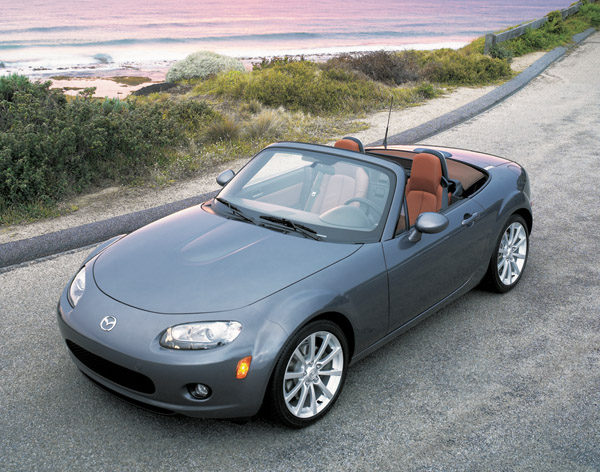
A convertible or cabriolet (/ˌkæbrioʊˈleɪ/) is a passenger car that can be driven with or without a roof in place. The methods of retracting and storing the roof vary across eras and manufacturers.
A convertible car's design allows an open-air driving experience, with the ability to provide a roof when required. A potential drawback of convertibles is their reduced structural rigidity (requiring significant engineering and modification to counteract the side effects of almost completely removing a car's roof).
The majority of convertible roofs are of a folding construction framework with the actual top made from cloth or other fabric. Other types of convertible roofs include retractable hardtops (often constructed from metal or plastic) and detachable hardtops (where a metal or plastic roof is manually removed and often stored in the trunk).
Other terms for convertibles include cabriolet, cabrio, drop top, drophead coupé, open two-seater, open top, rag top, soft top, spider, and spyder, although companies use many of these terms interchangeably. Thus, nomenclatural consistency is rare. The term cabriolet originated from a carriage cabriolet: "a light, two-wheeled, one-horse carriage with a folding top, capable of seating two persons"; however, the term is also used to describe other convertibles.
In the United Kingdom, the historical term for a two-door convertible is drophead coupe, and a four-door convertible was called an all-weather tourer.
Most of the early automobiles were open-air vehicles without any roof or sides. As car engines became more powerful by the end of the 19th century, folding textile or leather roofs (as had been used on victoria or landau carriages) began to appear on cars. Examples of early cars with roofs include the phaeton (a two-seat car with a temporary roof), the brougham or a coupé de ville, having an enclosed passenger compartment at the rear, while the driver sat in front either in the open, or the landaulet, where the driver has a fixed roof and the passenger compartment has a folding roof. Less expensive cars, such as the runabouts, sporting roadsters, or sturdy touring cars, remained either completely open air or were fitted with a rudimentary folding top and detachable clear side curtains.
In the 1920s, when steel bodies began to be mass-produced, closed cars became available to the average buyer, and fully open cars began to disappear from the mainstream market. By the mid 1930s, the remaining small number of convertibles sold were high-priced luxury models. In 1939, Plymouth introduced the first mechanically operated convertible roof powered by two vacuum cylinders.
Demand for convertibles increased as a result of American soldiers in France and the United Kingdom during World War II familiarizing themselves with small roadster cars, which were not available in the United States at that time. These roadsters included the MG Midget and Triumph Roadster. The convertible design was incorporated into the mass market unibody by Hudson in 1948. United States automakers manufactured a broad range of convertible models during the 1950s and 1960s – from economical compact-sized models such as the Rambler American and the Studebaker Lark, to the more expensive models, such as the Packard Caribbean, Oldsmobile 98, and Imperial by Chrysler. Automakers often included a convertible body style as an available body style in a model range.
Hub AI
Convertible AI simulator
(@Convertible_simulator)
Convertible
A convertible or cabriolet (/ˌkæbrioʊˈleɪ/) is a passenger car that can be driven with or without a roof in place. The methods of retracting and storing the roof vary across eras and manufacturers.
A convertible car's design allows an open-air driving experience, with the ability to provide a roof when required. A potential drawback of convertibles is their reduced structural rigidity (requiring significant engineering and modification to counteract the side effects of almost completely removing a car's roof).
The majority of convertible roofs are of a folding construction framework with the actual top made from cloth or other fabric. Other types of convertible roofs include retractable hardtops (often constructed from metal or plastic) and detachable hardtops (where a metal or plastic roof is manually removed and often stored in the trunk).
Other terms for convertibles include cabriolet, cabrio, drop top, drophead coupé, open two-seater, open top, rag top, soft top, spider, and spyder, although companies use many of these terms interchangeably. Thus, nomenclatural consistency is rare. The term cabriolet originated from a carriage cabriolet: "a light, two-wheeled, one-horse carriage with a folding top, capable of seating two persons"; however, the term is also used to describe other convertibles.
In the United Kingdom, the historical term for a two-door convertible is drophead coupe, and a four-door convertible was called an all-weather tourer.
Most of the early automobiles were open-air vehicles without any roof or sides. As car engines became more powerful by the end of the 19th century, folding textile or leather roofs (as had been used on victoria or landau carriages) began to appear on cars. Examples of early cars with roofs include the phaeton (a two-seat car with a temporary roof), the brougham or a coupé de ville, having an enclosed passenger compartment at the rear, while the driver sat in front either in the open, or the landaulet, where the driver has a fixed roof and the passenger compartment has a folding roof. Less expensive cars, such as the runabouts, sporting roadsters, or sturdy touring cars, remained either completely open air or were fitted with a rudimentary folding top and detachable clear side curtains.
In the 1920s, when steel bodies began to be mass-produced, closed cars became available to the average buyer, and fully open cars began to disappear from the mainstream market. By the mid 1930s, the remaining small number of convertibles sold were high-priced luxury models. In 1939, Plymouth introduced the first mechanically operated convertible roof powered by two vacuum cylinders.
Demand for convertibles increased as a result of American soldiers in France and the United Kingdom during World War II familiarizing themselves with small roadster cars, which were not available in the United States at that time. These roadsters included the MG Midget and Triumph Roadster. The convertible design was incorporated into the mass market unibody by Hudson in 1948. United States automakers manufactured a broad range of convertible models during the 1950s and 1960s – from economical compact-sized models such as the Rambler American and the Studebaker Lark, to the more expensive models, such as the Packard Caribbean, Oldsmobile 98, and Imperial by Chrysler. Automakers often included a convertible body style as an available body style in a model range.
Recent media