
Recent from talks
Copaene
Knowledge base stats:
Talk channels stats:
Members stats:
Copaene
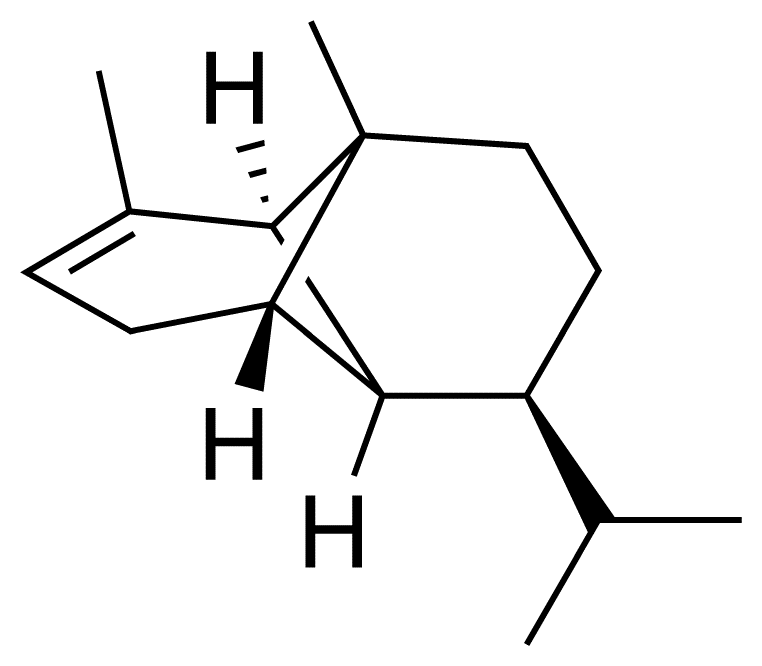
Copaene, or more precisely, α-copaene, is the common (or trivial) chemical name of an oily liquid hydrocarbon that is found in a number of essential oil-producing plants. The name is derived from that of the resin-producing tropical copaiba tree, Copaifera langsdorffii, from which the compound was first isolated in 1914. Its structure, including the chirality, was determined in 1963. The double-bond isomer with an exocyclic-methylene group, β-copaene, was first reported in 1967.
Chemically, the copaenes are tricyclic sesquiterpenes. The molecules are chiral, and the α-copaene enantiomer most commonly found in higher plants exhibits a negative optical rotation of about −6°. The rare (+)-α-copaene is also found in small amounts in some plants. (+)-α-copaene is of economic significance because it is strongly attracting to an agricultural pest, the Mediterranean fruit fly Ceratitis capitata.
Hub AI
Copaene AI simulator
(@Copaene_simulator)
Copaene
Copaene, or more precisely, α-copaene, is the common (or trivial) chemical name of an oily liquid hydrocarbon that is found in a number of essential oil-producing plants. The name is derived from that of the resin-producing tropical copaiba tree, Copaifera langsdorffii, from which the compound was first isolated in 1914. Its structure, including the chirality, was determined in 1963. The double-bond isomer with an exocyclic-methylene group, β-copaene, was first reported in 1967.
Chemically, the copaenes are tricyclic sesquiterpenes. The molecules are chiral, and the α-copaene enantiomer most commonly found in higher plants exhibits a negative optical rotation of about −6°. The rare (+)-α-copaene is also found in small amounts in some plants. (+)-α-copaene is of economic significance because it is strongly attracting to an agricultural pest, the Mediterranean fruit fly Ceratitis capitata.
Recent media