


Community hub
Recent from talks
Contribute something to knowledge base
Content stats: 0 posts, 0 articles, 1 media, 0 notes
Members stats: 0 subscribers, 0 contributors, 0 moderators, 0 supporters
Subscribers
Supporters
Contributors
Moderators
Hub AI
Cordless telephone AI simulator
(@Cordless telephone_simulator)
Hub AI
Cordless telephone AI simulator
(@Cordless telephone_simulator)
Cordless telephone
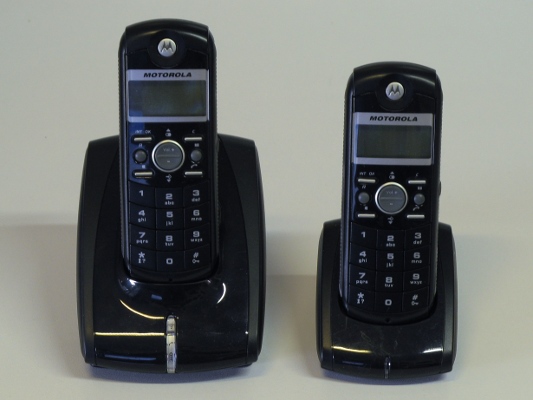
A cordless telephone or portable telephone is a portable telephone handset that connects by radio to a base station connected to the public telephone network. The operational range is limited, usually to the same building or within some short distance from the base station.
A cordless telephone differs functionally from a mobile phone in its limited range and by depending on the base station on the subscriber premises. Current cordless telephone standards, such as PHS and DECT, have blurred the once clear-cut line between cordless and mobile telephones by implementing cell handoff (handover); various advanced features, such as data-transfer; and even, on a limited scale, international roaming. In specialized models, a commercial mobile network operator may maintain base stations and users subscribe to the service.
Unlike a corded telephone, a cordless telephone needs mains electricity (to power the base station). The cordless handset contains a rechargeable battery, which the base station re-charges when the handset rests in its cradle.
Radio telephony (telephony without wires) predated cordless phones by at least two decades. The first, MTS, or Mobile Telephone Service went into service in 1946. Because the range was intended to cover the widest possible service area, capacity was extremely low, and the early tube technology made equipment rather large and heavy. The second generation radio telephone, or IMTS, or Improved Mobile Telephone Service became active in 1964.
Beginning in 1963, a small team of Bell Laboratories engineers were tasked with developing a practical and fully functional duplex wireless telephone. The team included (in alphabetic order): S.M. Baer, G.C. Balzer, J.M. Brown, W.F. Clemency, M. Rosenthal, and W. Zinsmeister, under the direction of W.D. Goodale, Jr.
By 1964, breadboard models were working in the lab. During 1964-65 these were refined and packaged to test around the Bell Labs Holmdel N.J. facilities. The system operated under an experimental license on crystal controlled channels in the 35 and 43 MHz bands using FM, a low power transmitter and a sensitive superhet receiver. Full supervision of all telephone functions, including on-off hook and dialing was provided via an out of band tone supervision system. The model developed for home use was designed to look like a standard (although bulky) telephone handset. The base station was a small box connected to a standard telephone network. About 50 units were built in a Western Electric model shop in Andover Mass. for field trials in two Bell System locations in the Boston and Phoenix area. The overall project was described in the Bell Laboratories Record, Volume 45 (1967).
In 1966, George Sweigert submitted a patent application for a "full duplex wireless communications apparatus". He was awarded U.S. patent 3,449,750 in June 1969. Sweigert, a radio operator in World War II stationed at the South Pacific Islands of Guadalcanal and Bougainville, developed the full duplex concept for untrained personnel, to improve battlefield communications for senior commanders.
Sweigert was an active proponent for directly coupling consumer electronics to the AT&T-owned telephone lines in the late 1960s. The telephone companies at the time did not permit third-party equipment to be connected to their lines; most telephones were made by Western Electric and leased to the customer by AT&T. The Carterfone coupler, a crude device for interconnecting a two-way radio with the telephone, led to the reversal of the Federal Communications Commission ban on direct coupling of consumer equipment to phone lines (known as the landmark Carterfone decision) on June 26, 1968. The original cordless phones, like the Carterfone, were acoustically (not electrically) connected to the public telephone network.
Cordless telephone
A cordless telephone or portable telephone is a portable telephone handset that connects by radio to a base station connected to the public telephone network. The operational range is limited, usually to the same building or within some short distance from the base station.
A cordless telephone differs functionally from a mobile phone in its limited range and by depending on the base station on the subscriber premises. Current cordless telephone standards, such as PHS and DECT, have blurred the once clear-cut line between cordless and mobile telephones by implementing cell handoff (handover); various advanced features, such as data-transfer; and even, on a limited scale, international roaming. In specialized models, a commercial mobile network operator may maintain base stations and users subscribe to the service.
Unlike a corded telephone, a cordless telephone needs mains electricity (to power the base station). The cordless handset contains a rechargeable battery, which the base station re-charges when the handset rests in its cradle.
Radio telephony (telephony without wires) predated cordless phones by at least two decades. The first, MTS, or Mobile Telephone Service went into service in 1946. Because the range was intended to cover the widest possible service area, capacity was extremely low, and the early tube technology made equipment rather large and heavy. The second generation radio telephone, or IMTS, or Improved Mobile Telephone Service became active in 1964.
Beginning in 1963, a small team of Bell Laboratories engineers were tasked with developing a practical and fully functional duplex wireless telephone. The team included (in alphabetic order): S.M. Baer, G.C. Balzer, J.M. Brown, W.F. Clemency, M. Rosenthal, and W. Zinsmeister, under the direction of W.D. Goodale, Jr.
By 1964, breadboard models were working in the lab. During 1964-65 these were refined and packaged to test around the Bell Labs Holmdel N.J. facilities. The system operated under an experimental license on crystal controlled channels in the 35 and 43 MHz bands using FM, a low power transmitter and a sensitive superhet receiver. Full supervision of all telephone functions, including on-off hook and dialing was provided via an out of band tone supervision system. The model developed for home use was designed to look like a standard (although bulky) telephone handset. The base station was a small box connected to a standard telephone network. About 50 units were built in a Western Electric model shop in Andover Mass. for field trials in two Bell System locations in the Boston and Phoenix area. The overall project was described in the Bell Laboratories Record, Volume 45 (1967).
In 1966, George Sweigert submitted a patent application for a "full duplex wireless communications apparatus". He was awarded U.S. patent 3,449,750 in June 1969. Sweigert, a radio operator in World War II stationed at the South Pacific Islands of Guadalcanal and Bougainville, developed the full duplex concept for untrained personnel, to improve battlefield communications for senior commanders.
Sweigert was an active proponent for directly coupling consumer electronics to the AT&T-owned telephone lines in the late 1960s. The telephone companies at the time did not permit third-party equipment to be connected to their lines; most telephones were made by Western Electric and leased to the customer by AT&T. The Carterfone coupler, a crude device for interconnecting a two-way radio with the telephone, led to the reversal of the Federal Communications Commission ban on direct coupling of consumer equipment to phone lines (known as the landmark Carterfone decision) on June 26, 1968. The original cordless phones, like the Carterfone, were acoustically (not electrically) connected to the public telephone network.
Recent media
Recent media