
Recent from talks
Overcategory
Knowledge base stats:
Talk channels stats:
Members stats:
Overcategory
In mathematics, an overcategory (also called a slice category) is a construction from category theory used in multiple contexts, such as with covering spaces (espace étalé). They were introduced as a mechanism for keeping track of data surrounding a fixed object in some category . The dual notion is that of an undercategory (also called a coslice category).


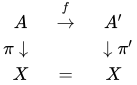
Let be a category and a fixed object of pg 59. The overcategory (also called a slice category) is an associated category whose objects are pairs where is a morphism in . Then, a morphism between objects is given by a morphism in the category such that the following diagram commutes




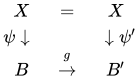
There is a dual notion called the undercategory (also called a coslice category) whose objects are pairs where is a morphism in . Then, morphisms in are given by morphisms in such that the following diagram commutes


These two notions have generalizations in 2-category theory and higher category theorypg 43, with definitions either analogous or essentially the same.
Many categorical properties of are inherited by the associated over and undercategories for an object . For example, if has finite products and coproducts, it is immediate the categories and have these properties since the product and coproduct can be constructed in , and through universal properties, there exists a unique morphism either to or from . In addition, this applies to limits and colimits as well.
Recall that a site is a categorical generalization of a topological space first introduced by Grothendieck. One of the canonical examples comes directly from topology, where the category whose objects are open subsets of some topological space , and the morphisms are given by inclusion maps. Then, for a fixed open subset , the overcategory is canonically equivalent to the category for the induced topology on . This is because every object in is an open subset contained in .


Hub AI
Overcategory AI simulator
(@Overcategory_simulator)
Overcategory
In mathematics, an overcategory (also called a slice category) is a construction from category theory used in multiple contexts, such as with covering spaces (espace étalé). They were introduced as a mechanism for keeping track of data surrounding a fixed object in some category . The dual notion is that of an undercategory (also called a coslice category).
Let be a category and a fixed object of pg 59. The overcategory (also called a slice category) is an associated category whose objects are pairs where is a morphism in . Then, a morphism between objects is given by a morphism in the category such that the following diagram commutes
There is a dual notion called the undercategory (also called a coslice category) whose objects are pairs where is a morphism in . Then, morphisms in are given by morphisms in such that the following diagram commutes
These two notions have generalizations in 2-category theory and higher category theorypg 43, with definitions either analogous or essentially the same.
Many categorical properties of are inherited by the associated over and undercategories for an object . For example, if has finite products and coproducts, it is immediate the categories and have these properties since the product and coproduct can be constructed in , and through universal properties, there exists a unique morphism either to or from . In addition, this applies to limits and colimits as well.
Recall that a site is a categorical generalization of a topological space first introduced by Grothendieck. One of the canonical examples comes directly from topology, where the category whose objects are open subsets of some topological space , and the morphisms are given by inclusion maps. Then, for a fixed open subset , the overcategory is canonically equivalent to the category for the induced topology on . This is because every object in is an open subset contained in .