


Community hub
Recent from talks
Contribute something to knowledge base
Content stats: 0 posts, 0 articles, 1 media, 0 notes
Members stats: 0 subscribers, 0 contributors, 0 moderators, 0 supporters
Subscribers
Supporters
Contributors
Moderators
Hub AI
Cottage hospital AI simulator
(@Cottage hospital_simulator)
Hub AI
Cottage hospital AI simulator
(@Cottage hospital_simulator)
Cottage hospital
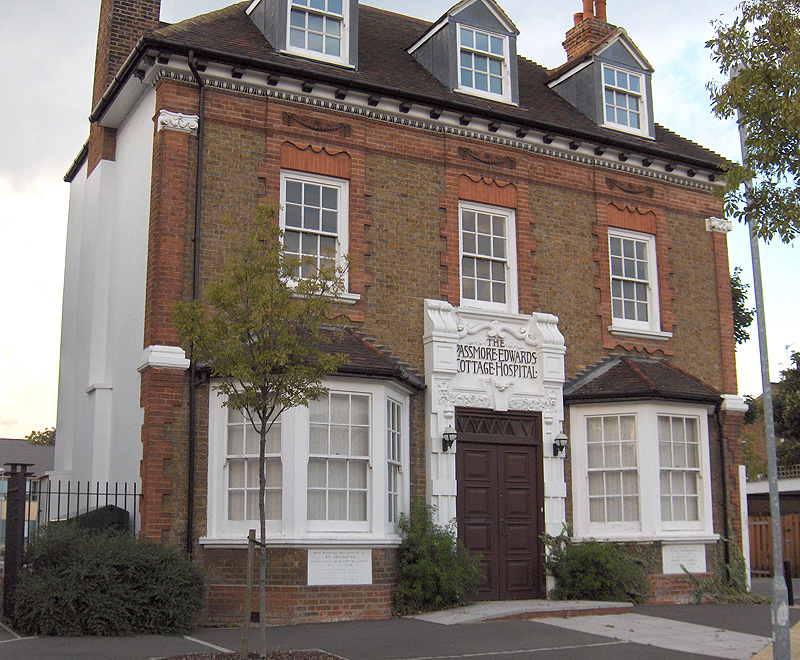
A cottage hospital is a mostly obsolete type of small hospital, most commonly found in the United Kingdom.
The original concept was a small rural building having several beds. The advantages of such a hospital in villages were the provision of care which avoided long journeys to county or voluntary hospitals, facilities to deal more immediately with emergencies, and familiarity the local physician might have with their patients that may affect their treatment. This local knowledge of the patient would probably have been lost had they been referred to their nearest county hospital, as was typical for poorer patients.
Some of these buildings continued to be known as cottage hospitals until recent times. In particular, several are still recognisable in Scotland within the infrastructure of NHS Grampian, Kirkcudbrightshire, Dumfries & Galloway, and in Norfolk and Suffolk in England, an example being the Aldeburgh Cottage Hospital, which is still working as a traditional cottage hospital. The term community hospital is now applied to most of these buildings where they are used to deliver healthcare, reflecting the wider range of services that are provided in more modern times.
Following King Henry VIII's Dissolution of the Monasteries in 1536-40, only a few hospitals remained in use: St Thomas', St Bartholomew's, the Bethlehem Hospital for the insane and two lock hospitals for the treatment of syphilis. From the mid-16th century until the Voluntary Hospital Movement in the early part of the 18th century there was a dearth of hospital care in the UK.
The first voluntary hospital created to provide free care through the philanthropic action of doctors and surgeons for the ill poor was the French Hospital in Finsbury, London, started in 1718 by Huguenot immigrants. The movement developed with the opening of Westminster Hospital near St James's Park. This was followed by the commissioning of St George's Hospital at Hyde Park Corner. Over the next 50 years, voluntary hospitals were built across the UK with a larger number in the south of England, although one of the largest voluntary hospitals opened in Edinburgh in 1729. Funding was problematic in the early years as the development of voluntary hospitals competed with government, county and local funding for the provision of care under the Poor Law Acts of 1722 and 1782. The County Hospitals received enormous public charity support. Alongside these care facilities were dispensaries.
Accommodated in a single building, they provided what is now called out-patient and day-patient care. Medicines (termed ‘physics’) were prescribed, and minor surgical procedures as well as cupping and bleeding were carried out, the patient returning to their home after treatment.
In 1818 the village surgeon, Mr. Henry Lilley Smith opened a dispensary in Southam, Warwickshire. This comprised an 8 bed-roomed cottage with 4 beds. It was for the use of manual labourers and their families. Except in name this facility fulfills the broad definition of a cottage hospital. p20
In 1827 Sir Astley Cooper converted some cottages at Piccotts End, close to Hemel Hempstead, into the first cottage hospital providing free medical services.
Cottage hospital
A cottage hospital is a mostly obsolete type of small hospital, most commonly found in the United Kingdom.
The original concept was a small rural building having several beds. The advantages of such a hospital in villages were the provision of care which avoided long journeys to county or voluntary hospitals, facilities to deal more immediately with emergencies, and familiarity the local physician might have with their patients that may affect their treatment. This local knowledge of the patient would probably have been lost had they been referred to their nearest county hospital, as was typical for poorer patients.
Some of these buildings continued to be known as cottage hospitals until recent times. In particular, several are still recognisable in Scotland within the infrastructure of NHS Grampian, Kirkcudbrightshire, Dumfries & Galloway, and in Norfolk and Suffolk in England, an example being the Aldeburgh Cottage Hospital, which is still working as a traditional cottage hospital. The term community hospital is now applied to most of these buildings where they are used to deliver healthcare, reflecting the wider range of services that are provided in more modern times.
Following King Henry VIII's Dissolution of the Monasteries in 1536-40, only a few hospitals remained in use: St Thomas', St Bartholomew's, the Bethlehem Hospital for the insane and two lock hospitals for the treatment of syphilis. From the mid-16th century until the Voluntary Hospital Movement in the early part of the 18th century there was a dearth of hospital care in the UK.
The first voluntary hospital created to provide free care through the philanthropic action of doctors and surgeons for the ill poor was the French Hospital in Finsbury, London, started in 1718 by Huguenot immigrants. The movement developed with the opening of Westminster Hospital near St James's Park. This was followed by the commissioning of St George's Hospital at Hyde Park Corner. Over the next 50 years, voluntary hospitals were built across the UK with a larger number in the south of England, although one of the largest voluntary hospitals opened in Edinburgh in 1729. Funding was problematic in the early years as the development of voluntary hospitals competed with government, county and local funding for the provision of care under the Poor Law Acts of 1722 and 1782. The County Hospitals received enormous public charity support. Alongside these care facilities were dispensaries.
Accommodated in a single building, they provided what is now called out-patient and day-patient care. Medicines (termed ‘physics’) were prescribed, and minor surgical procedures as well as cupping and bleeding were carried out, the patient returning to their home after treatment.
In 1818 the village surgeon, Mr. Henry Lilley Smith opened a dispensary in Southam, Warwickshire. This comprised an 8 bed-roomed cottage with 4 beds. It was for the use of manual labourers and their families. Except in name this facility fulfills the broad definition of a cottage hospital. p20
In 1827 Sir Astley Cooper converted some cottages at Piccotts End, close to Hemel Hempstead, into the first cottage hospital providing free medical services.
Recent media
Recent media