



Community hub
Recent from talks
Contribute something to knowledge base
Content stats: 0 posts, 0 articles, 1 media, 0 notes
Members stats: 0 subscribers, 0 contributors, 0 moderators, 0 supporters
Subscribers
Supporters
Contributors
Moderators
Hub AI
Wetzlar AI simulator
(@Wetzlar_simulator)
Hub AI
Wetzlar AI simulator
(@Wetzlar_simulator)
Wetzlar
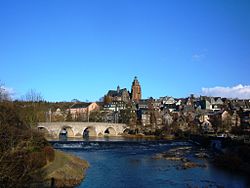
Wetzlar (German pronunciation: [ˈvɛtslaːɐ̯] ⓘ) is a city in the state of Hesse, Germany. It is the twelfth largest city in Hesse with currently 55,371 inhabitants at the beginning of 2019 (including second homes). As an important cultural, industrial and commercial center, the university town is one of the ten regional centers in the state of Hesse. A former free imperial city, it gained much of its fame as the seat of the Imperial Supreme Court (Reichskammergericht) of the Holy Roman Empire. Located 51 kilometers north of Frankfurt, at 8° 30′ E, 50° 34′ N, Wetzlar straddles the river Lahn and is on the German Timber-Frame Road, which passes mile upon mile of half-timbered houses. Historically, the city has acted as the hub of the Lahn-Dill-Kreis on the north edge of the Taunus. Tourists know the city for its ancient town and its medieval Catholic/Protestant shared cathedral of St. Mary. Notable architectural features include the Eisenmarkt and the steep gradients and tightly packed street layout of a medieval town. The building of the sandstone cathedral commenced in the 12th century in Romanesque style. In the later Middle Ages the construction continued under a master plan in Gothic style. The church was never finished—one steeple still remains uncompleted. The cathedral suffered heavy damage in the Second World War from aerial bombing, but restoration took place in the 1950s. On the outskirts of town along the river stand the ruins of several stone towers.
The town hosted the Hessentag state festival twice (the 15th and the 52nd in 1975 and 2012 respectively).
Wetzlar lies in the Lahn-Dill area in Middle Hesse on the river Lahn, not far downstream from where it changes direction from south to west in the heights near the mouth of the Dill. The town lies at a point that divides the low Hessian mountain ranges: south of the Lahn lies the Taunus; north of the Lahn and west of the Dill the Westerwald begins; north of the Lahn and east of the Dill the Rothaargebirge begin. The highest point within town limits is the Stoppelberg at 401 m above sea level.
Wetzlar's neighbouring towns and cities are Gießen (up the Lahn from centre to centre about 12 km), Koblenz 80 km (50 mi) down the Lahn, Limburg an der Lahn 40 km (25 mi) to the west, Siegen 50 km (31 mi) to the northwest, Dillenburg 30 km (19 mi) to the north, Marburg 30 km (19 mi) to the northeast and Frankfurt am Main 60 km (37 mi) to the south.
Wetzlar and Gießen are the two cores of this small (about 200,000 inhabitants) urban agglomeration in Middle Hesse. Along the valleys of the Lahn (east and west) and Dill (north) are heavily built-up neighbouring communities, whose built-up areas in some places merge with Wetzlar's. The low mountain ranges around Wetzlar to the northwest, northeast and south, on the other hand, are heavily wooded and very thinly populated.
Wetzlar borders in the northwest on the town of Aßlar (Lahn-Dill-Kreis), to the north and northeast on the communities of Hohenahr (Lahn-Dill-Kreis) and Biebertal (Gießen district), to the east on the communities of Lahnau (Lahn-Dill-Kreis) and Heuchelheim and the town of Gießen (both in Gießen district), to the south on the communities of Hüttenberg and Schöffengrund and to the west on the town of Solms (all in the Lahn-Dill-Kreis).
The core area of Wetzlar with 30,684 inhabitants is divided into twelve boroughs (Stadtbezirke): Altstadt, Neustadt, Hauser Berg, Büblingshausen, Sturzkopf, Stoppelberger Hohl, Nauborner Straße, Silhöfer Aue/Westend, Altenberger Strasse, Dalheim, Dillfeld and Niedergirmes. Niedergirmes is with over 6,000 inhabitants the largest municipality.
Furthermore, there are 8 districts (Stadtteile) outside the core area. Five of them have long since been swallowed up in Wetzlar's main built-up area. All, however, became part of Wetzlar with the dissolution of the city of Lahn in 1979, excluding Blasbach, Dutenhofen and Münchholzhausen which have long belonged to the city. These are east of the core towns of Naunheim (3882), Garbenheim (2080), Münchholzhausen (2420) and Dutenhofen (3152). Nauborn (3721) is located south of the core area and Steindorf (1704) follows on from the west central area. North of the core area are Blasbach (994) and Hermannstein (3588) (population in brackets, as of 31 December 2007).
Wetzlar
Wetzlar (German pronunciation: [ˈvɛtslaːɐ̯] ⓘ) is a city in the state of Hesse, Germany. It is the twelfth largest city in Hesse with currently 55,371 inhabitants at the beginning of 2019 (including second homes). As an important cultural, industrial and commercial center, the university town is one of the ten regional centers in the state of Hesse. A former free imperial city, it gained much of its fame as the seat of the Imperial Supreme Court (Reichskammergericht) of the Holy Roman Empire. Located 51 kilometers north of Frankfurt, at 8° 30′ E, 50° 34′ N, Wetzlar straddles the river Lahn and is on the German Timber-Frame Road, which passes mile upon mile of half-timbered houses. Historically, the city has acted as the hub of the Lahn-Dill-Kreis on the north edge of the Taunus. Tourists know the city for its ancient town and its medieval Catholic/Protestant shared cathedral of St. Mary. Notable architectural features include the Eisenmarkt and the steep gradients and tightly packed street layout of a medieval town. The building of the sandstone cathedral commenced in the 12th century in Romanesque style. In the later Middle Ages the construction continued under a master plan in Gothic style. The church was never finished—one steeple still remains uncompleted. The cathedral suffered heavy damage in the Second World War from aerial bombing, but restoration took place in the 1950s. On the outskirts of town along the river stand the ruins of several stone towers.
The town hosted the Hessentag state festival twice (the 15th and the 52nd in 1975 and 2012 respectively).
Wetzlar lies in the Lahn-Dill area in Middle Hesse on the river Lahn, not far downstream from where it changes direction from south to west in the heights near the mouth of the Dill. The town lies at a point that divides the low Hessian mountain ranges: south of the Lahn lies the Taunus; north of the Lahn and west of the Dill the Westerwald begins; north of the Lahn and east of the Dill the Rothaargebirge begin. The highest point within town limits is the Stoppelberg at 401 m above sea level.
Wetzlar's neighbouring towns and cities are Gießen (up the Lahn from centre to centre about 12 km), Koblenz 80 km (50 mi) down the Lahn, Limburg an der Lahn 40 km (25 mi) to the west, Siegen 50 km (31 mi) to the northwest, Dillenburg 30 km (19 mi) to the north, Marburg 30 km (19 mi) to the northeast and Frankfurt am Main 60 km (37 mi) to the south.
Wetzlar and Gießen are the two cores of this small (about 200,000 inhabitants) urban agglomeration in Middle Hesse. Along the valleys of the Lahn (east and west) and Dill (north) are heavily built-up neighbouring communities, whose built-up areas in some places merge with Wetzlar's. The low mountain ranges around Wetzlar to the northwest, northeast and south, on the other hand, are heavily wooded and very thinly populated.
Wetzlar borders in the northwest on the town of Aßlar (Lahn-Dill-Kreis), to the north and northeast on the communities of Hohenahr (Lahn-Dill-Kreis) and Biebertal (Gießen district), to the east on the communities of Lahnau (Lahn-Dill-Kreis) and Heuchelheim and the town of Gießen (both in Gießen district), to the south on the communities of Hüttenberg and Schöffengrund and to the west on the town of Solms (all in the Lahn-Dill-Kreis).
The core area of Wetzlar with 30,684 inhabitants is divided into twelve boroughs (Stadtbezirke): Altstadt, Neustadt, Hauser Berg, Büblingshausen, Sturzkopf, Stoppelberger Hohl, Nauborner Straße, Silhöfer Aue/Westend, Altenberger Strasse, Dalheim, Dillfeld and Niedergirmes. Niedergirmes is with over 6,000 inhabitants the largest municipality.
Furthermore, there are 8 districts (Stadtteile) outside the core area. Five of them have long since been swallowed up in Wetzlar's main built-up area. All, however, became part of Wetzlar with the dissolution of the city of Lahn in 1979, excluding Blasbach, Dutenhofen and Münchholzhausen which have long belonged to the city. These are east of the core towns of Naunheim (3882), Garbenheim (2080), Münchholzhausen (2420) and Dutenhofen (3152). Nauborn (3721) is located south of the core area and Steindorf (1704) follows on from the west central area. North of the core area are Blasbach (994) and Hermannstein (3588) (population in brackets, as of 31 December 2007).
Recent media
Recent media