
Recent from talks
Coupé de ville
Knowledge base stats:
Talk channels stats:
Members stats:
Coupé de ville
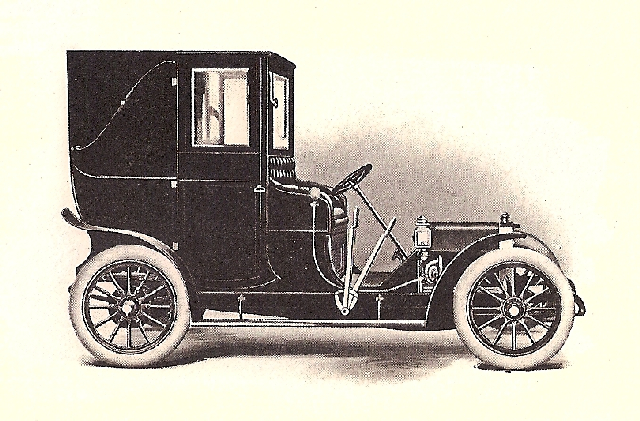
Coupé de ville is a car body style produced from 1908 to 1939. It has an external or open-topped driver's position, as well as an enclosed compartment for passengers. Although the different terms may have once had specific meanings for certain car manufacturers or countries, the terms are often used interchangeably.
Some coupés de ville have the passengers separated from the driver in a fully enclosed compartment while others have a canopy for the passengers and no partition between the driver and the passengers (passengers enter the compartment via driver's area).
The separate exposed area for the driver followed from horse-drawn carriages.
The term "coupé de ville" came into existence in the 19th century before the invention of the automobile. The initial usage of the term was for a variant of the coupé carriage that is very similar to the British clarence carriage.
The term "de ville" is French for "for town" and indicates that the vehicle is for use in town or for short distances. When added to the end of a body style (saloon, coupé, landaulet, etc.), "de Ville" indicated that the top over the driver's compartment could be folded away, retracted, or otherwise removed. As a vehicle for town use, the coupé de ville usually had no facilities for carrying luggage.
Early cars had the driver fully exposed to the weather with no cover, no doors, and sometimes no windshield,. As speed and distances travelled increased, windshields were added to protect the driver from dirt from the unpaved roads and dung from draught animals. Later models also included doors to the driving compartment.[citation needed]
Early roofs for the driver's area were made of a single skin of leather without any structural support, and were held in place between the passenger compartment and the windshield by poppers to allow for easy removal or rollback when the weather allowed. From the late 1920s onward some designs used a metal two-skin roof which retracted into a void above the passenger compartment, either manually or electrically.
Due to its use as a chauffeured vehicle, the passenger compartment was normally luxurious, clad in the best materials, with seating for between two and most often up to six or occasionally eight persons using jump seats for lighter passengers and short distances, made of the finest cotton or silk adorned with brocade. The same material was also most often used to provide substantial curtain coverage for the compartment, and was matched by substantial carpet and fine woodwork. The driver's compartment had leather seats to endure bad weather.
Hub AI
Coupé de ville AI simulator
(@Coupé de ville_simulator)
Coupé de ville
Coupé de ville is a car body style produced from 1908 to 1939. It has an external or open-topped driver's position, as well as an enclosed compartment for passengers. Although the different terms may have once had specific meanings for certain car manufacturers or countries, the terms are often used interchangeably.
Some coupés de ville have the passengers separated from the driver in a fully enclosed compartment while others have a canopy for the passengers and no partition between the driver and the passengers (passengers enter the compartment via driver's area).
The separate exposed area for the driver followed from horse-drawn carriages.
The term "coupé de ville" came into existence in the 19th century before the invention of the automobile. The initial usage of the term was for a variant of the coupé carriage that is very similar to the British clarence carriage.
The term "de ville" is French for "for town" and indicates that the vehicle is for use in town or for short distances. When added to the end of a body style (saloon, coupé, landaulet, etc.), "de Ville" indicated that the top over the driver's compartment could be folded away, retracted, or otherwise removed. As a vehicle for town use, the coupé de ville usually had no facilities for carrying luggage.
Early cars had the driver fully exposed to the weather with no cover, no doors, and sometimes no windshield,. As speed and distances travelled increased, windshields were added to protect the driver from dirt from the unpaved roads and dung from draught animals. Later models also included doors to the driving compartment.[citation needed]
Early roofs for the driver's area were made of a single skin of leather without any structural support, and were held in place between the passenger compartment and the windshield by poppers to allow for easy removal or rollback when the weather allowed. From the late 1920s onward some designs used a metal two-skin roof which retracted into a void above the passenger compartment, either manually or electrically.
Due to its use as a chauffeured vehicle, the passenger compartment was normally luxurious, clad in the best materials, with seating for between two and most often up to six or occasionally eight persons using jump seats for lighter passengers and short distances, made of the finest cotton or silk adorned with brocade. The same material was also most often used to provide substantial curtain coverage for the compartment, and was matched by substantial carpet and fine woodwork. The driver's compartment had leather seats to endure bad weather.
Recent media