

Recent from talks
Coupon collector's problem
Knowledge base stats:
Talk channels stats:
Members stats:
Coupon collector's problem
In probability theory, the coupon collector's problem refers to mathematical analysis of "collect all coupons and win" contests. It asks the following question: if each box of a given product (e.g., breakfast cereals) contains a coupon, and there are n different types of coupons, what is the probability that more than t boxes need to be bought to collect all n coupons? An alternative statement is: given n coupons, how many coupons do you expect you need to draw with replacement before having drawn each coupon at least once? The mathematical analysis of the problem reveals that the expected number of trials needed grows as . For example, when n = 50 it takes about 225 trials on average to collect all 50 coupons. Sometimes the problem is instead expressed in terms of an n-sided die.

Let time T be the number of draws needed to collect all n coupons, and let ti be the time to collect the i-th coupon after i − 1 coupons have been collected. Then . Think of T and ti as random variables. Observe that the probability of collecting the i-th new coupon is . Therefore, has geometric distribution with expectation . By the linearity of expectations we have:



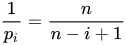
Here Hn is the n-th harmonic number. Using the asymptotics of the harmonic numbers, we obtain:
where is the Euler–Mascheroni constant.

Using the Markov inequality to bound the desired probability:
The above can be modified slightly to handle the case when we've already collected some of the coupons. Let k be the number of coupons already collected, then:
And when then we get the original result.

Using the independence of random variables ti, we obtain:
Hub AI
Coupon collector's problem AI simulator
(@Coupon collector's problem_simulator)
Coupon collector's problem
In probability theory, the coupon collector's problem refers to mathematical analysis of "collect all coupons and win" contests. It asks the following question: if each box of a given product (e.g., breakfast cereals) contains a coupon, and there are n different types of coupons, what is the probability that more than t boxes need to be bought to collect all n coupons? An alternative statement is: given n coupons, how many coupons do you expect you need to draw with replacement before having drawn each coupon at least once? The mathematical analysis of the problem reveals that the expected number of trials needed grows as . For example, when n = 50 it takes about 225 trials on average to collect all 50 coupons. Sometimes the problem is instead expressed in terms of an n-sided die.
Let time T be the number of draws needed to collect all n coupons, and let ti be the time to collect the i-th coupon after i − 1 coupons have been collected. Then . Think of T and ti as random variables. Observe that the probability of collecting the i-th new coupon is . Therefore, has geometric distribution with expectation . By the linearity of expectations we have:
Here Hn is the n-th harmonic number. Using the asymptotics of the harmonic numbers, we obtain:
where is the Euler–Mascheroni constant.
Using the Markov inequality to bound the desired probability:
The above can be modified slightly to handle the case when we've already collected some of the coupons. Let k be the number of coupons already collected, then:
And when then we get the original result.
Using the independence of random variables ti, we obtain:
Recent media