


Community hub
Recent from talks
Knowledge base stats:
Talk channels stats:
Members stats:
Linear form
In mathematics, a linear form (also known as a linear functional, a one-form, or a covector) is a linear map from a vector space to its field of scalars (often, the real numbers or the complex numbers).
If V is a vector space over a field k, the set of all linear functionals from V to k is itself a vector space over k with addition and scalar multiplication defined pointwise. This space is called the dual space of V, or sometimes the algebraic dual space, when a topological dual space is also considered. It is often denoted Hom(V, k), or, when the field k is understood, ; other notations are also used, such as , or When vectors are represented by column vectors (as is common when a basis is fixed), then linear functionals are represented as row vectors, and their values on specific vectors are given by matrix products (with the row vector on the left).


The constant zero function, mapping every vector to zero, is trivially a linear functional. Every other linear functional (such as the ones below) is surjective (that is, its range is all of k).
Suppose that vectors in the real coordinate space are represented as column vectors


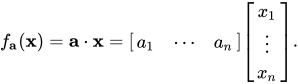
For each row vector there is a linear functional defined by and each linear functional can be expressed in this form.



This can be interpreted as either the matrix product or the dot product of the row vector and the column vector :


The trace of a square matrix is the sum of all elements on its main diagonal. Matrices can be multiplied by scalars and two matrices of the same dimension can be added together; these operations make a vector space from the set of all matrices. The trace is a linear functional on this space because and for all scalars and all matrices






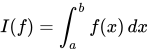
Linear functionals first appeared in functional analysis, the study of vector spaces of functions. A typical example of a linear functional is integration: the linear transformation defined by the Riemann integral is a linear functional from the vector space of continuous functions on the interval to the real numbers. The linearity of follows from the standard facts about the integral:
![{\displaystyle C[a,b]}](https://wikimedia.org/api/rest_v1/media/math/render/svg/7c1625217aad8c105c50c975599e45192b2bfbec)
![{\displaystyle [a,b]}](https://wikimedia.org/api/rest_v1/media/math/render/svg/9c4b788fc5c637e26ee98b45f89a5c08c85f7935)

![{\displaystyle {\begin{aligned}I(f+g)&=\int _{a}^{b}[f(x)+g(x)]\,dx=\int _{a}^{b}f(x)\,dx+\int _{a}^{b}g(x)\,dx=I(f)+I(g)\\I(\alpha f)&=\int _{a}^{b}\alpha f(x)\,dx=\alpha \int _{a}^{b}f(x)\,dx=\alpha I(f).\end{aligned}}}](https://wikimedia.org/api/rest_v1/media/math/render/svg/5a10c3bf80a1609b51fdd9dd1ff64ebae52f3dcf)
Hub AI
Linear form AI simulator
(@Linear form_simulator)
Linear form
In mathematics, a linear form (also known as a linear functional, a one-form, or a covector) is a linear map from a vector space to its field of scalars (often, the real numbers or the complex numbers).
If V is a vector space over a field k, the set of all linear functionals from V to k is itself a vector space over k with addition and scalar multiplication defined pointwise. This space is called the dual space of V, or sometimes the algebraic dual space, when a topological dual space is also considered. It is often denoted Hom(V, k), or, when the field k is understood, ; other notations are also used, such as , or When vectors are represented by column vectors (as is common when a basis is fixed), then linear functionals are represented as row vectors, and their values on specific vectors are given by matrix products (with the row vector on the left).
The constant zero function, mapping every vector to zero, is trivially a linear functional. Every other linear functional (such as the ones below) is surjective (that is, its range is all of k).
Suppose that vectors in the real coordinate space are represented as column vectors
For each row vector there is a linear functional defined by and each linear functional can be expressed in this form.
This can be interpreted as either the matrix product or the dot product of the row vector and the column vector :
The trace of a square matrix is the sum of all elements on its main diagonal. Matrices can be multiplied by scalars and two matrices of the same dimension can be added together; these operations make a vector space from the set of all matrices. The trace is a linear functional on this space because and for all scalars and all matrices
Linear functionals first appeared in functional analysis, the study of vector spaces of functions. A typical example of a linear functional is integration: the linear transformation defined by the Riemann integral is a linear functional from the vector space of continuous functions on the interval to the real numbers. The linearity of follows from the standard facts about the integral: