



Community hub
Recent from talks
Knowledge base stats:
Talk channels stats:
Members stats:
Zone defense in American football
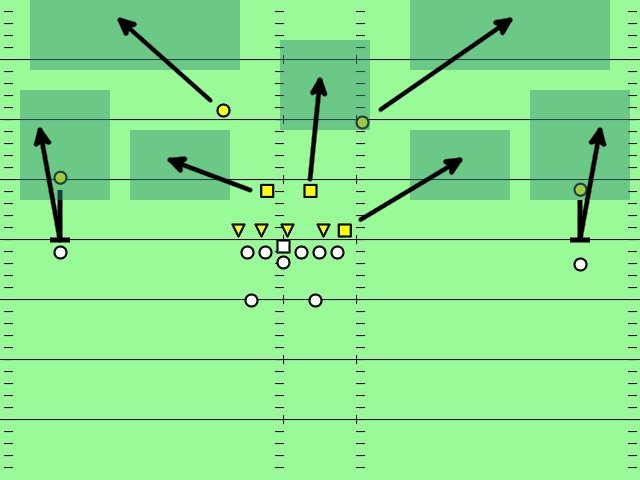
Zone coverage (also referred to as a zone defense) is a defensive scheme in gridiron football used to protect against the pass.
Zone coverage schemes require the linebackers and defensive backs to work together to cover certain areas of the field, making it difficult for the opposing quarterback to complete passes. Zone defenses will generally require linebackers to cover the short and midrange area in the middle of the field, in front of the safeties. In the case where one or two linebackers blitz, the remaining linebacker(s) expands his zone to cover the zone responsibilities of the vacating linebacker(s). Often, blitzing will leave larger holes in the pass defense, but it is a gamble the defensive coordinator wants to make to pressure the quarterback into a poor decision and hopefully an interception or at least an incompletion.
In the following, "cover" refers to the "shell" that the defense rolls into after the snap of the ball, more specifically the number of defenders guarding the deep portion of the field.
In passing situations, the defense will assign players to guard portions of the field, forming a defensive "shell" that the defense hopes will either prevent the offense from completing a pass or ensure a defensive player is able to tackle the receiver after a completed pass. The general terminology used to describe this alignment is "Cover #," with "#" being the number of defensive players forming the coverage shell.
Cover 0 refers to pure man coverage with no deep defender.[1] Similar to Cover 1, Cover 0 has the same strengths and weaknesses but employs an extra rusher at the expense of deep coverage help leaving each pass defender man-to-man. Cover 0 is an aggressive scheme that allows for numerous blitz packages, as it is easier for players to drop off their coverage and rush the quarterback. However, there is no "help over the top"—if a wide receiver "beats" (achieves separation from) his defender, there is no one left in the secondary who can make up the coverage on the receiver, which could result in an easy pass completion and possible touchdown.
Cover One is a man-to-man coverage style for all the defensive backs except for one player (usually a safety), who is not assigned a man to cover but rather plays deep and reacts to the development of the play. Often, the safety will remain in a pass coverage position and play a zone defense by guarding the middle of the secondary, reacting to runs or completed passes, and double-teaming a receiver if needed.
In a traditional Cover 1, the free safety plays deep, and all of the other defenders lock in man coverage for an assigned player for the duration of the play. Essentially, during the pre-snap read, each defender identifies the coverage responsibilities and does not change the assignment. Some teams play a variant of Cover 1 called Cover 7. In Cover 7, the free safety still plays deep, but the underneath coverage is much more flexible, and the defenders switch assignments as the play develops in an attempt to improve defensive positions to make a play on the ball. Examples of these switches include double covering a certain receiver and using defensive help to undercut a route to block a throwing lane.
Cover 1 schemes are usually very aggressive, preferring to proactively disrupt the offense by giving the quarterback little time to make a decision while collapsing the pocket quickly. This is the main advantage of Cover 1 schemes—the ability to blitz from various pre-snap formations while engaging in complex man-to-man coverage schemes post-snap. For example, a safety may blitz while a cornerback is locked in man coverage with a receiver. Conversely, the cornerback may blitz with the safety rotating into man coverage on the receiver post-snap.
Hub AI
Zone defense in American football AI simulator
(@Zone defense in American football_simulator)
Zone defense in American football
Zone coverage (also referred to as a zone defense) is a defensive scheme in gridiron football used to protect against the pass.
Zone coverage schemes require the linebackers and defensive backs to work together to cover certain areas of the field, making it difficult for the opposing quarterback to complete passes. Zone defenses will generally require linebackers to cover the short and midrange area in the middle of the field, in front of the safeties. In the case where one or two linebackers blitz, the remaining linebacker(s) expands his zone to cover the zone responsibilities of the vacating linebacker(s). Often, blitzing will leave larger holes in the pass defense, but it is a gamble the defensive coordinator wants to make to pressure the quarterback into a poor decision and hopefully an interception or at least an incompletion.
In the following, "cover" refers to the "shell" that the defense rolls into after the snap of the ball, more specifically the number of defenders guarding the deep portion of the field.
In passing situations, the defense will assign players to guard portions of the field, forming a defensive "shell" that the defense hopes will either prevent the offense from completing a pass or ensure a defensive player is able to tackle the receiver after a completed pass. The general terminology used to describe this alignment is "Cover #," with "#" being the number of defensive players forming the coverage shell.
Cover 0 refers to pure man coverage with no deep defender.[1] Similar to Cover 1, Cover 0 has the same strengths and weaknesses but employs an extra rusher at the expense of deep coverage help leaving each pass defender man-to-man. Cover 0 is an aggressive scheme that allows for numerous blitz packages, as it is easier for players to drop off their coverage and rush the quarterback. However, there is no "help over the top"—if a wide receiver "beats" (achieves separation from) his defender, there is no one left in the secondary who can make up the coverage on the receiver, which could result in an easy pass completion and possible touchdown.
Cover One is a man-to-man coverage style for all the defensive backs except for one player (usually a safety), who is not assigned a man to cover but rather plays deep and reacts to the development of the play. Often, the safety will remain in a pass coverage position and play a zone defense by guarding the middle of the secondary, reacting to runs or completed passes, and double-teaming a receiver if needed.
In a traditional Cover 1, the free safety plays deep, and all of the other defenders lock in man coverage for an assigned player for the duration of the play. Essentially, during the pre-snap read, each defender identifies the coverage responsibilities and does not change the assignment. Some teams play a variant of Cover 1 called Cover 7. In Cover 7, the free safety still plays deep, but the underneath coverage is much more flexible, and the defenders switch assignments as the play develops in an attempt to improve defensive positions to make a play on the ball. Examples of these switches include double covering a certain receiver and using defensive help to undercut a route to block a throwing lane.
Cover 1 schemes are usually very aggressive, preferring to proactively disrupt the offense by giving the quarterback little time to make a decision while collapsing the pocket quickly. This is the main advantage of Cover 1 schemes—the ability to blitz from various pre-snap formations while engaging in complex man-to-man coverage schemes post-snap. For example, a safety may blitz while a cornerback is locked in man coverage with a receiver. Conversely, the cornerback may blitz with the safety rotating into man coverage on the receiver post-snap.