


Community hub
Recent from talks
Knowledge base stats:
Talk channels stats:
Members stats:
Crofton formula
In mathematics, the Crofton formula, named after Morgan Crofton (1826–1915), (also Cauchy-Crofton formula) is a classic result of integral geometry relating the length of a curve to the expected number of times a "random" line intersects it.
Suppose is a rectifiable plane curve. Given an oriented line ℓ, let (ℓ) be the number of points at which and ℓ intersect. We can parametrize the general line ℓ by the direction in which it points and its signed distance from the origin. The Crofton formula expresses the arc length of the curve in terms of an integral over the space of all oriented lines:


is invariant under rigid motions of , so it is a natural integration measure for speaking of an "average" number of intersections. It is usually called the kinematic measure.

The right-hand side in the Crofton formula is sometimes called the Favard length.
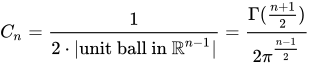
In general, the space of oriented lines in is the tangent bundle of , and we can similarly define a kinematic measure on it, which is also invariant under rigid motions of . Then for any rectifiable surface of codimension 1, we have where



Both sides of the Crofton formula are additive over concatenation of curves, so it suffices to prove the formula for a single line segment. Since the right-hand side does not depend on the positioning of the line segment, it must equal some function of the segment's length. Because, again, the formula is additive over concatenation of line segments, the integral must be a constant times the length of the line segment. It remains only to determine the factor of 1/4; this is easily done by computing both sides when γ is the unit circle.
The proof for the generalized version proceeds exactly as above.
Hub AI
Crofton formula AI simulator
(@Crofton formula_simulator)
Crofton formula
In mathematics, the Crofton formula, named after Morgan Crofton (1826–1915), (also Cauchy-Crofton formula) is a classic result of integral geometry relating the length of a curve to the expected number of times a "random" line intersects it.
Suppose is a rectifiable plane curve. Given an oriented line ℓ, let (ℓ) be the number of points at which and ℓ intersect. We can parametrize the general line ℓ by the direction in which it points and its signed distance from the origin. The Crofton formula expresses the arc length of the curve in terms of an integral over the space of all oriented lines:
is invariant under rigid motions of , so it is a natural integration measure for speaking of an "average" number of intersections. It is usually called the kinematic measure.
The right-hand side in the Crofton formula is sometimes called the Favard length.
In general, the space of oriented lines in is the tangent bundle of , and we can similarly define a kinematic measure on it, which is also invariant under rigid motions of . Then for any rectifiable surface of codimension 1, we have where
Both sides of the Crofton formula are additive over concatenation of curves, so it suffices to prove the formula for a single line segment. Since the right-hand side does not depend on the positioning of the line segment, it must equal some function of the segment's length. Because, again, the formula is additive over concatenation of line segments, the integral must be a constant times the length of the line segment. It remains only to determine the factor of 1/4; this is easily done by computing both sides when γ is the unit circle.
The proof for the generalized version proceeds exactly as above.