
Recent from talks
Cryptographic hash function
Knowledge base stats:
Talk channels stats:
Members stats:
Cryptographic hash function
A cryptographic hash function (CHF) is a hash algorithm (a map of an arbitrary binary string to a binary string with a fixed size of bits) that has special properties desirable for a cryptographic application:

Cryptographic hash functions have many information-security applications, notably in digital signatures, message authentication codes (MACs), and other forms of authentication. They can also be used as ordinary hash functions, to index data in hash tables, for fingerprinting, to detect duplicate data or uniquely identify files, and as checksums to detect accidental data corruption. Indeed, in information-security contexts, cryptographic hash values are sometimes called (digital) fingerprints, checksums, (message) digests, or just hash values, even though all these terms stand for more general functions with rather different properties and purposes.
Non-cryptographic hash functions are used in hash tables and to detect accidental errors; their constructions frequently provide no resistance to a deliberate attack. For example, a denial-of-service attack on hash tables is possible if the collisions are easy to find, as in the case of linear cyclic redundancy check (CRC) functions.
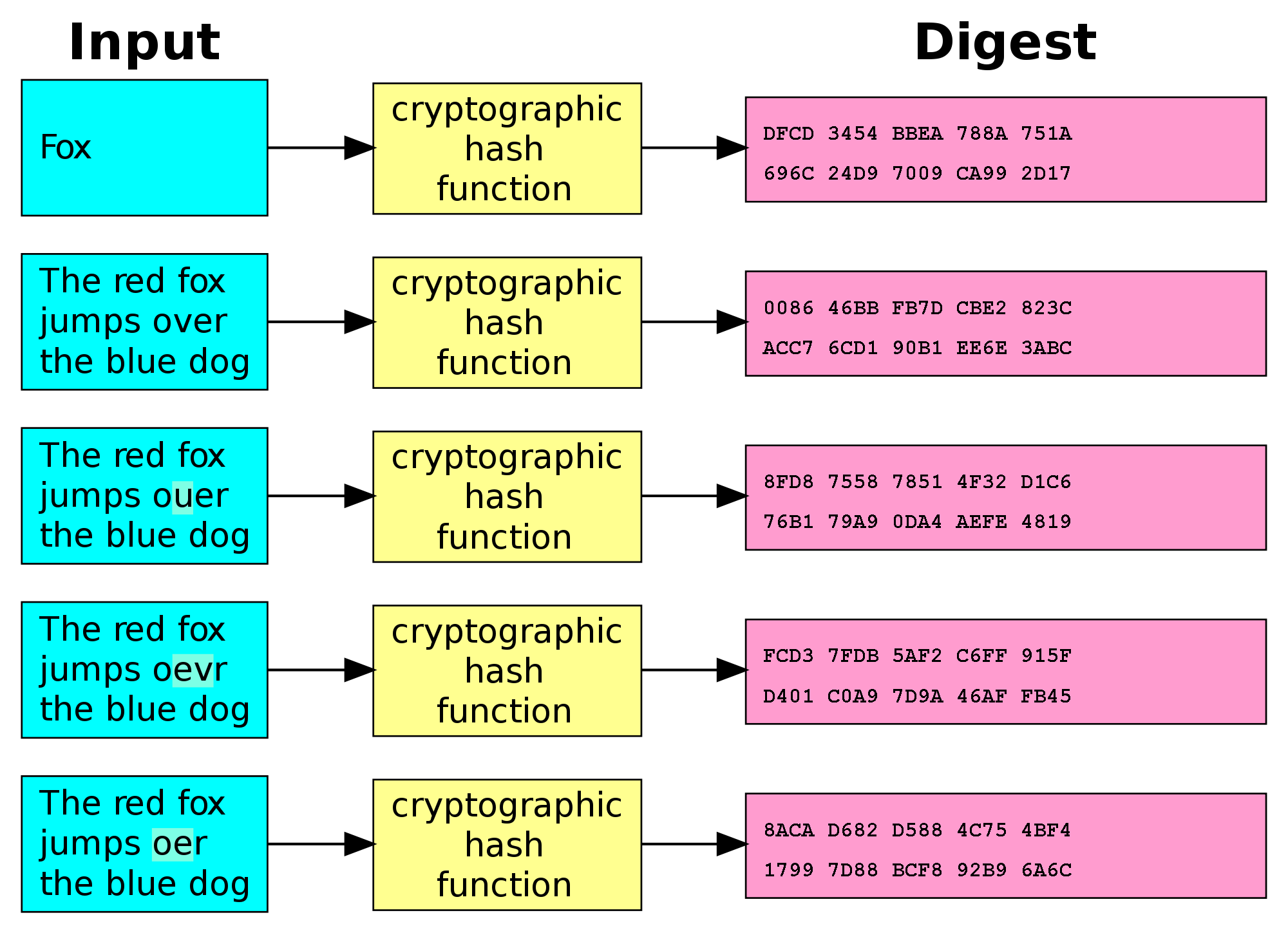
Most cryptographic hash functions are designed to take a string of any length as input and produce a fixed-length hash value.
A cryptographic hash function must be able to withstand all known types of cryptanalytic attack. In theoretical cryptography, the security level of a cryptographic hash function has been defined using the following properties:
Collision resistance implies second pre-image resistance but does not imply pre-image resistance. The weaker assumption is always preferred in theoretical cryptography, but in practice, a hash-function that is only second pre-image resistant is considered insecure and is therefore not recommended for real applications.
Informally, these properties mean that a malicious adversary cannot replace or modify the input data without changing its digest. Thus, if two strings have the same digest, one can be very confident that they are identical. Second pre-image resistance prevents an attacker from crafting a document with the same hash as a document the attacker cannot control. Collision resistance prevents an attacker from creating two distinct documents with the same hash.
A function meeting these criteria may still have undesirable properties. Currently, popular cryptographic hash functions are vulnerable to length-extension attacks: given hash(m) and len(m) but not m, by choosing a suitable m′ an attacker can calculate hash(m ∥ m′), where ∥ denotes concatenation. This property can be used to break naive authentication schemes based on hash functions. The HMAC construction works around these problems.
Hub AI
Cryptographic hash function AI simulator
(@Cryptographic hash function_simulator)
Cryptographic hash function
A cryptographic hash function (CHF) is a hash algorithm (a map of an arbitrary binary string to a binary string with a fixed size of bits) that has special properties desirable for a cryptographic application:
Cryptographic hash functions have many information-security applications, notably in digital signatures, message authentication codes (MACs), and other forms of authentication. They can also be used as ordinary hash functions, to index data in hash tables, for fingerprinting, to detect duplicate data or uniquely identify files, and as checksums to detect accidental data corruption. Indeed, in information-security contexts, cryptographic hash values are sometimes called (digital) fingerprints, checksums, (message) digests, or just hash values, even though all these terms stand for more general functions with rather different properties and purposes.
Non-cryptographic hash functions are used in hash tables and to detect accidental errors; their constructions frequently provide no resistance to a deliberate attack. For example, a denial-of-service attack on hash tables is possible if the collisions are easy to find, as in the case of linear cyclic redundancy check (CRC) functions.
Most cryptographic hash functions are designed to take a string of any length as input and produce a fixed-length hash value.
A cryptographic hash function must be able to withstand all known types of cryptanalytic attack. In theoretical cryptography, the security level of a cryptographic hash function has been defined using the following properties:
Collision resistance implies second pre-image resistance but does not imply pre-image resistance. The weaker assumption is always preferred in theoretical cryptography, but in practice, a hash-function that is only second pre-image resistant is considered insecure and is therefore not recommended for real applications.
Informally, these properties mean that a malicious adversary cannot replace or modify the input data without changing its digest. Thus, if two strings have the same digest, one can be very confident that they are identical. Second pre-image resistance prevents an attacker from crafting a document with the same hash as a document the attacker cannot control. Collision resistance prevents an attacker from creating two distinct documents with the same hash.
A function meeting these criteria may still have undesirable properties. Currently, popular cryptographic hash functions are vulnerable to length-extension attacks: given hash(m) and len(m) but not m, by choosing a suitable m′ an attacker can calculate hash(m ∥ m′), where ∥ denotes concatenation. This property can be used to break naive authentication schemes based on hash functions. The HMAC construction works around these problems.
Recent media