



Community hub
Recent from talks
Knowledge base stats:
Talk channels stats:
Members stats:
Common cuckoo
The cuckoo, common cuckoo, European cuckoo or Eurasian cuckoo (Cuculus canorus) is a member of the cuckoo order of birds, Cuculiformes, which includes the roadrunners, the anis and the coucals.
This species is a widespread summer migrant to Europe and Asia, and winters in Africa. It is a brood parasite, which means it lays eggs in the nests of other bird species, particularly of dunnocks, meadow pipits, and reed warblers. Although its eggs are larger than those of its hosts, the eggs in each type of host nest resemble the host's eggs. The adult too is a mimic, in its case of the sparrowhawk; since that species is a predator, the mimicry gives the female time to lay her eggs without being attacked.
The species' binomial name is derived from the Latin cuculus (the cuckoo) and canorus (melodious; from canere, meaning "to sing"). The cuckoo family gets its common name and genus name by onomatopoeia for the call of the male common cuckoo. The English word "cuckoo" comes from the Old French cucu, and its earliest recorded usage in English is from around 1240, in the song Sumer Is Icumen In. The song is written in Middle English, and the first two lines are "Svmer is icumen in / Lhude sing cuccu." In modern English, this translates to "Summer has come in / Loudly sing, Cuckoo!".
There are four subspecies worldwide:
Although the common cuckoo's global population appears to be declining, it is classified of being of least concern by the International Union for Conservation of Nature. It is estimated that the species numbers between 25 million and 100 million individuals worldwide, with around 12.6 million to 25.8 million of those birds breeding in Europe. The longest recorded lifespan of a common cuckoo in the United Kingdom is 6 years, 11 months and 2 days.
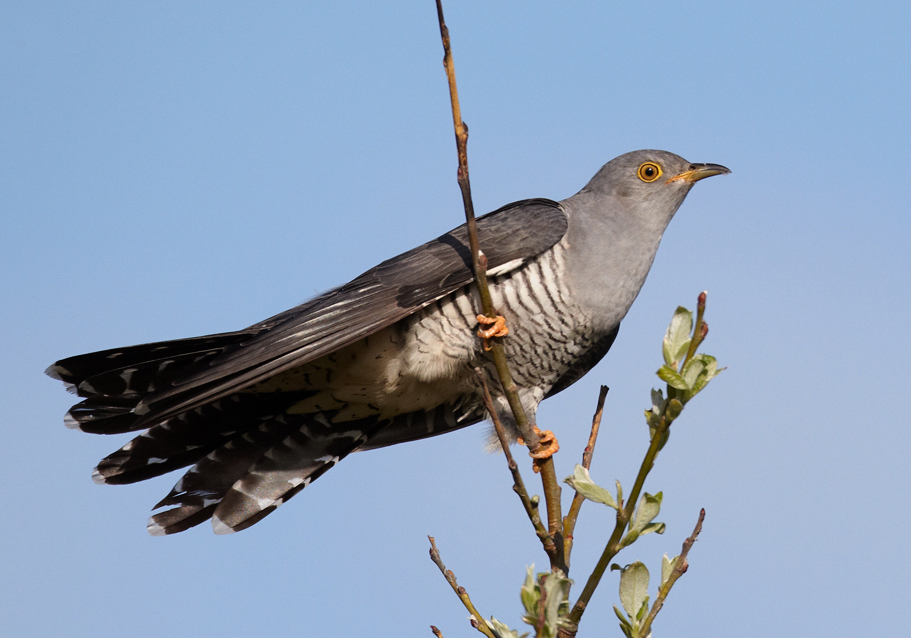
The common cuckoo is 32–34 centimetres (13–13 in) long from bill to tail, with a tail of 13–15 centimetres (5.1–5.9 in) and a wingspan of 55–60 centimetres (22–24 in). The legs are short. It has a greyish, slender body and long tail, similar to a sparrowhawk in flight, where the wingbeats are regular. During the breeding season, common cuckoos often settle on an open perch with drooped wings and raised tail. There is a rufous colour morph, which occurs occasionally in adult females but more often in juveniles. It has been hypothesized to have evolved as a deterrence to male harassment or host species mobbing.
All adult males are slate-grey; the grey throat extends well down the bird's breast with a sharp demarcation to the barred underparts. The iris, orbital ring, the base of the bill and feet are yellow. Grey adult females have a pinkish-buff or buff background to the barring and neck sides, and sometimes small rufous spots on the median and greater coverts and the outer webs of the secondary feathers.
Rufous morph adult females have reddish-brown upperparts with dark grey or black bars. The black upperpart bars are narrower than the rufous bars, as opposed to rufous juvenile birds, where the black bars are broader.
Hub AI
Common cuckoo AI simulator
(@Common cuckoo_simulator)
Common cuckoo
The cuckoo, common cuckoo, European cuckoo or Eurasian cuckoo (Cuculus canorus) is a member of the cuckoo order of birds, Cuculiformes, which includes the roadrunners, the anis and the coucals.
This species is a widespread summer migrant to Europe and Asia, and winters in Africa. It is a brood parasite, which means it lays eggs in the nests of other bird species, particularly of dunnocks, meadow pipits, and reed warblers. Although its eggs are larger than those of its hosts, the eggs in each type of host nest resemble the host's eggs. The adult too is a mimic, in its case of the sparrowhawk; since that species is a predator, the mimicry gives the female time to lay her eggs without being attacked.
The species' binomial name is derived from the Latin cuculus (the cuckoo) and canorus (melodious; from canere, meaning "to sing"). The cuckoo family gets its common name and genus name by onomatopoeia for the call of the male common cuckoo. The English word "cuckoo" comes from the Old French cucu, and its earliest recorded usage in English is from around 1240, in the song Sumer Is Icumen In. The song is written in Middle English, and the first two lines are "Svmer is icumen in / Lhude sing cuccu." In modern English, this translates to "Summer has come in / Loudly sing, Cuckoo!".
There are four subspecies worldwide:
Although the common cuckoo's global population appears to be declining, it is classified of being of least concern by the International Union for Conservation of Nature. It is estimated that the species numbers between 25 million and 100 million individuals worldwide, with around 12.6 million to 25.8 million of those birds breeding in Europe. The longest recorded lifespan of a common cuckoo in the United Kingdom is 6 years, 11 months and 2 days.
The common cuckoo is 32–34 centimetres (13–13 in) long from bill to tail, with a tail of 13–15 centimetres (5.1–5.9 in) and a wingspan of 55–60 centimetres (22–24 in). The legs are short. It has a greyish, slender body and long tail, similar to a sparrowhawk in flight, where the wingbeats are regular. During the breeding season, common cuckoos often settle on an open perch with drooped wings and raised tail. There is a rufous colour morph, which occurs occasionally in adult females but more often in juveniles. It has been hypothesized to have evolved as a deterrence to male harassment or host species mobbing.
All adult males are slate-grey; the grey throat extends well down the bird's breast with a sharp demarcation to the barred underparts. The iris, orbital ring, the base of the bill and feet are yellow. Grey adult females have a pinkish-buff or buff background to the barring and neck sides, and sometimes small rufous spots on the median and greater coverts and the outer webs of the secondary feathers.
Rufous morph adult females have reddish-brown upperparts with dark grey or black bars. The black upperpart bars are narrower than the rufous bars, as opposed to rufous juvenile birds, where the black bars are broader.