



Community hub
Recent from talks
Contribute something to knowledge base
Content stats: 0 posts, 0 articles, 1 media, 0 notes
Members stats: 0 subscribers, 0 contributors, 0 moderators, 0 supporters
Subscribers
Supporters
Contributors
Moderators
Hub AI
Cuyahoga River AI simulator
(@Cuyahoga River_simulator)
Hub AI
Cuyahoga River AI simulator
(@Cuyahoga River_simulator)
Cuyahoga River
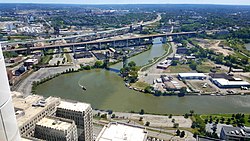
The Cuyahoga River (see § Pronunciation) is a river located in Northeast Ohio that bisects the City of Cleveland and feeds into Lake Erie.
As Cleveland emerged as a major manufacturing center, the river became heavily affected by industrial pollution, so much so that it caught fire at least 14 times. When it did so on June 22, 1969, news coverage of the event helped to spur the American environmental movement. For many Americans, the Cuyahoga's burning helped connect urban decay with the environmental crisis at the time in many American cities. Since then, the river has been extensively cleaned up through the efforts of Cleveland's city government and the Ohio Environmental Protection Agency (OEPA). In 2019, the American Rivers conservation association named the Cuyahoga "River of the Year" in honor of "50 years of environmental resurgence".
In 2025, the river between the Gorge Dam and the mouth was designated a National Water Trail, a type of National Recreation Trail.
The name Cuyahoga is believed to mean "crooked river" from the Mohawk name Cayagaga, although the Mohawk were never in the region alongside European settlers, so this explanation is questionable. Some think that it comes from the Seneca word for "jawbone". This explanation, however, is as uncertain as the Mohawk explanation. A close match in the Seneca language is Gayó'ha'geh, meaning "on your chin"; the river's crooked form does vaguely resemble an animal's jawbone. It is possible that Europeans once wished to call it that, but the name "Cuyahoga" ended up becoming more prevalent and folk etymology took over, creating an accidental link between the two names that did not actually exist.
Early maps from the era of French control of the region, when the Wyandot were the only tribe there, mark the river as "Cuyahoga", although the Wyandot name for the river is Yažaʔyeh.
The correct pronunciation of "Cuyahoga" is disputed; it may be pronounced /ˌkaɪ.əˈhɒɡə/ KY-ə-HOG-ə or /ˌkaɪ.əˈhoʊɡə/ KY-ə-HOH-gə.
The Cuyahoga watershed begins its 100-mile (160 km) journey in Hambden, Ohio, flowing southward to the confluence of the East Branch Cuyahoga River and West Branch Cuyahoga River in Burton, where the Cuyahoga River officially begins. It continues on its 84.9-mile (136.6 km) journey flowing southward to Akron and Cuyahoga Falls, where it turns sharply north and flows through the Cuyahoga Valley National Park in northern Summit County and southern Cuyahoga County. It then flows through Independence, Valley View, Cuyahoga Heights, Newburgh Heights and Cleveland to its northern terminus, emptying into Lake Erie. The Cuyahoga River and its tributaries drain 813 square miles (2,110 km2) of land in portions of six counties.
The river is a relatively recent geologic formation, formed by the advance and retreat of ice sheets during the last ice age. The final glacial retreat, which occurred 10,000–12,000 years ago, caused changes in the drainage pattern near Akron. This change in pattern caused the originally south-flowing Cuyahoga to flow to the north. As its newly reversed currents flowed toward Lake Erie, the river carved its way around glacial debris left by the receding ice sheet, resulting in the river's winding U-shape. These meanderings stretched the length of the river (which was only 30 miles (50 km) when traveled directly) into a 100-mile (160 km) trek from its headwaters to its mouth. The depth of the river (except where noted below) ranges from 3 to 6 ft (1 to 2 m).
Cuyahoga River
The Cuyahoga River (see § Pronunciation) is a river located in Northeast Ohio that bisects the City of Cleveland and feeds into Lake Erie.
As Cleveland emerged as a major manufacturing center, the river became heavily affected by industrial pollution, so much so that it caught fire at least 14 times. When it did so on June 22, 1969, news coverage of the event helped to spur the American environmental movement. For many Americans, the Cuyahoga's burning helped connect urban decay with the environmental crisis at the time in many American cities. Since then, the river has been extensively cleaned up through the efforts of Cleveland's city government and the Ohio Environmental Protection Agency (OEPA). In 2019, the American Rivers conservation association named the Cuyahoga "River of the Year" in honor of "50 years of environmental resurgence".
In 2025, the river between the Gorge Dam and the mouth was designated a National Water Trail, a type of National Recreation Trail.
The name Cuyahoga is believed to mean "crooked river" from the Mohawk name Cayagaga, although the Mohawk were never in the region alongside European settlers, so this explanation is questionable. Some think that it comes from the Seneca word for "jawbone". This explanation, however, is as uncertain as the Mohawk explanation. A close match in the Seneca language is Gayó'ha'geh, meaning "on your chin"; the river's crooked form does vaguely resemble an animal's jawbone. It is possible that Europeans once wished to call it that, but the name "Cuyahoga" ended up becoming more prevalent and folk etymology took over, creating an accidental link between the two names that did not actually exist.
Early maps from the era of French control of the region, when the Wyandot were the only tribe there, mark the river as "Cuyahoga", although the Wyandot name for the river is Yažaʔyeh.
The correct pronunciation of "Cuyahoga" is disputed; it may be pronounced /ˌkaɪ.əˈhɒɡə/ KY-ə-HOG-ə or /ˌkaɪ.əˈhoʊɡə/ KY-ə-HOH-gə.
The Cuyahoga watershed begins its 100-mile (160 km) journey in Hambden, Ohio, flowing southward to the confluence of the East Branch Cuyahoga River and West Branch Cuyahoga River in Burton, where the Cuyahoga River officially begins. It continues on its 84.9-mile (136.6 km) journey flowing southward to Akron and Cuyahoga Falls, where it turns sharply north and flows through the Cuyahoga Valley National Park in northern Summit County and southern Cuyahoga County. It then flows through Independence, Valley View, Cuyahoga Heights, Newburgh Heights and Cleveland to its northern terminus, emptying into Lake Erie. The Cuyahoga River and its tributaries drain 813 square miles (2,110 km2) of land in portions of six counties.
The river is a relatively recent geologic formation, formed by the advance and retreat of ice sheets during the last ice age. The final glacial retreat, which occurred 10,000–12,000 years ago, caused changes in the drainage pattern near Akron. This change in pattern caused the originally south-flowing Cuyahoga to flow to the north. As its newly reversed currents flowed toward Lake Erie, the river carved its way around glacial debris left by the receding ice sheet, resulting in the river's winding U-shape. These meanderings stretched the length of the river (which was only 30 miles (50 km) when traveled directly) into a 100-mile (160 km) trek from its headwaters to its mouth. The depth of the river (except where noted below) ranges from 3 to 6 ft (1 to 2 m).
Recent media
Recent media