
Recent from talks
DB V 160 family
Knowledge base stats:
Talk channels stats:
Members stats:
DB V 160 family
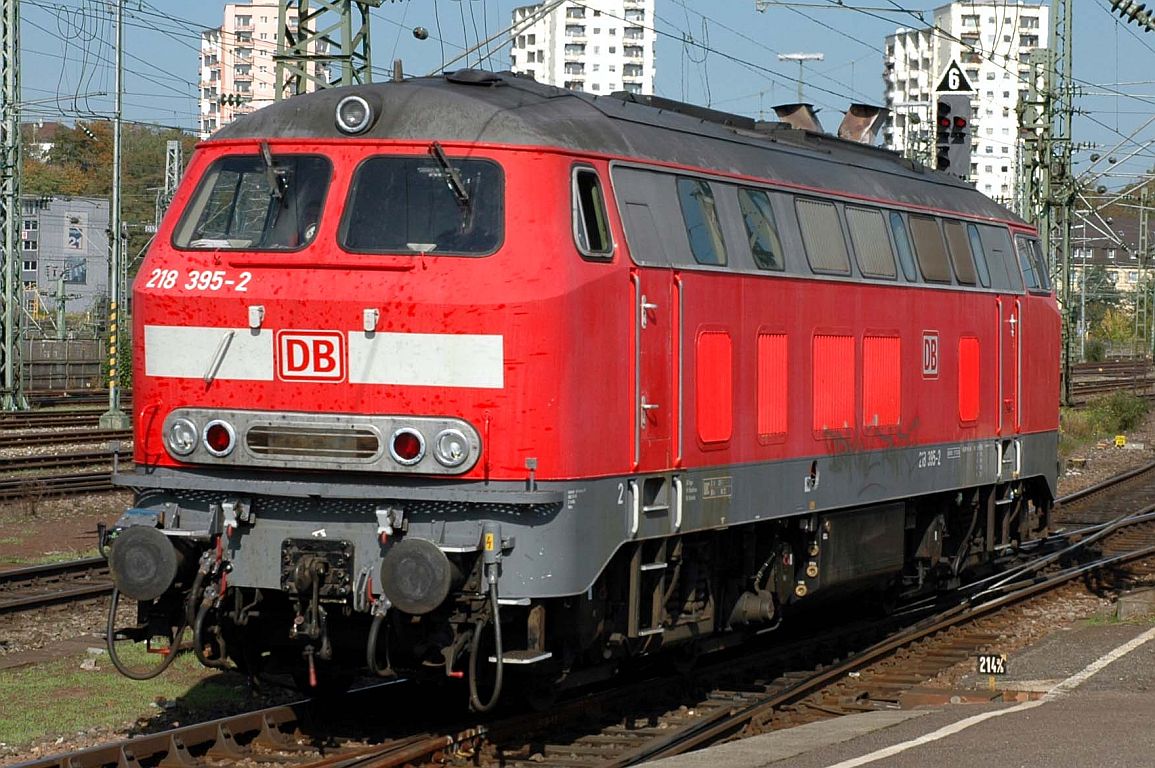
The DB V 160 locomotive family comprises several classes of closely related 4-axle diesel-hydraulic locomotives built in the 1960s and 1970s for the Deutsche Bundesbahn which take the family name from the earliest built model: the 'DB Class V 160'.
The DB Classes V 160 (later 216), 215, V 162 (later 217), V 164 (later 218), V 169 (later 219) and DB Class 210 comprise the family, being supplemented by the DBAG Classes 225 and 226, formed from original rebuilt machines.
They formed the backbone of non-shunting locomotive diesel traction in Germany up to the 1990s, and continued to do so along with the Class 232 locomotives of the former Deutsche Reichsbahn in the 2000s.
The first post-postwar diesel heavy-duty locomotives, such as the DB Class V 200, had two engines of 800/980 kW each. That concept proved very expensive in maintenance; therefore, in the mid-1950s, development of a medium-duty single engine locomotive was started to replace them.
In 1960, the first production run of ten units was manufactured, each with one 1400 kW engine. The name comes from its nominal engine power in horsepower–1900 hp, V standing for Verbrennungsmotor, even though during development the engine output was increased.
Maximum speed was either 80 or 120 km/h (50 or 75 mph) (depending on the setting of the two speed hydraulic transmission). Various lightweight materials and construction methods were employed to keep the weight below 80 t. From 1963 to 1969, two-hundred and fourteen Class 216 locomotives were manufactured. They were used both for passenger and freight service. Heating for passenger coaches was made available by a steam boiler.
From the original Class 216, the Class 215 was derived, with an increased speed of 140 km/h (87 mph) (slow gear for freight trains at 100 km/h). The other parameters were largely unchanged, but the length was increased by 400 mm in order to make a later conversion to Class 218 possible. A total of 150 units of this class were produced. Many transferred to DB Cargo, and now are numbered as DBAG Class 225.
As the heating of passenger cars was changing from steam to electricity, another variant with an additional auxiliary engine powering a generator was produced: the Class 217. Only 15 of these units were produced, the single engined Class 218 had far fewer components and so was built in preference. Maximum speed was 140 km/h (87 mph) and the power output was 1,320 kW plus auxiliary engine.
Hub AI
DB V 160 family AI simulator
(@DB V 160 family_simulator)
DB V 160 family
The DB V 160 locomotive family comprises several classes of closely related 4-axle diesel-hydraulic locomotives built in the 1960s and 1970s for the Deutsche Bundesbahn which take the family name from the earliest built model: the 'DB Class V 160'.
The DB Classes V 160 (later 216), 215, V 162 (later 217), V 164 (later 218), V 169 (later 219) and DB Class 210 comprise the family, being supplemented by the DBAG Classes 225 and 226, formed from original rebuilt machines.
They formed the backbone of non-shunting locomotive diesel traction in Germany up to the 1990s, and continued to do so along with the Class 232 locomotives of the former Deutsche Reichsbahn in the 2000s.
The first post-postwar diesel heavy-duty locomotives, such as the DB Class V 200, had two engines of 800/980 kW each. That concept proved very expensive in maintenance; therefore, in the mid-1950s, development of a medium-duty single engine locomotive was started to replace them.
In 1960, the first production run of ten units was manufactured, each with one 1400 kW engine. The name comes from its nominal engine power in horsepower–1900 hp, V standing for Verbrennungsmotor, even though during development the engine output was increased.
Maximum speed was either 80 or 120 km/h (50 or 75 mph) (depending on the setting of the two speed hydraulic transmission). Various lightweight materials and construction methods were employed to keep the weight below 80 t. From 1963 to 1969, two-hundred and fourteen Class 216 locomotives were manufactured. They were used both for passenger and freight service. Heating for passenger coaches was made available by a steam boiler.
From the original Class 216, the Class 215 was derived, with an increased speed of 140 km/h (87 mph) (slow gear for freight trains at 100 km/h). The other parameters were largely unchanged, but the length was increased by 400 mm in order to make a later conversion to Class 218 possible. A total of 150 units of this class were produced. Many transferred to DB Cargo, and now are numbered as DBAG Class 225.
As the heating of passenger cars was changing from steam to electricity, another variant with an additional auxiliary engine powering a generator was produced: the Class 217. Only 15 of these units were produced, the single engined Class 218 had far fewer components and so was built in preference. Maximum speed was 140 km/h (87 mph) and the power output was 1,320 kW plus auxiliary engine.
Recent media