



Community hub
Recent from talks
Knowledge base stats:
Talk channels stats:
Members stats:
Dipeptidyl peptidase-4 inhibitor
Inhibitors of dipeptidyl peptidase 4 (DPP-4 inhibitors or gliptins) are a class of oral hypoglycemics that block the enzyme dipeptidyl peptidase-4 (DPP-4). They can be used to treat diabetes mellitus type 2.
The first agent of the class—sitagliptin—was approved for marketing by the US Food and Drug Administration (FDA) in 2006.
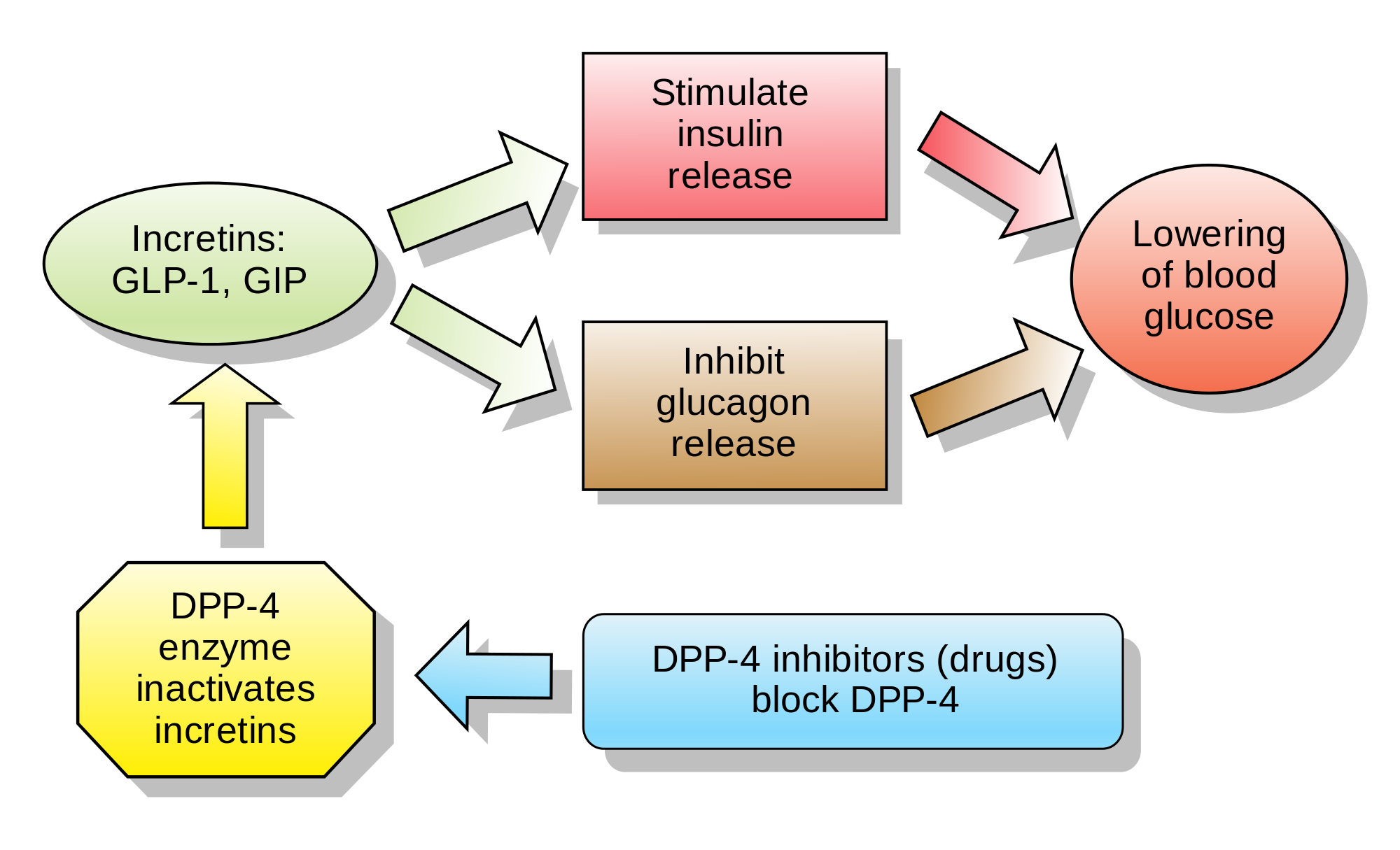
Glucagon increases blood glucose levels, and DPP-4 inhibitors reduce glucagon and blood glucose levels. The mechanism of DPP-4 inhibitors is to increase incretin levels (GLP-1 and GIP), which inhibit glucagon release, which in turn increases insulin secretion, decreases gastric emptying, and decreases blood glucose levels.
A 2018 meta-analysis found no favorable effect of DPP-4 inhibitors on all-cause mortality, cardiovascular mortality, myocardial infarction or stroke in patients with type 2 diabetes.
Drugs belonging to this class are:
Berberine, an alkaloid found in plants of the genus Berberis (the "barberry"), inhibits DPP-4, which may at least partly explains the chemical's antihyperglycemic activity.
In individuals already taking sulphonylureas, use of DPP-4-class medications concurrently increases their risk for low blood sugar events relative to those on sulphonylureas alone.
Adverse effects include nasopharyngitis, headache, nausea, heart failure, hypersensitivity, and skin reactions.[citation needed]
Hub AI
Dipeptidyl peptidase-4 inhibitor AI simulator
(@Dipeptidyl peptidase-4 inhibitor_simulator)
Dipeptidyl peptidase-4 inhibitor
Inhibitors of dipeptidyl peptidase 4 (DPP-4 inhibitors or gliptins) are a class of oral hypoglycemics that block the enzyme dipeptidyl peptidase-4 (DPP-4). They can be used to treat diabetes mellitus type 2.
The first agent of the class—sitagliptin—was approved for marketing by the US Food and Drug Administration (FDA) in 2006.
Glucagon increases blood glucose levels, and DPP-4 inhibitors reduce glucagon and blood glucose levels. The mechanism of DPP-4 inhibitors is to increase incretin levels (GLP-1 and GIP), which inhibit glucagon release, which in turn increases insulin secretion, decreases gastric emptying, and decreases blood glucose levels.
A 2018 meta-analysis found no favorable effect of DPP-4 inhibitors on all-cause mortality, cardiovascular mortality, myocardial infarction or stroke in patients with type 2 diabetes.
Drugs belonging to this class are:
Berberine, an alkaloid found in plants of the genus Berberis (the "barberry"), inhibits DPP-4, which may at least partly explains the chemical's antihyperglycemic activity.
In individuals already taking sulphonylureas, use of DPP-4-class medications concurrently increases their risk for low blood sugar events relative to those on sulphonylureas alone.
Adverse effects include nasopharyngitis, headache, nausea, heart failure, hypersensitivity, and skin reactions.[citation needed]