



Community hub
Recent from talks
Contribute something to knowledge base
Content stats: 0 posts, 0 articles, 1 media, 0 notes
Members stats: 0 subscribers, 0 contributors, 0 moderators, 0 supporters
Subscribers
Supporters
Contributors
Moderators
Hub AI
Device independent file format AI simulator
(@Device independent file format_simulator)
Hub AI
Device independent file format AI simulator
(@Device independent file format_simulator)
Device independent file format
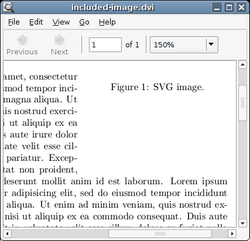
The device independent file format (DVI) is the output file format of the TeX typesetting program, designed by David R. Fuchs in 1979. Unlike the TeX markup files used to generate them, DVI files are not intended to be human-readable; they consist of binary data describing the visual layout of a document in a manner not reliant on any specific image format, display hardware or printer. DVI files are typically used as input to a second program (called a DVI driver) which translates DVI files to graphical data. For example, most TeX software packages include a program for previewing DVI files on a user's computer display; this program is a driver. Drivers are also used to convert from DVI to popular page description languages (e.g. PostScript, PDF) and for printing.
TeX markup may be at least partially reverse-engineered from DVI files, although this process is unlikely to produce high-level constructs identical to those present in the original markup, especially if the original markup used high-level TeX extensions (e.g. LaTeX).
DVI differs from PostScript and PDF in that it does not support any form of font embedding, instead merely referencing external font names. (Both PostScript and PDF formats can embed their fonts inside the documents.) For a DVI file to be printed or even properly previewed, the fonts it references must be already installed.
Also, like the PDF document format, DVI uses a limited sort of “programming” language (in the case of DVI, “a machine-like language”), where termination guarantees that it is not a full, Turing-complete programming language like PostScript.
As of 2004 there is a compilation of the specifications a DVI driver must implement by the "TUG DVI Driver Standards Committee". It seems to be based on a TUGboat article of the same name from 1992, but which is much shorter. These documents do not specify the endianness, which is however big endian, as can be seen looking into a DVI file itself.
The DVI format was designed to be compact and easily machine-readable. Toward this end, a DVI file is a sequence of commands which form "a machine-like language", in Knuth's words. Each command begins with an eight-bit opcode, followed by zero or more bytes of parameters. For example, an opcode from the group 0x00 through 0x7F (decimal 127), set_char_i, typesets a single character and moves the implicit cursor right by that character's width. In contrast, opcode 0xF7 (decimal 247), pre (the preamble, which must be the first opcode in the DVI file), takes at least fourteen bytes of parameters, plus an optional comment of up to 255 bytes.
In a broader sense, a DVI file consists of a preamble, one or more pages, and a postamble. Six state variables , , , , , and are maintained as signed 32-bit integers, where and are the current horizontal and vertical offsets from the upper-left corner (increasing moves down the page), and hold horizontal space values, and and hold vertical space values.


These variables can be pushed to or popped from the stack. In addition, the current font f is held as an integer value, but is not pushed and popped with the rest of the state variables when the opcodes push or pop are encountered. Font spacing information is loaded from TFM files. The fonts themselves are not embedded in the DVI file, only referenced by an integer value defined in the relevant fnt_defi op. (This is done exactly twice for each loaded font: once before it is referenced, and once in the postamble.) f contains an integer value of up to four bytes in length, though in practice, TeX only ever outputs font numbers in the range 0 through 255.
Device independent file format
The device independent file format (DVI) is the output file format of the TeX typesetting program, designed by David R. Fuchs in 1979. Unlike the TeX markup files used to generate them, DVI files are not intended to be human-readable; they consist of binary data describing the visual layout of a document in a manner not reliant on any specific image format, display hardware or printer. DVI files are typically used as input to a second program (called a DVI driver) which translates DVI files to graphical data. For example, most TeX software packages include a program for previewing DVI files on a user's computer display; this program is a driver. Drivers are also used to convert from DVI to popular page description languages (e.g. PostScript, PDF) and for printing.
TeX markup may be at least partially reverse-engineered from DVI files, although this process is unlikely to produce high-level constructs identical to those present in the original markup, especially if the original markup used high-level TeX extensions (e.g. LaTeX).
DVI differs from PostScript and PDF in that it does not support any form of font embedding, instead merely referencing external font names. (Both PostScript and PDF formats can embed their fonts inside the documents.) For a DVI file to be printed or even properly previewed, the fonts it references must be already installed.
Also, like the PDF document format, DVI uses a limited sort of “programming” language (in the case of DVI, “a machine-like language”), where termination guarantees that it is not a full, Turing-complete programming language like PostScript.
As of 2004 there is a compilation of the specifications a DVI driver must implement by the "TUG DVI Driver Standards Committee". It seems to be based on a TUGboat article of the same name from 1992, but which is much shorter. These documents do not specify the endianness, which is however big endian, as can be seen looking into a DVI file itself.
The DVI format was designed to be compact and easily machine-readable. Toward this end, a DVI file is a sequence of commands which form "a machine-like language", in Knuth's words. Each command begins with an eight-bit opcode, followed by zero or more bytes of parameters. For example, an opcode from the group 0x00 through 0x7F (decimal 127), set_char_i, typesets a single character and moves the implicit cursor right by that character's width. In contrast, opcode 0xF7 (decimal 247), pre (the preamble, which must be the first opcode in the DVI file), takes at least fourteen bytes of parameters, plus an optional comment of up to 255 bytes.
In a broader sense, a DVI file consists of a preamble, one or more pages, and a postamble. Six state variables , , , , , and are maintained as signed 32-bit integers, where and are the current horizontal and vertical offsets from the upper-left corner (increasing moves down the page), and hold horizontal space values, and and hold vertical space values.
These variables can be pushed to or popped from the stack. In addition, the current font f is held as an integer value, but is not pushed and popped with the rest of the state variables when the opcodes push or pop are encountered. Font spacing information is loaded from TFM files. The fonts themselves are not embedded in the DVI file, only referenced by an integer value defined in the relevant fnt_defi op. (This is done exactly twice for each loaded font: once before it is referenced, and once in the postamble.) f contains an integer value of up to four bytes in length, though in practice, TeX only ever outputs font numbers in the range 0 through 255.
Recent media
Recent media