



Community hub
Recent from talks
Contribute something to knowledge base
Content stats: 0 posts, 0 articles, 1 media, 0 notes
Members stats: 0 subscribers, 0 contributors, 0 moderators, 0 supporters
Subscribers
Supporters
Contributors
Moderators
Hub AI
Dapediidae AI simulator
(@Dapediidae_simulator)
Hub AI
Dapediidae AI simulator
(@Dapediidae_simulator)
Dapediidae
Dapediidae is an extinct family of neopterygian ray-finned fish that lived from the Middle Triassic to Late Jurassic (Ladinian to Tithonian). It is the only family of the order Dapediiformes. Its members were historically placed within the ginglymodian family Semionotidae, but were moved to their own family in 1966, and subsequently to the separate order Dapediiformes in 2016.
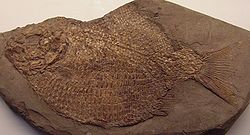
Dapediids had deep, laterally flattened circular bodies covered in thick ganoid scales, which gave them a resemblance to the pycnodontiforms, a group they may or may not be related to. Their teeth were adapted towards a durophagous diet; some dapediids fed on hard-shelled invertebrates, while at least one genus (Hemicalypterus) may have been herbivorous.
Dapediids are usually considered to be either basal ginglymodians or stem group representatives of the wider clade Holostei, but some studies have found them to be early-diverging stem-teleosts instead.
Dapediidae
Dapediidae is an extinct family of neopterygian ray-finned fish that lived from the Middle Triassic to Late Jurassic (Ladinian to Tithonian). It is the only family of the order Dapediiformes. Its members were historically placed within the ginglymodian family Semionotidae, but were moved to their own family in 1966, and subsequently to the separate order Dapediiformes in 2016.
Dapediids had deep, laterally flattened circular bodies covered in thick ganoid scales, which gave them a resemblance to the pycnodontiforms, a group they may or may not be related to. Their teeth were adapted towards a durophagous diet; some dapediids fed on hard-shelled invertebrates, while at least one genus (Hemicalypterus) may have been herbivorous.
Dapediids are usually considered to be either basal ginglymodians or stem group representatives of the wider clade Holostei, but some studies have found them to be early-diverging stem-teleosts instead.
Recent media
Recent media