



Community hub
Recent from talks
Contribute something to knowledge base
Content stats: 0 posts, 0 articles, 1 media, 0 notes
Members stats: 0 subscribers, 0 contributors, 0 moderators, 0 supporters
Subscribers
Supporters
Contributors
Moderators
Hub AI
Whiptail stingray AI simulator
(@Whiptail stingray_simulator)
Hub AI
Whiptail stingray AI simulator
(@Whiptail stingray_simulator)
Whiptail stingray
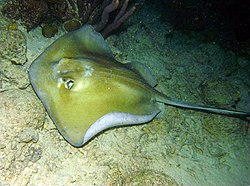
The whiptail stingrays are a family, the Dasyatidae, of rays in the order Myliobatiformes. They are found worldwide in tropical to temperate marine waters, and a number of species have also penetrated into fresh water in Africa, Asia, and Australia. Members of this family have flattened pectoral fin discs that range from oval to diamond-like in shape. Their common name comes from their whip-like tails, which are much longer than the disc and lack dorsal and caudal fins. All whiptail stingrays, except the porcupine ray (Urogymnus asperrimus), have one or more venomous stings near the base of the tail, which is used in defense. In order to sting their victims, they jerk their tails as the stinger falls off and stays in the wound that they have created. The stinger of a whiptail stingray is pointy, sharp with jagged edges. During mating season, males often hold onto females by using teeth which curve towards the corners of their mouths. They range in size from 0.18 to 2.0 m (0.59 to 6.56 ft) or more across in the case of the smalleye stingray and giant freshwater stingray. Species, being highly electroreceptive, can detect weak electric fields from prey. Electroreception is a product of electroreceptors dispersed across the skin. This network of pores is part of organs known as the ampullae of Lorenzini.
The taxonomy of Dasyatidae was revised by Peter Last, Gavin Naylor, and Mabel Manjaji-Matsumoto in 2016, based on morphological and molecular phylogenetic data. The placement of Megatrygon within the family is provisional pending further research, as evidence suggests it may be more closely related to the families Potamotrygonidae and Urotrygonidae than to other dasyatids.
Whiptail rays are commonly found in shallow tropical water, but they may also be found in temperate regions. Having flat bodies, they are demersal, meaning they live at the bottom of a body of water. These rays specifically live sometimes buried in sand or mud or even near coral reefs on continental shelves, or the shelf created when part of a continent is under water. Whiptail rays typically inhabit shallow coastlines of 100 to 200 meters down, but some go as far as 600 meters. To avoid being preyed upon, these rays usually stay buried with just their eyes protruding. These rays are preyed on by multiple shark species, specifically hammerhead sharks.
Some species of whiptail rays live in mangrove swamps, while others reside in the open ocean. Not all species of Whiptail rays live in salt water, however. The subfamily Potamotrygoninae lives solely in freshwater, often buried in sand or mud in backwaters or shallow rivers. This specific species only resides in West Africa and the Atlantic drainages of South America.
The diet of Whiptail rays generally includes mollusks, crustaceans, jellyfish, and bony fish. They extract food by digging in the sand. In areas such as Stingray City in Grand Cayman and Hamelyn Bay in Western Australia, some rays accept scraps from tourists. Rays may also gather at fisherman's fish cleaning stations. Their electroreceptive abilities allow the rays to detect weak electric fields from prey. This ability allows rays to identify the relative area of prey from a distance.
Species' flesh may be used for human consumption in areas like South-West Asia where it's salted and dried. Skin may also be used for leather products like wallets and shoes. Species may be found in aquarium exhibits or used for ecotourism.
Many whiptail ray species face decreasing populations, with a large number marked from threatened to endangered. The Smalltooth Stingray, Starrynose Cowtail Ray, Pakistan Whipray, Shorttail Whipray, Smooth Stingray, Colares Stingray, Wingfin Stingray, and Thorny Whipray are marked as critically endangered. Threats to stingrays include bycatch as product of overfishing, water contamination, loss of habitat, tourism, and climate change causing increased water temperatures. Note that some of these species listed below may be repeats under alternative names.
Whiptail stingray
The whiptail stingrays are a family, the Dasyatidae, of rays in the order Myliobatiformes. They are found worldwide in tropical to temperate marine waters, and a number of species have also penetrated into fresh water in Africa, Asia, and Australia. Members of this family have flattened pectoral fin discs that range from oval to diamond-like in shape. Their common name comes from their whip-like tails, which are much longer than the disc and lack dorsal and caudal fins. All whiptail stingrays, except the porcupine ray (Urogymnus asperrimus), have one or more venomous stings near the base of the tail, which is used in defense. In order to sting their victims, they jerk their tails as the stinger falls off and stays in the wound that they have created. The stinger of a whiptail stingray is pointy, sharp with jagged edges. During mating season, males often hold onto females by using teeth which curve towards the corners of their mouths. They range in size from 0.18 to 2.0 m (0.59 to 6.56 ft) or more across in the case of the smalleye stingray and giant freshwater stingray. Species, being highly electroreceptive, can detect weak electric fields from prey. Electroreception is a product of electroreceptors dispersed across the skin. This network of pores is part of organs known as the ampullae of Lorenzini.
The taxonomy of Dasyatidae was revised by Peter Last, Gavin Naylor, and Mabel Manjaji-Matsumoto in 2016, based on morphological and molecular phylogenetic data. The placement of Megatrygon within the family is provisional pending further research, as evidence suggests it may be more closely related to the families Potamotrygonidae and Urotrygonidae than to other dasyatids.
Whiptail rays are commonly found in shallow tropical water, but they may also be found in temperate regions. Having flat bodies, they are demersal, meaning they live at the bottom of a body of water. These rays specifically live sometimes buried in sand or mud or even near coral reefs on continental shelves, or the shelf created when part of a continent is under water. Whiptail rays typically inhabit shallow coastlines of 100 to 200 meters down, but some go as far as 600 meters. To avoid being preyed upon, these rays usually stay buried with just their eyes protruding. These rays are preyed on by multiple shark species, specifically hammerhead sharks.
Some species of whiptail rays live in mangrove swamps, while others reside in the open ocean. Not all species of Whiptail rays live in salt water, however. The subfamily Potamotrygoninae lives solely in freshwater, often buried in sand or mud in backwaters or shallow rivers. This specific species only resides in West Africa and the Atlantic drainages of South America.
The diet of Whiptail rays generally includes mollusks, crustaceans, jellyfish, and bony fish. They extract food by digging in the sand. In areas such as Stingray City in Grand Cayman and Hamelyn Bay in Western Australia, some rays accept scraps from tourists. Rays may also gather at fisherman's fish cleaning stations. Their electroreceptive abilities allow the rays to detect weak electric fields from prey. This ability allows rays to identify the relative area of prey from a distance.
Species' flesh may be used for human consumption in areas like South-West Asia where it's salted and dried. Skin may also be used for leather products like wallets and shoes. Species may be found in aquarium exhibits or used for ecotourism.
Many whiptail ray species face decreasing populations, with a large number marked from threatened to endangered. The Smalltooth Stingray, Starrynose Cowtail Ray, Pakistan Whipray, Shorttail Whipray, Smooth Stingray, Colares Stingray, Wingfin Stingray, and Thorny Whipray are marked as critically endangered. Threats to stingrays include bycatch as product of overfishing, water contamination, loss of habitat, tourism, and climate change causing increased water temperatures. Note that some of these species listed below may be repeats under alternative names.
Recent media
Recent media