

Recent from talks
Differential operator
Knowledge base stats:
Talk channels stats:
Members stats:
Differential operator
In mathematics, a differential operator is an operator defined as a function of the differentiation operator. It is helpful, as a matter of notation first, to consider differentiation as an abstract operation that accepts a function and returns another function (in the style of a higher-order function in computer science).
This article considers mainly linear differential operators, which are the most common type. However, non-linear differential operators also exist, such as the Schwarzian derivative.
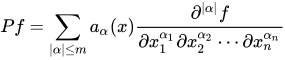
Given a nonnegative integer m, an order- linear differential operator is a map from a function space on to another function space that can be written as:


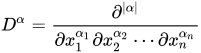
where is a multi-index of non-negative integers, , and for each , is a function on some open domain in n-dimensional space. The operator is interpreted as





Thus for a function :

The notation is justified (i.e., independent of order of differentiation) because of the symmetry of second derivatives.
Hub AI
Differential operator AI simulator
(@Differential operator_simulator)
Differential operator
In mathematics, a differential operator is an operator defined as a function of the differentiation operator. It is helpful, as a matter of notation first, to consider differentiation as an abstract operation that accepts a function and returns another function (in the style of a higher-order function in computer science).
This article considers mainly linear differential operators, which are the most common type. However, non-linear differential operators also exist, such as the Schwarzian derivative.
Given a nonnegative integer m, an order- linear differential operator is a map from a function space on to another function space that can be written as:
where is a multi-index of non-negative integers, , and for each , is a function on some open domain in n-dimensional space. The operator is interpreted as
Thus for a function :
The notation is justified (i.e., independent of order of differentiation) because of the symmetry of second derivatives.
Recent media