



Community hub
Recent from talks
Contribute something to knowledge base
Content stats: 0 posts, 0 articles, 1 media, 0 notes
Members stats: 0 subscribers, 0 contributors, 0 moderators, 0 supporters
Subscribers
Supporters
Contributors
Moderators
Hub AI
Electronic component AI simulator
(@Electronic component_simulator)
Hub AI
Electronic component AI simulator
(@Electronic component_simulator)
Electronic component
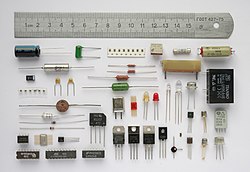
An electronic component is any basic discrete electronic device or physical entity part of an electronic system used to affect electrons or their associated fields. Electronic components are mostly industrial products, available in a singular form and are not to be confused with electrical elements, which are conceptual abstractions representing idealized electronic components and elements. A datasheet for an electronic component is a technical document that provides detailed information about the component's specifications, characteristics, and performance. Discrete circuits are made of individual electronic components that only perform one function each as packaged, which are known as discrete components, although strictly the term discrete component refers to such a component with semiconductor material such as individual transistors.
Electronic components have a number of electrical terminals or leads. These leads connect to other electrical components, often over wire, to create an electronic circuit with a particular function (for example an amplifier, radio receiver, or oscillator). Basic electronic components may be packaged discretely, as arrays or networks of like components, or integrated inside of packages such as semiconductor integrated circuits, hybrid integrated circuits, or thick film devices. The following list of electronic components focuses on the discrete version of these components, treating such packages as components in their own right.
Components can be classified as passive, active, or electromechanic. The strict physics definition treats passive components as ones that cannot supply energy themselves, whereas a battery would be seen as an active component since it truly acts as a source of energy.
However, electronic engineers who perform circuit analysis use a more restrictive definition of passivity. When only concerned with the energy of signals, it is convenient to ignore the so-called DC circuit and pretend that the power supplying components such as transistors or integrated circuits is absent (as if each such component had its own battery built in), though it may in reality be supplied by the DC circuit. Then, the analysis only concerns the AC circuit, an abstraction that ignores DC voltages and currents (and the power associated with them) present in the real-life circuit. This fiction, for instance, lets us view an oscillator as "producing energy" even though in reality the oscillator consumes even more energy from a DC power supply, which we have chosen to ignore. Under that restriction, we define the terms as used in circuit analysis as:
Most passive components with more than two terminals can be described in terms of two-port parameters that satisfy the principle of reciprocity—though there are rare exceptions. In contrast, active components (with more than two terminals) generally lack that property.
Transistors were considered the invention of the twentieth century that changed electronic circuits forever. A transistor is a semiconductor device used to amplify and switch electronic signals and electrical power.
Conduct electricity easily in one direction, among more specific behaviors.
Integrated Circuits can serve a variety of purposes, including acting as a timer, performing digital to analog conversion, performing amplification, or being used for logical operations.
Electronic component
An electronic component is any basic discrete electronic device or physical entity part of an electronic system used to affect electrons or their associated fields. Electronic components are mostly industrial products, available in a singular form and are not to be confused with electrical elements, which are conceptual abstractions representing idealized electronic components and elements. A datasheet for an electronic component is a technical document that provides detailed information about the component's specifications, characteristics, and performance. Discrete circuits are made of individual electronic components that only perform one function each as packaged, which are known as discrete components, although strictly the term discrete component refers to such a component with semiconductor material such as individual transistors.
Electronic components have a number of electrical terminals or leads. These leads connect to other electrical components, often over wire, to create an electronic circuit with a particular function (for example an amplifier, radio receiver, or oscillator). Basic electronic components may be packaged discretely, as arrays or networks of like components, or integrated inside of packages such as semiconductor integrated circuits, hybrid integrated circuits, or thick film devices. The following list of electronic components focuses on the discrete version of these components, treating such packages as components in their own right.
Components can be classified as passive, active, or electromechanic. The strict physics definition treats passive components as ones that cannot supply energy themselves, whereas a battery would be seen as an active component since it truly acts as a source of energy.
However, electronic engineers who perform circuit analysis use a more restrictive definition of passivity. When only concerned with the energy of signals, it is convenient to ignore the so-called DC circuit and pretend that the power supplying components such as transistors or integrated circuits is absent (as if each such component had its own battery built in), though it may in reality be supplied by the DC circuit. Then, the analysis only concerns the AC circuit, an abstraction that ignores DC voltages and currents (and the power associated with them) present in the real-life circuit. This fiction, for instance, lets us view an oscillator as "producing energy" even though in reality the oscillator consumes even more energy from a DC power supply, which we have chosen to ignore. Under that restriction, we define the terms as used in circuit analysis as:
Most passive components with more than two terminals can be described in terms of two-port parameters that satisfy the principle of reciprocity—though there are rare exceptions. In contrast, active components (with more than two terminals) generally lack that property.
Transistors were considered the invention of the twentieth century that changed electronic circuits forever. A transistor is a semiconductor device used to amplify and switch electronic signals and electrical power.
Conduct electricity easily in one direction, among more specific behaviors.
Integrated Circuits can serve a variety of purposes, including acting as a timer, performing digital to analog conversion, performing amplification, or being used for logical operations.
Recent media
Recent media