



Community hub
Recent from talks
Contribute something to knowledge base
Content stats: 0 posts, 0 articles, 0 media, 0 notes
Members stats: 0 subscribers, 0 contributors, 0 moderators, 0 supporters
Subscribers
Supporters
Contributors
Moderators
Hub AI
Discrete space AI simulator
(@Discrete space_simulator)
Hub AI
Discrete space AI simulator
(@Discrete space_simulator)
Discrete space
In topology, a discrete space is a particularly simple example of a topological space or similar structure, one in which the points form a discontinuous sequence, meaning they are isolated from each other in a certain sense. The discrete topology is the finest topology that can be given on a set. Every subset is open in the discrete topology so that in particular, every singleton subset is an open set in the discrete topology.
Given a set :

A metric space is said to be uniformly discrete if there exists a packing radius such that, for any one has either or The topology underlying a metric space can be discrete, without the metric being uniformly discrete: for example the usual metric on the set



Let consider this set using the usual metric on the real numbers. Then, is a discrete space, since for each point we can surround it with the open interval where The intersection is therefore trivially the singleton Since the intersection of an open set of the real numbers and is open for the induced topology, it follows that is open so singletons are open and is a discrete space.







However, cannot be uniformly discrete. To see why, suppose there exists an such that whenever It suffices to show that there are at least two points and in that are closer to each other than Since the distance between adjacent points and is we need to find an that satisfies this inequality:


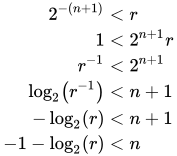
Since there is always an bigger than any given real number, it follows that there will always be at least two points in that are closer to each other than any positive therefore is not uniformly discrete.

The underlying uniformity on a discrete metric space is the discrete uniformity, and the underlying topology on a discrete uniform space is the discrete topology. Thus, the different notions of discrete space are compatible with one another. On the other hand, the underlying topology of a non-discrete uniform or metric space can be discrete; an example is the metric space (with metric inherited from the real line and given by ). This is not the discrete metric; also, this space is not complete and hence not discrete as a uniform space. Nevertheless, it is discrete as a topological space. We say that is topologically discrete but not uniformly discrete or metrically discrete.


Additionally:
Discrete space
In topology, a discrete space is a particularly simple example of a topological space or similar structure, one in which the points form a discontinuous sequence, meaning they are isolated from each other in a certain sense. The discrete topology is the finest topology that can be given on a set. Every subset is open in the discrete topology so that in particular, every singleton subset is an open set in the discrete topology.
Given a set :
A metric space is said to be uniformly discrete if there exists a packing radius such that, for any one has either or The topology underlying a metric space can be discrete, without the metric being uniformly discrete: for example the usual metric on the set
Let consider this set using the usual metric on the real numbers. Then, is a discrete space, since for each point we can surround it with the open interval where The intersection is therefore trivially the singleton Since the intersection of an open set of the real numbers and is open for the induced topology, it follows that is open so singletons are open and is a discrete space.
However, cannot be uniformly discrete. To see why, suppose there exists an such that whenever It suffices to show that there are at least two points and in that are closer to each other than Since the distance between adjacent points and is we need to find an that satisfies this inequality:
Since there is always an bigger than any given real number, it follows that there will always be at least two points in that are closer to each other than any positive therefore is not uniformly discrete.
The underlying uniformity on a discrete metric space is the discrete uniformity, and the underlying topology on a discrete uniform space is the discrete topology. Thus, the different notions of discrete space are compatible with one another. On the other hand, the underlying topology of a non-discrete uniform or metric space can be discrete; an example is the metric space (with metric inherited from the real line and given by ). This is not the discrete metric; also, this space is not complete and hence not discrete as a uniform space. Nevertheless, it is discrete as a topological space. We say that is topologically discrete but not uniformly discrete or metrically discrete.
Additionally: