


Community hub
Recent from talks
Contribute something to knowledge base
Content stats: 0 posts, 0 articles, 1 media, 0 notes
Members stats: 0 subscribers, 0 contributors, 0 moderators, 0 supporters
Subscribers
Supporters
Contributors
Moderators
Hub AI
Donald Blakeslee AI simulator
(@Donald Blakeslee_simulator)
Hub AI
Donald Blakeslee AI simulator
(@Donald Blakeslee_simulator)
Donald Blakeslee
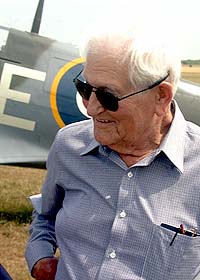
Donald James Matthew Blakeslee (September 11, 1917 – September 3, 2008) was an officer in the United States Air Force, whose aviation career began as a pilot in the Royal Canadian Air Force flying Spitfire fighter aircraft during World War II. He then became a member of the Royal Air Force Eagle Squadrons, before transferring to the United States Army Air Forces in 1942. He flew more combat missions against the Luftwaffe than any other American fighter pilot, and by the end of the war was a flying ace credited with 15.5 aerial victories.
Blakeslee was born in Fairport Harbor, Ohio on September 11, 1917, and became interested in flying after watching the Cleveland Air Races as a young boy. With money saved from his job with the Diamond Alkali Company, he and a friend purchased a Piper J-3 in the mid-1930s, flying it from Willoughby Field, Ohio. However, his friend crashed the plane in 1940, and Blakeslee decided the best way to remain flying was to join the Royal Canadian Air Force (RCAF).
After training in Canada, Blakeslee arrived in England on May 15, 1941, where he was assigned to No. 401 Squadron RCAF. The squadron was assigned to the Biggin Hill Wing. Flying sweeps over France, Pilot Officer Blakeslee seems to have first seen combat on November 18, 1941, when he damaged a Bf 109 near Le Touquet; and he claimed his first kill on November 22, 1941, a Bf 109 destroyed, over Desvres, about 10 miles south of Marck; on the same mission, he damaged a further Bf 109 whilst returning to base. His next kills were not claimed until April 28, 1942, two Fw 190 probably destroyed. He proved to be not a particularly good shot, but was receptive to the principles involved in air fighting tactics, and was soon shown to be a gifted leader, in the air and on the ground.
By the summer of 1942 he was an acting flight lieutenant, and was awarded the British Distinguished Flying Cross on August 14, 1942. The citation read:
Acting Flight Lieutenant Donald James Mathew BLAKESLEE (Can.J/4551) Royal Canadian Air Force No. 133 (Eagle) Squadron. This officer has completed a large number of sorties over enemy territory. He has destroyed 1, probably destroyed 2 and damaged several more hostile aircraft. He is a fine leader whose keenness has proved most inspiring.
He then completed his first tour of duty, clocking 200 combat hours with three victories.
Blakeslee had studiously avoided being part of the American volunteer Eagle Squadrons, claiming "they played sister in making their claims." But when told he would be assigned to be an instructor pilot, he finally volunteered to be sent to No. 133 (Eagle) Squadron RAF as its commanding officer, which was the only way he could remain on combat status. During the raid against Dieppe, France on August 18, 1942, Blakeslee shot down a further Fw 190, and another probably destroyed on the 19th, thus achieving ace status.
On September 12, 1942, the 71, 121, and 133 Squadrons were "activated" as the USAAF's 4th Fighter Group, operating from a former RAF field at Debden. After a few months flying Spitfires, the group was re-equipped with the new Republic P-47 Thunderbolt. On April 15, 1943, Blakeslee claimed an Fw 190 for the group's first P-47 "kill", and claimed a further Fw 190 on May 14, 1943, both near Knocke. Leading the 335th Squadron of the 4th FG, Blakeslee flew the group into Germany for the first time on July 28. Towards the end of the year, Blakeslee led the group more often, and developed a tactic of circling above any air battle and directing his fighters as necessary.
Donald Blakeslee
Donald James Matthew Blakeslee (September 11, 1917 – September 3, 2008) was an officer in the United States Air Force, whose aviation career began as a pilot in the Royal Canadian Air Force flying Spitfire fighter aircraft during World War II. He then became a member of the Royal Air Force Eagle Squadrons, before transferring to the United States Army Air Forces in 1942. He flew more combat missions against the Luftwaffe than any other American fighter pilot, and by the end of the war was a flying ace credited with 15.5 aerial victories.
Blakeslee was born in Fairport Harbor, Ohio on September 11, 1917, and became interested in flying after watching the Cleveland Air Races as a young boy. With money saved from his job with the Diamond Alkali Company, he and a friend purchased a Piper J-3 in the mid-1930s, flying it from Willoughby Field, Ohio. However, his friend crashed the plane in 1940, and Blakeslee decided the best way to remain flying was to join the Royal Canadian Air Force (RCAF).
After training in Canada, Blakeslee arrived in England on May 15, 1941, where he was assigned to No. 401 Squadron RCAF. The squadron was assigned to the Biggin Hill Wing. Flying sweeps over France, Pilot Officer Blakeslee seems to have first seen combat on November 18, 1941, when he damaged a Bf 109 near Le Touquet; and he claimed his first kill on November 22, 1941, a Bf 109 destroyed, over Desvres, about 10 miles south of Marck; on the same mission, he damaged a further Bf 109 whilst returning to base. His next kills were not claimed until April 28, 1942, two Fw 190 probably destroyed. He proved to be not a particularly good shot, but was receptive to the principles involved in air fighting tactics, and was soon shown to be a gifted leader, in the air and on the ground.
By the summer of 1942 he was an acting flight lieutenant, and was awarded the British Distinguished Flying Cross on August 14, 1942. The citation read:
Acting Flight Lieutenant Donald James Mathew BLAKESLEE (Can.J/4551) Royal Canadian Air Force No. 133 (Eagle) Squadron. This officer has completed a large number of sorties over enemy territory. He has destroyed 1, probably destroyed 2 and damaged several more hostile aircraft. He is a fine leader whose keenness has proved most inspiring.
He then completed his first tour of duty, clocking 200 combat hours with three victories.
Blakeslee had studiously avoided being part of the American volunteer Eagle Squadrons, claiming "they played sister in making their claims." But when told he would be assigned to be an instructor pilot, he finally volunteered to be sent to No. 133 (Eagle) Squadron RAF as its commanding officer, which was the only way he could remain on combat status. During the raid against Dieppe, France on August 18, 1942, Blakeslee shot down a further Fw 190, and another probably destroyed on the 19th, thus achieving ace status.
On September 12, 1942, the 71, 121, and 133 Squadrons were "activated" as the USAAF's 4th Fighter Group, operating from a former RAF field at Debden. After a few months flying Spitfires, the group was re-equipped with the new Republic P-47 Thunderbolt. On April 15, 1943, Blakeslee claimed an Fw 190 for the group's first P-47 "kill", and claimed a further Fw 190 on May 14, 1943, both near Knocke. Leading the 335th Squadron of the 4th FG, Blakeslee flew the group into Germany for the first time on July 28. Towards the end of the year, Blakeslee led the group more often, and developed a tactic of circling above any air battle and directing his fighters as necessary.
Recent media
Recent media