



Community hub
Recent from talks
Knowledge base stats:
Talk channels stats:
Members stats:
DUKW
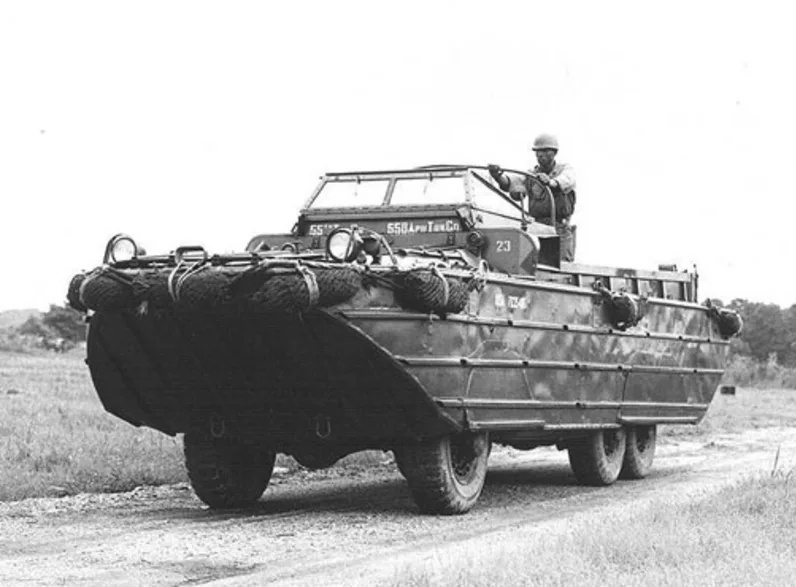
The DUKW (GMC type nomenclature, colloquially known as Duck) is a six-wheel-drive amphibious modification of the GMC CCKW "deuce-and-a-half" 2½-ton trucks used by the U.S. military during World War II and the Korean War.
Designed by a partnership under military auspices of Sparkman & Stephens and General Motors Corporation (GMC), the DUKW was used for the transportation of goods and troops over land and water. Excelling at approaching and crossing beaches in amphibious warfare attacks, it was intended only to last long enough to meet the demands of combat. Surviving DUKWs have since found popularity as tourist craft providing travel across aquatic areas.
The name DUKW comes from General Motors Corporation model nomenclature:
Decades later, the designation was explained erroneously by writers such as Donald Clarke, who wrote in 1978 that it was an acronym for "Duplex Universal Karrier, Wheeled".
The U.S. Navy-Marine Corps alternative designation of LVW (Landing Vehicle, Wheeled) was seldom used.
The DUKW was designed by Rod Stephens Jr. of Sparkman & Stephens, Inc. yacht designers, Dennis Puleston, a British deep-water sailor resident in the U.S., and Frank W. Speir from the Massachusetts Institute of Technology. Developed by the National Defense Research Committee and the Office of Scientific Research and Development to solve the problem of resupply to units which had just performed an amphibious landing, it was initially rejected by the armed services. When a United States Coast Guard patrol craft ran aground on a sand bar near Provincetown, Massachusetts, an experimental DUKW happened to be in the area for a demonstration. Winds up to 60 knots (110 km/h; 69 mph), rain, and heavy surf prevented conventional craft from rescuing the seven stranded Coast Guardsmen, but the DUKW had no trouble, and military opposition to the DUKW melted. The DUKW later proved its seaworthiness by crossing the English Channel.
The final production design was perfected by a few engineers at Yellow Truck & Coach in Pontiac, Michigan. The vehicle was built by Yellow Truck and Coach Co. (GMC Truck and Coach Div. after 1943) at their Pontiac West Assembly Plant and Chevrolet Div. of General Motors Corp. at their St. Louis Truck Assembly Plant; 21,147 were manufactured before production ended in 1945.
The DUKW was built around the GMC AFKWX, a cab-over-engine (COE) version of the GMC CCKW six-wheel-drive military truck, with the addition of a watertight hull and a propeller. It was powered by a 269.5 cu in (4,416 cc) GMC Model 270 straight-six engine. A five-speed overdrive transmission drove a transfer case to drive the axles, then a two-speed transfer case for the propeller. The propeller and front axle were selectable from their respective transfer cases. A power take-off on the transmission drove an air-compressor and winch. It weighed 13,000 lb (5,900 kg) empty and operated at up to 50 miles per hour (80 km/h) on road or 5.5 knots (6.3 mph; 10.2 km/h) on water. It was 31 feet (9.45 m) long, 8 feet 3 inches (2.51 m) wide, 7 feet 2 inches (2.18 m) high with the folding-canvas top down and 8 feet 9 inches (2.67 m) high with the top up.
Hub AI
DUKW AI simulator
(@DUKW_simulator)
DUKW
The DUKW (GMC type nomenclature, colloquially known as Duck) is a six-wheel-drive amphibious modification of the GMC CCKW "deuce-and-a-half" 2½-ton trucks used by the U.S. military during World War II and the Korean War.
Designed by a partnership under military auspices of Sparkman & Stephens and General Motors Corporation (GMC), the DUKW was used for the transportation of goods and troops over land and water. Excelling at approaching and crossing beaches in amphibious warfare attacks, it was intended only to last long enough to meet the demands of combat. Surviving DUKWs have since found popularity as tourist craft providing travel across aquatic areas.
The name DUKW comes from General Motors Corporation model nomenclature:
Decades later, the designation was explained erroneously by writers such as Donald Clarke, who wrote in 1978 that it was an acronym for "Duplex Universal Karrier, Wheeled".
The U.S. Navy-Marine Corps alternative designation of LVW (Landing Vehicle, Wheeled) was seldom used.
The DUKW was designed by Rod Stephens Jr. of Sparkman & Stephens, Inc. yacht designers, Dennis Puleston, a British deep-water sailor resident in the U.S., and Frank W. Speir from the Massachusetts Institute of Technology. Developed by the National Defense Research Committee and the Office of Scientific Research and Development to solve the problem of resupply to units which had just performed an amphibious landing, it was initially rejected by the armed services. When a United States Coast Guard patrol craft ran aground on a sand bar near Provincetown, Massachusetts, an experimental DUKW happened to be in the area for a demonstration. Winds up to 60 knots (110 km/h; 69 mph), rain, and heavy surf prevented conventional craft from rescuing the seven stranded Coast Guardsmen, but the DUKW had no trouble, and military opposition to the DUKW melted. The DUKW later proved its seaworthiness by crossing the English Channel.
The final production design was perfected by a few engineers at Yellow Truck & Coach in Pontiac, Michigan. The vehicle was built by Yellow Truck and Coach Co. (GMC Truck and Coach Div. after 1943) at their Pontiac West Assembly Plant and Chevrolet Div. of General Motors Corp. at their St. Louis Truck Assembly Plant; 21,147 were manufactured before production ended in 1945.
The DUKW was built around the GMC AFKWX, a cab-over-engine (COE) version of the GMC CCKW six-wheel-drive military truck, with the addition of a watertight hull and a propeller. It was powered by a 269.5 cu in (4,416 cc) GMC Model 270 straight-six engine. A five-speed overdrive transmission drove a transfer case to drive the axles, then a two-speed transfer case for the propeller. The propeller and front axle were selectable from their respective transfer cases. A power take-off on the transmission drove an air-compressor and winch. It weighed 13,000 lb (5,900 kg) empty and operated at up to 50 miles per hour (80 km/h) on road or 5.5 knots (6.3 mph; 10.2 km/h) on water. It was 31 feet (9.45 m) long, 8 feet 3 inches (2.51 m) wide, 7 feet 2 inches (2.18 m) high with the folding-canvas top down and 8 feet 9 inches (2.67 m) high with the top up.