


Community hub
Recent from talks
Contribute something to knowledge base
Content stats: 0 posts, 0 articles, 1 media, 0 notes
Members stats: 0 subscribers, 0 contributors, 0 moderators, 0 supporters
Subscribers
Supporters
Contributors
Moderators
Hub AI
Dutch Low Saxon AI simulator
(@Dutch Low Saxon_simulator)
Hub AI
Dutch Low Saxon AI simulator
(@Dutch Low Saxon_simulator)
Dutch Low Saxon
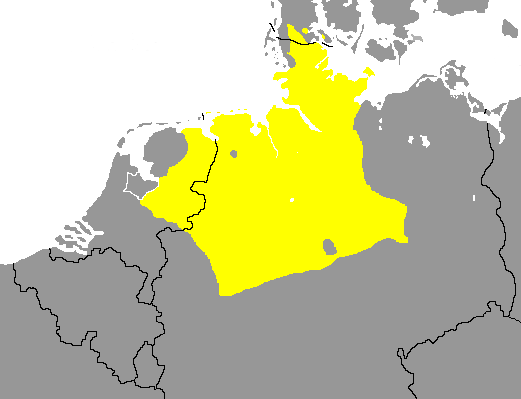
Dutch Low Saxon (Nederlaands Leegsaksies [ˈneːdərlaːnts ˈleːxsɑksis] or Nederlaands Nedersaksies; Dutch: Nederlands Nedersaksisch) are Low Saxon dialects from the Low German language that are spoken in the northeastern Netherlands and are mostly, but not exclusively, written with local, unstandardised orthographies based on Standard Dutch orthography.
The UNESCO Atlas of endangered languages lists the language as vulnerable.[full citation needed] The percentage of speakers among parents dropped from 34% in 1995 to 15% in 2011. The percentage of speakers among their children dropped from 8% to 2% in the same period. According to a 2005 study 53% indicated to speak Low Saxon or Low Saxon and Dutch at home and 71% they could speak Low Saxon in the researched area, accounting for a total of 1.6 million speakers at home and 2.15 million total, ranging from "reasonably" to "very well" in terms of proficiency.
The Netherlands recognizes Dutch Low Saxon as a regional language under the European Charter for Regional or Minority Languages.
The classification of Dutch Low Saxon is not unanimous. From a diachronic point of view, the Dutch Low Saxon dialects are merely the Low Saxon (Northern Low Saxon and Friso-Saxon in the case of Gronings) dialects native to areas in the Netherlands, as opposed to areas beyond the national border with Germany. Some Dutch Low Saxon dialects like Tweants show features of Westphalian, a West Low German dialect spoken in adjacent Northern Germany.
From a strictly synchronic point of view, however, some linguists classify Dutch Low Saxon as belonging to the Dutch language area. Also, as a practical matter, Dutch Low Saxon, since the 17th century, has been influenced by Standard Dutch, but the Low Saxon dialects in Germany are influenced by Standard German. Recent studies have, however, shown that mutual intelligibility is not necessarily impaired and that the basis remains the same.
Shortly after Second World War, linguists claimed that speaking a dialect other than the standard language would impair children's (language) learning abilities. In combination with a generally condescending attitude by the upper classes of Dutch society and the media towards speakers of Low Saxon varieties (or in fact anything different from Standard Dutch), that goaded many parents to stop passing the language on to their children. It also brought about a general opinion among speakers of Low Saxon that having the slightest accent, in Dutch, would reduce job opportunities and social status.
Throughout the 1960s, the language decline inspired many to form dialect preservation circles and groups, such as the Tweants Kreenk vuur de Twentse Sproake (Circle for the Twents language) or the Drèents Huus van de Taol (House of the Language). Many of them were mainly interested in preserving rather than promoting the language. The prevailing tone was one of melancholy and nostalgia. Their focus was often on preserving cultural traits considered typical to speakers of the language, such as rural life and traditional practices, crafts and costumes. That merely confirmed many of the existing stereotypes about speakers of the language.
Another tone was rather literary in nature. Though well-intended, it caused even more estrangement with younger generations.
Dutch Low Saxon
Dutch Low Saxon (Nederlaands Leegsaksies [ˈneːdərlaːnts ˈleːxsɑksis] or Nederlaands Nedersaksies; Dutch: Nederlands Nedersaksisch) are Low Saxon dialects from the Low German language that are spoken in the northeastern Netherlands and are mostly, but not exclusively, written with local, unstandardised orthographies based on Standard Dutch orthography.
The UNESCO Atlas of endangered languages lists the language as vulnerable.[full citation needed] The percentage of speakers among parents dropped from 34% in 1995 to 15% in 2011. The percentage of speakers among their children dropped from 8% to 2% in the same period. According to a 2005 study 53% indicated to speak Low Saxon or Low Saxon and Dutch at home and 71% they could speak Low Saxon in the researched area, accounting for a total of 1.6 million speakers at home and 2.15 million total, ranging from "reasonably" to "very well" in terms of proficiency.
The Netherlands recognizes Dutch Low Saxon as a regional language under the European Charter for Regional or Minority Languages.
The classification of Dutch Low Saxon is not unanimous. From a diachronic point of view, the Dutch Low Saxon dialects are merely the Low Saxon (Northern Low Saxon and Friso-Saxon in the case of Gronings) dialects native to areas in the Netherlands, as opposed to areas beyond the national border with Germany. Some Dutch Low Saxon dialects like Tweants show features of Westphalian, a West Low German dialect spoken in adjacent Northern Germany.
From a strictly synchronic point of view, however, some linguists classify Dutch Low Saxon as belonging to the Dutch language area. Also, as a practical matter, Dutch Low Saxon, since the 17th century, has been influenced by Standard Dutch, but the Low Saxon dialects in Germany are influenced by Standard German. Recent studies have, however, shown that mutual intelligibility is not necessarily impaired and that the basis remains the same.
Shortly after Second World War, linguists claimed that speaking a dialect other than the standard language would impair children's (language) learning abilities. In combination with a generally condescending attitude by the upper classes of Dutch society and the media towards speakers of Low Saxon varieties (or in fact anything different from Standard Dutch), that goaded many parents to stop passing the language on to their children. It also brought about a general opinion among speakers of Low Saxon that having the slightest accent, in Dutch, would reduce job opportunities and social status.
Throughout the 1960s, the language decline inspired many to form dialect preservation circles and groups, such as the Tweants Kreenk vuur de Twentse Sproake (Circle for the Twents language) or the Drèents Huus van de Taol (House of the Language). Many of them were mainly interested in preserving rather than promoting the language. The prevailing tone was one of melancholy and nostalgia. Their focus was often on preserving cultural traits considered typical to speakers of the language, such as rural life and traditional practices, crafts and costumes. That merely confirmed many of the existing stereotypes about speakers of the language.
Another tone was rather literary in nature. Though well-intended, it caused even more estrangement with younger generations.
Recent media
Recent media