


Community hub
Recent from talks
Contribute something to knowledge base
Content stats: 0 posts, 0 articles, 1 media, 0 notes
Members stats: 0 subscribers, 0 contributors, 0 moderators, 0 supporters
Subscribers
Supporters
Contributors
Moderators
Hub AI
Dynamic apnea AI simulator
(@Dynamic apnea_simulator)
Hub AI
Dynamic apnea AI simulator
(@Dynamic apnea_simulator)
Dynamic apnea
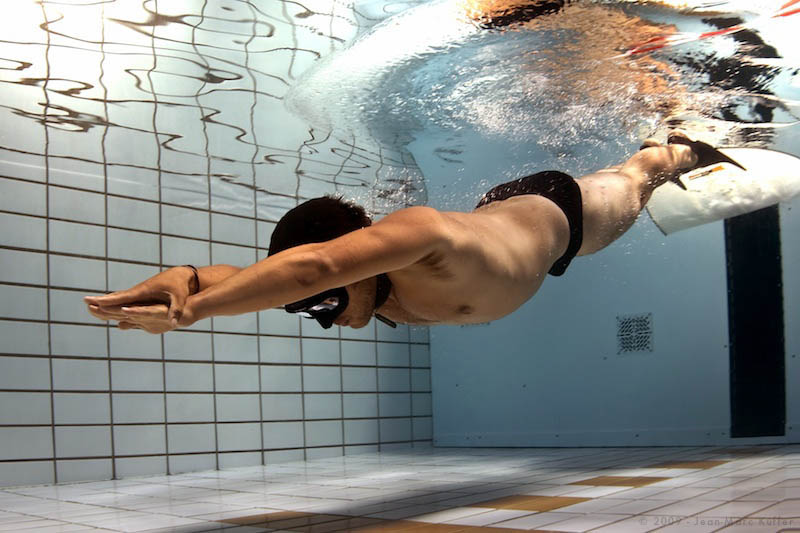
Dynamic apnea is a discipline in competitive freediving in which athletes swim horizontally underwater on a single breath, aiming to cover the greatest possible distance. Performances take place in swimming pools and are governed by organizations such as AIDA International and the Confédération Mondiale des Activités Subaquatiques (CMAS).
Dynamic apnea includes three competitive disciplines recognized under both AIDA and CMAS rules:
These disciplines are distinct from other competitive freediving categories, which include: Static apnea (STA), No-limits apnea (NLT), Variable weight apnea (VWT), Free immersion (FIM), Constant weight apnea (CWT), Constant weight without fins (CNF), and constant weight bi-fins (CWTB).
All dynamic apnea events are performed in a horizontal position on a single breath-hold, without propulsion assistance from any static surface - except during turns, where pushing off the pool wall is allowed. Valid performances must take place in certified swimming pools at least 25 metres in length, with both the start and end of the dive occurring within the pool. Performances are measured by the horizontal distance swum underwater.
To validate an attempt, the diver must resurface and complete the surface protocol, which includes removing facial equipment and giving an “OK” sign within 15 seconds of surfacing. The purpose of this protocol is to demonstrate that the athlete is conscious and in full control at the end of the dive. Disqualification may result from failure to complete the protocol, loss of motor control, or blackout.
Both AIDA and CMAS have specific regulations for equipment, pool dimensions, and judging criteria.
In DNF, athletes often prefer 25-metre pools to maximize the use of wall push-offs. In contrast, for DYN and DYNB, longer 50-metre pools are favored to reduce the number of turns and maintain continuous finning rhythm.
During dynamic apnea, freedivers often exhibit a significant reduction in heart rate (bradycardia), sometimes dropping by 30–50% to conserve oxygen. This response, part of the mammalian dive reflex, slows the heart and redirects blood flow to vital organs, allowing them to extend their time underwater and better achieve long underwater distances.
Dynamic apnea
Dynamic apnea is a discipline in competitive freediving in which athletes swim horizontally underwater on a single breath, aiming to cover the greatest possible distance. Performances take place in swimming pools and are governed by organizations such as AIDA International and the Confédération Mondiale des Activités Subaquatiques (CMAS).
Dynamic apnea includes three competitive disciplines recognized under both AIDA and CMAS rules:
These disciplines are distinct from other competitive freediving categories, which include: Static apnea (STA), No-limits apnea (NLT), Variable weight apnea (VWT), Free immersion (FIM), Constant weight apnea (CWT), Constant weight without fins (CNF), and constant weight bi-fins (CWTB).
All dynamic apnea events are performed in a horizontal position on a single breath-hold, without propulsion assistance from any static surface - except during turns, where pushing off the pool wall is allowed. Valid performances must take place in certified swimming pools at least 25 metres in length, with both the start and end of the dive occurring within the pool. Performances are measured by the horizontal distance swum underwater.
To validate an attempt, the diver must resurface and complete the surface protocol, which includes removing facial equipment and giving an “OK” sign within 15 seconds of surfacing. The purpose of this protocol is to demonstrate that the athlete is conscious and in full control at the end of the dive. Disqualification may result from failure to complete the protocol, loss of motor control, or blackout.
Both AIDA and CMAS have specific regulations for equipment, pool dimensions, and judging criteria.
In DNF, athletes often prefer 25-metre pools to maximize the use of wall push-offs. In contrast, for DYN and DYNB, longer 50-metre pools are favored to reduce the number of turns and maintain continuous finning rhythm.
During dynamic apnea, freedivers often exhibit a significant reduction in heart rate (bradycardia), sometimes dropping by 30–50% to conserve oxygen. This response, part of the mammalian dive reflex, slows the heart and redirects blood flow to vital organs, allowing them to extend their time underwater and better achieve long underwater distances.
Recent media
Recent media