Hubbry Logo
Court of Appeal (England and Wales)Court of Appeal (England and Wales)Main
Open search
Court of Appeal (England and Wales)
Community hub
Court of Appeal (England and Wales)
logo
8 pages, 0 posts
0 subscribers
Be the first to start a discussion here.
Court of Appeal (England and Wales)
from Wikipedia

Court of Appeal
Established1 November 1875[1]
JurisdictionEngland and Wales
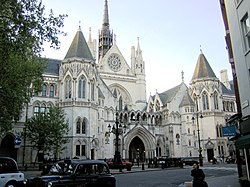
LocationRoyal Courts of Justice, Strand, City of Westminster, London, UK
Composition methodAppointment by the Monarch on recommendation of the Lord Chancellor who receive a recommendation from the Judicial Appointments Commission
Authorised by
Appeals toSupreme Court of the United Kingdom
Appeals from
Judge term lengthMandatory retirement at age 75
Number of positions44
Websitehttps://www.judiciary.gov.uk/you-and-the-judiciary/going-to-court/court-of-appeal-home/
Lady Chief Justice of England and Wales
CurrentlyThe Baroness Carr of Walton-on-the-Hill
Since1 October 2023
Lead position ends1 September 2039
Jurist term ends1 September 2039
Master of the Rolls
CurrentlySir Geoffrey Vos
Since11 January 2021
Jurist term ends22 April 2030

The Court of Appeal (formally "His Majesty's Court of Appeal in England",[2] commonly cited as "CA", "EWCA" or "CoA") is the highest court within the Senior Courts of England and Wales, and second in the legal system of England and Wales only to the Supreme Court of the United Kingdom.[3] The Court of Appeal was created in 1875,[4] and today comprises 39 Lord Justices of Appeal and Lady Justices of Appeal.[4]

The court has two divisions, Criminal and Civil, led by the Lady Chief Justice and the Master of the Rolls respectively. Criminal appeals are heard in the Criminal Division, and civil appeals in the Civil Division. The Criminal Division hears appeals from the Crown Court, while the Civil Division hears appeals from the County Court, High Court of Justice and Family Court. Permission to appeal is normally required from either the lower court or the Court of Appeal itself; and with permission, further appeal may lie to the Supreme Court. Its decisions are binding on all courts, including itself, apart from the Supreme Court.

History

[edit]

Formation and early history

[edit]

The appeal system before 1875 was chaotic. The superior courts system consisted of 12 different courts, with appeal on common law matters to the Court of Exchequer Chamber, chancery matters to the Court of Appeal in Chancery and other matters to the Privy Council. The Judicature Commission, which was founded in 1867 to investigate the formation of a "Supreme Court" (a High Court and Court of Appeal), conducted a review of this. The result was published in 1869. The recommendation was that there should be a common system of appeal from all of the High Court divisions, with a limited set of appeals allowed to the House of Lords.[5] This reform was implemented by the Judicature Acts, with the Appellate Jurisdiction Act 1876 giving an almost limitless right of appeal to the Lords.[6]

The new legal structure provided a single Court of Appeal, which heard appeals from all the various divisions of the new unified High Court of Justice. It only heard civil cases: opportunities for appealing in criminal cases remained limited until the 20th century.[7] In its early days, the Court of Appeal divided its sittings between Westminster Hall for appeals from the Common Law divisions, and Lincoln's Inn for Chancery, Probate, Divorce and Admiralty appeals, with five Lords Justices. After the opening of the Royal Courts of Justice in 1882 the Court of Appeal transferred there, where it remains. As well as the Lords Justices, the Lord Chancellor, any previous Lords Chancellor, the Lord Chief Justice, the Lords of Appeal in Ordinary, the Vice-Chancellor of the Chancery Division and the Master of the Rolls could also hear cases, although in practice only the Master of the Rolls did so.[8]

Changes in appellate jurisdiction and procedure

[edit]

The absence of limits on appeals to the House of Lords was the cause of much concern: it led to an additional set of expensive and time-consuming appeals from the Court of Appeal, which thus could not take decisions in the knowledge that they were final. The appeals from the county courts were seen similarly, involving an appeal to the High Court of Justice and the bypassing of the Court of Appeal for a second set of appeals to the Lords. The Administration of Justice (Appeals) Act 1934, a short statute, solved both problems neatly by abolishing the appeal of county court decisions to the High Court and instead sending them automatically to the Court of Appeal, and by establishing that appeals to the Lords could only take place with the consent of the Court of Appeal or of the Lords themselves.[9]

A second set of reforms to the appeals system followed the report of the Evershed Committee on High Court Procedure in 1953, which recognised the high cost to the litigants of an additional set of appeals, particularly since the loser in a civil case paid the victor's legal bills. Among the few changes that were made, the practice ceased of counsel reading out the judgment, cross-examinations, documents and evidence given in the lower court; this saved time and costs. The process of "leapfrogging" (appealing from the High Court to the House of Lords without needing to go through the Court of Appeal), which the committee had recommended, was eventually brought into force with the Administration of Justice Act 1969.[10]

A separate Court of Criminal Appeal had been established in 1908. In 1966 this was merged with its older namesake, establishing the present-day structure of a single Court of Appeal with two Divisions: Civil and Criminal.[7]

In the early 1960s there was discussion between judges and academics in the United Kingdom and the United States comparing the processes of appeal used in each nation. Although the British judges found the emphasis on written arguments unattractive, they did like the idea of pre-reading: that the court should read the pleadings of counsel, the case being appealed and the judgment from the lower court before delivering its judgment. But the idea was quietly scrapped, despite a successful tryout in the Court of Appeal. The court over which Lord Denning presided from 1962 to 1982 was under no pressure and had no inclination to modernise, with liaisons and management[clarification needed] handled by clerks with little knowledge.[clarification needed] This changed in 1981 with the appointment of a Registrar, John Adams, an academic and lawyer, who significantly reformed the internal workings of the Court.[11]

The Woolf and Bowman reforms

[edit]

In July 1996, Lord Woolf published Access to Justice, a report on the accessibility of the courts to the public. Woolf identified civil litigation as being characterised by excessive cost, delay and complexity, and succeeded in replacing the diverse rules with a single set of Civil Procedure Rules.[12] Before Woolf had even published his final report, Sir Jeffery Bowman, the recently retired senior partner of PriceWaterhouse, was commissioned to write a report on the Civil Division of the Court of Appeal. Bowman noted a growing workload and delays, with 14 months between setting down and disposing of a case in 70% of cases, the rest taking even longer than that – some had taken five years.[13] He recommended extending the requirement to ask leave to appeal to almost all appeal cases; allowing certain appeals to be heard at a lower level; focusing of procedure; imposition of time limits on oral arguments; and the use of judicial time more towards reading and less towards sitting in court.[14]

Bowman's recommendations were mainly enacted through statutory provisions, such as Part IV of the Access to Justice Act 1999. In Tanfern Ltd v Cameron-MacDonald [2000] 1 WLR 1311, Brooke LJ laid down the procedural methods of the Court of Appeal post-Woolf and Bowman. With a few exceptions, such as cases where "the liberty of the subject" is an issue, permission is required to appeal, and may be granted either by the lower court or by the Court of Appeal.[15] As a general rule, appeals are now limited to a review of the decision of the lower court, only allowing a full appeal where there was a serious procedural irregularity or the decision was wrong through "blatant error".[16]

Divisions

[edit]

Civil Division

[edit]

The Civil Division deals with all non-criminal cases, and has been part of the court since its establishment in 1875. The Civil Division is bound by the Supreme Court of the United Kingdom when making decisions, and is normally bound by its own previous decisions, with four exceptions:[citation needed]

  • where the previous decision was made without the judges knowing of a particular law:
  • where there are two previous conflicting decisions;
  • where there is a later conflicting Supreme Court or House of Lords decision, and
  • where a law was assumed to exist in a previous case but did not.

The first three were established by the case of Young v Bristol Aeroplane Co Ltd in 1946, the fourth by R (on the application of Kadhim) v Brent London Borough Housing Benefit Review Board in 2001.[17] The Civil Division is led by the Master of the Rolls, currently Geoffrey Vos (who is entitled to the post-nominal MR), assisted by the Vice-President of the Civil Division, Sir Nicholas Underhill. The division hears cases from the High Court of Justice, the County Court and several tribunals.[18]

Although the Lady Chief Justice is senior to the Master of the Rolls, the Civil Division is much broader in scope than the Criminal Division. With only three judges on the bench (rather than five or more in the Supreme Court), this allows the Master of the Rolls huge opportunity for shaping the common law and, most notably, Lord Denning made the most of this potential.[citation needed]

Criminal Division

[edit]

The Criminal Division was established in 1966 with the merger of the Court of Criminal Appeal into the Court of Appeal. It hears all appeals from the Crown Court which are in connection with a trial on indictment (i.e. with a jury) and where the Crown Court has sentenced a defendant committed from the Magistrates' Court. It also exercises the jurisdiction to order the issue of writs of venire de novo.[19] The Criminal Division, while bound by the Supreme Court, is more flexible with binding itself, due to the heightened stakes in a case where a possible penalty is a prison sentence.[20] The Division is led by the Lady Chief Justice, currently The Baroness Carr of Walton-on-the-Hill, assisted by the Vice-President of the Criminal Division, currently Lord Justice Holroyde.[21]

Procedure for appeal

[edit]

Sections 54 to 59 of the Access to Justice Act 1999 and Part 52 of the Civil Procedure Rules 1998 came into force on 2 May 2000, and created one universal appeals system; not all of these are to the Court of Appeal, with the principle used that an appeal should go to the next highest court in the hierarchy.[22] Appeals are allowed if the decision in the court below was incorrect, or suffered from a serious procedural error or irregularity.[23]

Almost all appeals require permission, a major innovation from the previous system, where appeals were, on the request of counsel, almost all automatically put through. The application for permission should be made to the lower court, although this is not mandatory; it may be asked of the appellate court itself. In Re T (A Child) [2002] EWCA Civ 1736, the Civil Division strongly advised that counsel apply at the lower courts, since the judge, fully aware of the facts, will take less time to process, there is no harm if the application fails or if it is approved but counsel decides not to proceed with the case and there are no additional costs involved. The only problem here is that judgments may occasionally be reserved, and only given later by post – there may not be an opportunity to ask for permission to appeal at the lower court.[24]

The Court of Appeal, when considering an application for appeal, may decide based on the paper documents or refer the case to an oral hearing, something often done when it is apparent that a refusal of the written case will lead the applicant to send a second, oral application. If a written application is refused, the applicant may ask for an oral hearing to discuss the refusal. Under the Civil Procedure Rules 1998, the appeal must have "a real prospect of success", or there must be "some other compelling reason why the appeal should be heard" for it to be accepted.[25]

Under certain, limited, circumstances, second appeals are allowed. This is when an appeal goes to the High Court or the County Court and a party to the case wishes to appeal it further, to the Court of Appeal. Section 55(1) of the Access to Justice Act 1999 says that, when an appeal is made to the County Court or the High Court and that court makes a decision, no further appeal is allowed to the Court of Appeal unless the Court considers that the case raises "an important point of principle or practice" or "there is some other compelling reason for the Court of Appeal to hear it".[26] In Tanfern Ltd v Cameron-MacDonald [2000] 1 WLR 1311 the Court commented on this limitation of second appeals, pointing out that the Lords Justices of Appeal were a valuable and scarce resource – it was necessary to impose limitations on appeals to prevent the Court and its judges becoming overburdened.[27]

There are two sorts of hearings that the Court of Appeal can hold; reviews, and full rehearings. Section 52.11(1) of the Civil Procedure Rules 1998 establishes that appeals should always be reviews, unless there are individual circumstances that, "in the interest of justice", make a rehearing necessary.[28] In its case law, the Court has emphasised that it is up to the individual panel of judges to decide whether to hold a review or rehearing, with the circumstances of the case playing a large part.[23] In 2004 the Court heard 1,059 appeals, of which 295 were allowed and 413 directly dismissed.[29]

Qualifying cases seeking settlement of contract or personal injury claims up to a value of £100,000, for which permission to appeal has been sought, obtained or adjourned, may be referred to the Court of Appeal Mediation Scheme, a mediation scheme operated by the Centre for Effective Dispute Resolution (CEDR), so that cases can be resolved more speedily without absorbing court time and impacting less significantly on any ongoing relationship between the litigants.[30] Data reported in 2022 stated that the scheme had achieved a 40–50% success rate.[31]

Judges

[edit]

The Court of Appeal's main judges are the Lord Justices of Appeal and Lady Justices of Appeal. The Senior Courts Act 1981 provides that the Court of Appeal comprises 39 ordinary sitting Lords and Lady Justices and the Lady Chief Justice, Master of the Rolls, President of the Queen's Bench Division, President of the Family Division, and Chancellor of the High Court.[32] Retired Lords and Lady Justices sometimes sit in cases, as have retired Law Lords, and High Court judges are allowed to sit on occasion and there are a number of Senior Circuit Judges authorised to sit as judges of the Criminal Division.

Lords and Lady Justices have, since 1946, been drawn exclusively from the High Court of Justice; prior to this, Lords Justices were sometimes recruited directly from the Bar.[33] Dame Elizabeth Butler-Sloss was the first woman appointed as a Lord Justice of Appeal in 1988; she was known officially as "Lord Justice" until a practice direction was issued in 1994 to refer to her informally as "Lady Justice", and the official title in section 3 of the Senior Courts Act 1981 was amended by the Courts Act 2003. Dame Kathryn Thirlwall was the twelfth Lady Justice, appointed in 2017, bringing the number of active Lady Justices to 9 out of 39.

The division of work in the Court of Appeal is demonstrated by the 2005 statistics, in which Lords and Lady Justices sat 66% of the time, High Court Judges 26% of the time and Circuit and Deputy High Court Judges 8 per cent of the time.[34] Lord and Lady Justices are currently paid £188,900, with the Master of the Rolls paid £205,700 and the Lady Chief Justice £230,400.[35]

The Civil Division is led by the Master of the Rolls, currently Sir Geoffrey Vos; the Chancellor of the High Court and President of the Family Division regularly, for a period of weeks, lead the Civil Division. Several Civil Division Lords Justices are seconded to the Criminal Division, which is currently led by the Lady Chief Justice, The Baroness Carr of Walton-on-the-Hill.[36]

Broadcasting

[edit]

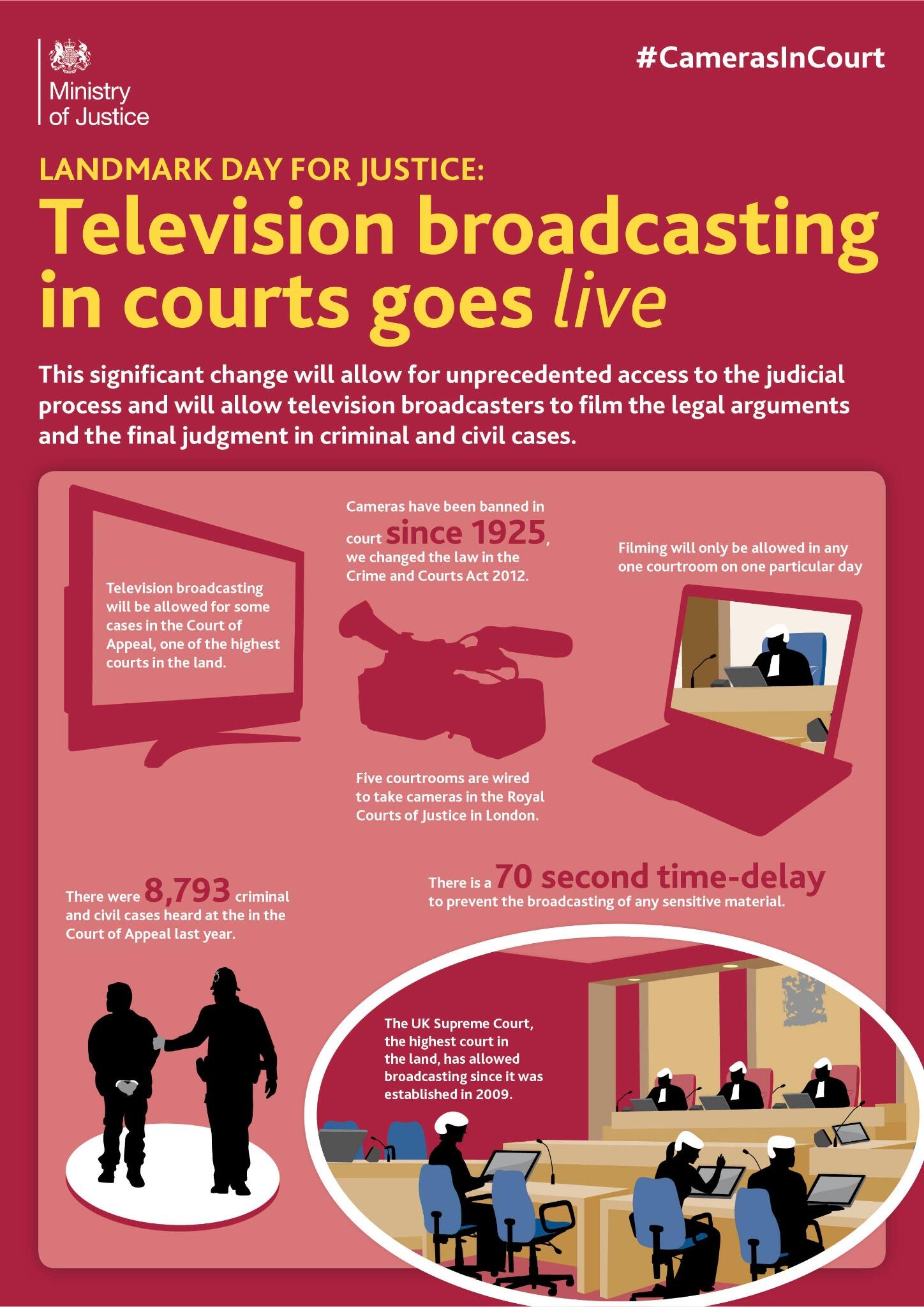
On 31 October 2013 the Court of Appeal allowed cameras in the court for a (70-second broadcast delay) "live" broadcast feed for the first time.[37] Cameras were banned in all courts in 1925 (although they were allowed in the Supreme Court of the United Kingdom from its 2009 inception). Cameras have now been allowed in some courts due to changes made by the Crime and Courts Act 2013. In 2013, only one court could be broadcast per day.[38]

See also

[edit]

References

[edit]

Bibliography

[edit]
[edit]
Revisions and contributorsEdit on WikipediaRead on Wikipedia
from Grokipedia
The Court of Appeal (England and Wales) is a senior appellate court within the judiciary of England and Wales, divided into Civil and Criminal Divisions, which hear appeals from decisions of the High Court, County Court, Crown Court, and certain tribunals. It serves as the second-highest court in the hierarchy below the Supreme Court, focusing exclusively on reviewing legal errors, procedural irregularities, or unduly lenient/harsh sentences rather than retrying facts. The Civil Division, presided over by the Master of the Rolls and comprising Lords and Ladies Justices of Appeal, addresses civil matters including contract disputes, family law, and administrative appeals, while the Criminal Division, led by the Lord Chief Justice, handles criminal appeals against convictions and sentences from the Crown Court. Established under the Judicature Acts of 1873 and 1875, with its Criminal Division formalized in 1966, the court operates from the Royal Courts of Justice in London and plays a critical role in upholding consistency and fairness in judicial outcomes across England and Wales.

History

Establishment in 1875 and Initial Jurisdiction

The Judicature Acts 1873 and 1875 restructured the superior courts of England and Wales by creating the Supreme Court of Judicature, comprising the High Court of Justice and the newly formed Court of Appeal. These reforms, driven by recommendations from the Judicature Commission established in 1869, sought to consolidate the fragmented administration of common law and equity jurisdictions, which had led to procedural inefficiencies and delays amid rising caseloads from industrial and commercial growth. The Court of Appeal was positioned as the intermediate appellate tier, with ultimate appeals lying to the House of Lords. At its inception in 1875, the court's jurisdiction was limited to civil appeals from the High Court's divisions, including those involving Queen's Bench, Chancery, Probate, Divorce, and Admiralty matters. This unified the previously disjointed appeal pathways—such as writs of error to the Exchequer Chamber for common law or appeals to the Lords Justices for equity—into a single, streamlined process to enhance consistency and expedition. Criminal appeals remained outside its scope, typically handled through prerogative remedies like certiorari or direct petitions to the Home Secretary, with no dedicated appellate court until later enactments. The court's initial composition included ex officio judges—the Lord Chancellor, the Lord Chief Justice of England, the Master of the Rolls, and the chief justices of the Common Pleas and Exchequer divisions—augmented by five appointed Lords Justices of Appeal to form its core bench. Sittings commenced at locations including Westminster Hall and Lincoln's Inn, prior to the court's relocation to the purpose-built Royal Courts of Justice in 1882. This structure emphasized appellate review on points of law and fact, though leave was often required, reflecting a balance between access to justice and curbing frivolous appeals.

Expansion to Criminal Appeals and Mid-20th Century Developments

Prior to the establishment of dedicated appellate mechanisms, criminal convictions in England and Wales were subject to limited review, primarily through irregular procedures such as writs of error or royal prerogative, which offered scant grounds for overturning jury verdicts. The Criminal Appeal Act 1907 marked a pivotal shift by creating the Court of Criminal Appeal as a specialized body to hear appeals from convictions and sentences in the Crown courts and assizes, empowering it to quash unsafe convictions or substitute lesser sentences based on errors of law, fact, or miscarriage of justice. This court operated independently of the civil-focused Court of Appeal, drawing its judges primarily from the High Court, though it lacked the integrated administrative structure of the broader appellate system. By the mid-20th century, the separation of criminal appeals proved inefficient amid rising caseloads and overlapping judicial resources, prompting scrutiny from the Interdepartmental Committee on the Court of Criminal Appeal (Donovan Committee) in the early 1960s. The committee recommended merging the Court of Criminal Appeal into the Court of Appeal to streamline operations, facilitate judge allocation between civil and criminal divisions, and enhance procedural consistency without diluting specialized expertise. The Criminal Appeal Act 1966 implemented these reforms, effective 1 October 1966, by abolishing the standalone Court of Criminal Appeal and vesting its jurisdiction in a newly formed Criminal Division of the Court of Appeal. This expansion unified appellate oversight under the Court of Appeal, allowing the Criminal Division—presided over by the Lord Chief Justice—to adjudicate appeals from the Crown Court on grounds including wrongful conviction, excessive sentencing, or procedural irregularities, while preserving the Civil Division's distinct role. The merger addressed practical bottlenecks, such as the prior system's reliance on ad hoc judge assignments, and aligned with broader mid-century judicial modernization efforts to cope with post-war increases in litigation volume—criminal appeals rose from around 200 annually in the 1930s to over 500 by the 1960s—without requiring new judicial appointments. Subsequent consolidation via the Criminal Appeal Act 1968 codified procedures for the Criminal Division, emphasizing evidence-based review and limiting retrials to exceptional cases of fresh evidence, thereby reinforcing the division's role in safeguarding against miscarriages while upholding finality in verdicts. These changes enhanced the Court of Appeal's overall efficacy as the primary intermediate appellate authority in England and Wales, handling approximately 1,000 criminal appeals per year by the late 1960s.

Key Reforms from Woolf Report to Present

The Woolf Report, published in 1996, recommended sweeping changes to civil litigation to promote proportionality, efficiency, and reduced adversarialism, including stricter controls on appeals to the Court of Appeal's Civil Division. These culminated in the Civil Procedure Rules (CPR) effective from 26 April 1999, which introduced a mandatory permission-to-appeal stage for most civil appeals under CPR Part 52, applying a "real prospect of success" test or requirement of some other compelling reason. This reform aimed to filter out weak cases early, addressing pre-existing delays where appeals comprised over 50% of the court's workload in the mid-1990s. The Access to Justice Act 1999 further embedded these principles by mandating permission for appeals from lower courts to the Court of Appeal (section 54), rendering refusals by the lower court final under section 54(4), thereby curtailing satellite litigation. Drawing on the contemporaneous Bowman Review of 1997, the Act enabled flexible court composition, allowing single High Court judges to handle preliminary matters and restructuring the Civil Appeals Office for better case management, which reduced listing times from an average of 11 months in 1997 to under six months by 2001. Destination of appeals orders under the Act redirected many county court appeals directly to the High Court, easing the Court of Appeal's burden. The Constitutional Reform Act 2005 marked a structural shift by establishing the UK Supreme Court on 1 October 2009, transferring the House of Lords' appellate role and positioning the Court of Appeal as the intermediate domestic appellate court, with appeals thence requiring permission on points of law of general public importance. This enhanced judicial independence by separating the judiciary from Parliament, while maintaining the court's core jurisdiction under the Senior Courts Act 1981. Subsequent Jackson Review reforms, implemented from 1 April 2013 via CPR amendments, reinforced Woolf-era efficiency in civil appeals by introducing costs budgeting (CPR 3.12–3.20) and stricter sanctions for non-compliance, as affirmed in Court of Appeal decisions like Denton v TH White Ltd EWCA Civ 906, which prioritized adherence to timetables to deter protracted or speculative appeals. These changes, alongside the Court of Appeal Mediation Scheme launched in 2003, promoted settlement and proportionality, reducing appealed cases involving disproportionate costs. In the Criminal Division, the Criminal Appeal Act 1995—enacted shortly before the Woolf Report but influencing post-1990s practice—established the Criminal Cases Review Commission on 1 April 1997 to investigate potential miscarriages and refer cases to the court, broadening access to fresh evidence appeals under section 2. No major structural reforms have occurred since, though ongoing Law Commission consultations as of 2025 propose refining referral criteria and retrial safeguards to address persistent backlog concerns without altering core jurisdiction.

Organizational Structure

Civil Division

The Civil Division of the Court of Appeal is presided over by the Master of the Rolls, who serves as its president and Head of Civil Justice in England and Wales. This role, the second most senior judicial office after the Lord Chief Justice, involves overseeing the division's operations and ensuring the efficient administration of civil appeals. Additional senior judges, including the Lord Chief Justice, Heads of Division, and the Senior Presiding Judge, may sit in the division as needed. The division is staffed by 34 Lords and Lady Justices of Appeal, with occasional participation by retired appeal judges or High Court judges to handle caseload demands. Hearings in the Civil Division are conducted by panels of two or three Lords or Lady Justices of Appeal, with the size determined by judicial direction based on case complexity. The division operates primarily from the Royal Courts of Justice in London, where most appeals are heard in open court, often with reserved judgments delivered later. Selected proceedings have been live-streamed since 2019 to enhance public access, excluding cases involving litigants in person or certain judicial reviews. Administratively, the Civil Division is supported by the Civil Appeals Office, divided into specialized teams for Business and Property, Private Law, and Public Law matters, alongside a Listing Team responsible for scheduling. Each appeal is assigned a case manager and lawyer, with oversight provided by two Masters of Civil Appeals, who exercise delegated jurisdiction under the Master of the Rolls. Electronic filing via CE-File is mandatory for professional representatives, streamlining case management and bundle preparation in line with Civil Procedure Rules Part 52.

Criminal Division

The Criminal Division of the Court of Appeal serves as the primary appellate body for criminal cases in England and Wales, reviewing decisions from the Crown Court to ensure the safety of convictions and appropriateness of sentences. It processes appeals against convictions on indictment, where the ground for allowance is that the conviction is unsafe, as well as appeals against sentences imposed following such convictions. Additional functions include hearing challenges to confiscation orders, referrals by the Attorney General regarding unduly lenient sentences, and appeals from service courts in its capacity as the Court Martial Appeal Court. Presided over by the Lord Chief Justice, the division draws from the Court of Appeal's judiciary, which comprises the Lord Chief Justice, the Master of the Rolls, heads of division, and 39 ordinary Lord/Lady Justices of Appeal. Hearings typically involve panels of three judges, selected from combinations of Lord/Lady Justices of Appeal, High Court judges, or one High Court judge paired with a specially nominated senior circuit judge. These judges, appointed by the King on recommendations from the Judicial Appointments Commission, possess extensive prior judicial experience to address complex criminal appeals. Administrative support is provided by the Criminal Appeal Office (CAO), located at the Royal Courts of Justice in London, which manages case filings, listings, and procedural guidance under the Criminal Procedure Rules and Criminal Practice Directions. Most appeals require prior permission from a single judge or the full court, with the division empowered to quash convictions, substitute lesser offences, order retrials, or adjust sentences as needed. The division operates exclusively from the Royal Courts of Justice, Strand, London, emphasizing its role as a centralized safeguard against errors in serious criminal proceedings.

Administrative Framework

The Court of Appeal (England and Wales) is operationally administered by HM Courts and Tribunals Service (HMCTS), an executive agency of the Ministry of Justice responsible for managing the criminal, civil, and family courts across England and Wales, including facilities, listings, staffing, and procedural support. This arrangement ensures judicial independence in decision-making while delegating non-judicial functions to executive oversight, with HMCTS handling approximately 40,000 civil appeals and a comparable volume of criminal matters annually as of recent statistics. The court's primary location is the Royal Courts of Justice in London, where administrative staff coordinate hearings, though sittings may occur at other venues in England and Wales for logistical reasons. The Civil Division's administration is centralized in the Civil Appeals Office at the Royal Courts of Justice, which processes appeals from the High Court, County Court, and tribunals, assigning each case to a dedicated case manager and lawyer for progression from permission applications to full hearings. This office manages specialized inquiries via dedicated lines for categories like Chancery/commercial (020 7947 6139) or family/personal injury cases (020 7947 7828), ensuring efficient resource allocation amid a caseload dominated by permission refusals at the single-judge stage. The Criminal Division relies on the Criminal Appeal Office for intake and administration, including the lodging of forms for appeals against Crown Court convictions or sentences under the Criminal Appeal Act 1968. This office verifies procedural compliance, coordinates with HMCTS for listing, and supports the division's focus on substantive reviews, with appeals typically heard by panels of three judges led by the Vice-President. Strategic governance intersects with administration through the Lord Chief Justice, who holds ultimate responsibility for the , advised by the Judicial Executive Board on policy and resourcing, while HMCTS reports to the for operational funding and efficiency targets set under the Courts Act 2003. This dual structure, formalized post-constitutional reforms, balances executive efficiency with judicial autonomy, though tensions arise in resource allocation during high-volume periods.

Jurisdiction and Powers

Scope of Civil Jurisdiction

The Civil Division of the Court of Appeal holds appellate jurisdiction over civil proceedings in England and Wales, reviewing decisions from the High Court, County Court, Family Court, and select tribunals, without exercising original jurisdiction. This encompasses appeals against judgments or orders in diverse civil domains, including contractual disputes, tort claims, property rights, and administrative actions, where permission to appeal is generally required under Civil Procedure Rules Part 52, except for specified cases such as committal orders or refusals of habeas corpus. Under section 15 of the Senior Courts Act 1981, the division possesses the full authority of the originating court or tribunal for civil appeals, enabling it to hear, determine, amend, execute, and enforce judgments, with enforcement mechanisms aligned to those of the High Court. Appeals originate primarily from High Court decisions across its King's Bench Division (covering general civil litigation, administrative law, and judicial review), Chancery Division (handling business, property, and trusts), and Family Division (addressing matrimonial and child welfare matters outside criminal contexts), as well as from County Court rulings in higher-value claims or designated proceedings like those under the Housing Act or inheritance disputes. The jurisdiction extends to tribunals, including appeals from the Employment Appeal Tribunal on employment rights violations, the Upper Tribunal's Administrative Appeals Chamber on regulatory and planning decisions, the Competition Appeal Tribunal on merger controls and antitrust rulings, and limited immigration and asylum appeals from the Upper Tribunal's Immigration and Asylum Chamber. This broad remit covers specialized areas such as commercial arbitration challenges, technology and construction disputes, intellectual property infringements, defamation claims, personal injury assessments up to certain thresholds, and retained judicial reviews not transferred to tribunals post-2000 reforms. The division's role emphasizes correction of legal errors, procedural irregularities, or irrationality, with further appeals possible to the Supreme Court on points of law of general public importance.

Scope of Criminal Jurisdiction

The Criminal Division of the Court of Appeal exercises jurisdiction over appeals against convictions and sentences arising from proceedings in the Crown Court, primarily in cases tried on indictment. Under section 1 of the Criminal Appeal Act 1968, a person convicted on indictment may appeal to the court against the conviction, subject to obtaining leave to appeal or a certificate from the trial judge that the case is fit for appeal. The court allows such an appeal only if it considers the conviction unsafe, as stipulated in section 2 of the same Act, a test introduced by amendments in the Criminal Appeal Act 1995 to emphasize evidential reliability over mere technical error. This jurisdiction extends to appeals against sentences passed following conviction on indictment, pursuant to section 9 of the 1968 Act, where the sentence is not fixed by law, and includes cases where the appellant pleaded guilty. Appeals against sentences imposed by the Crown Court for offences originating in magistrates' courts are also within scope under section 10. In addition to defendant-initiated appeals, the division hears prosecution appeals and references. The Attorney General may refer cases involving unduly lenient sentences for review under section 36 of the Criminal Justice Act 1988, enabling the court to increase sentences deemed inappropriately low while preserving double jeopardy protections against conviction appeals in acquittal cases. Prosecution appeals against acquittals on points of law arise under section 36 of the Criminal Appeal Act 1968, where the Attorney General refers questions following a directed acquittal or jury disagreement, though such references do not alter the acquittal itself but clarify law for future cases. Further, under Part 9 of the Criminal Justice Act 2003, the prosecution may appeal pre-trial rulings by Crown Court judges that would terminate proceedings or significantly harm the case, provided notice is given before the jury is sworn, allowing the court to review and potentially order a retrial if the ruling is wrong in law. The jurisdiction encompasses ancillary orders from Crown Court proceedings, including appeals against confiscation orders under the Proceeds of Crime Act 2002, where the court assesses whether the order is disproportionate or based on erroneous findings of benefit from crime. Appeals against other post-conviction orders, such as hospital orders or committals for contempt, fall within scope if tied to Crown Court criminal trials. The Criminal Cases Review Commission may refer convictions or sentences to the court under sections 9 to 11 of the Criminal Appeal Act 1995, treating the reference as an appeal with leave deemed granted, facilitating review of potential miscarriages identified post-trial. Exclusions apply: appeals from magistrates' courts go first to the Crown Court, and the division does not hear summary-only offences directly unless elevated. The court also sits as the Court Martial Appeal Court for service personnel appeals under the Armed Forces Act 2006, though this operates as a distinct jurisdiction.

Limitations, Overlaps, and Appeals to Supreme Court

The Court of Appeal exercises no original jurisdiction and is restricted to hearing appeals from lower courts and tribunals, including the High Court, Crown Court, County Court, and specified tribunals, thereby excluding any role in initiating or trying cases de novo. Its appellate authority is further bounded by procedural filters, requiring permission to appeal in most instances, granted only if there exists a real prospect of success or another compelling reason why the appeal should be heard. Second or subsequent appeals face heightened limitations, permissible solely where they raise an important point of principle or practice and demonstrate a real prospect of success, designed to prevent undue prolongation of litigation. In criminal matters, the Criminal Division's scope is confined to reviewing convictions and sentences from the Crown Court, with appeals allowable only on points of law or where the conviction is unsafe, excluding retrials on facts alone absent legal error. Jurisdictional overlaps arise primarily in administrative and supervisory contexts, where the Civil Division reviews decisions from the High Court's Divisional Court on judicial reviews, creating a layered appellate path that intersects with the High Court's original oversight of public bodies and tribunals. Similarly, in civil proceedings, appeals from County Court decisions exceeding certain financial thresholds may route through the High Court before reaching the Court of Appeal, blurring direct hierarchical lines in multi-tiered disputes. These overlaps necessitate careful delineation to avoid forum-shopping, with the Court of Appeal empowered to transfer suitable cases upward under Civil Procedure Rules to consolidate handling. The court's decisions bind inferior courts like the High Court but hold only persuasive weight for future Court of Appeal panels, mitigating self-overlap through stare decisis while allowing evolution in precedent. Appeals from the Court of Appeal to the Supreme Court demand prior permission from the Court of Appeal, applied for within 28 days of its judgment in civil cases, certifying that the appeal involves a point of law of general public importance. If denied, applicants may renew the request directly to the Supreme Court, which assesses jurisdiction and merits independently. Criminal appeals face narrower gateways, restricted to certified points of law of general public importance or Attorney General references, with no automatic right and applications typically lodged via the Court of Appeal first. These mechanisms ensure finality, with the Supreme Court hearing fewer than 100 cases annually from the Court of Appeal, prioritizing systemic legal clarity over routine error correction.

Appellate Procedure

Application and Permission Stages

Permission to appeal is required for most cases in both the Civil and Criminal Divisions of the Court of Appeal, serving as a gateway to filter out unmeritorious claims and promote efficient use of judicial resources. In civil proceedings, governed by Civil Procedure Rules (CPR) Part 52, permission must demonstrate a real prospect of success or another compelling reason why the appeal should be heard. Applications are filed using an Appellant's Notice (Form N161), which includes concise grounds of appeal, supporting arguments, and relevant documents such as the sealed order under challenge. Time limits are strict: permission should first be sought from the lower court (High Court or County Court) within 21 days of the decision, extendable only with good reason; if refused or not applied for, the application shifts to the Court of Appeal, typically within 7 days of refusal or 21 days of the decision where direct application is permitted. The Court of Appeal considers civil permission applications on paper by a single Lord Justice of Appeal, who may grant, refuse, or direct an oral hearing. Refusal on paper allows renewal for an oral hearing before two judges, usually within 14 days, where the applicant bears the burden of persuading the court of arguable error, such as misapplication of law or irrationality in fact-finding. In the Criminal Division, under the Criminal Appeal Act 1968, leave to appeal against conviction (section 1) or sentence (section 11) is mandatory unless the trial judge certifies the case as fit for appeal or it arises from an Attorney General's reference. Applications are lodged via a notice of appeal or application for leave (Form EX1 or similar), filed at the Crown Office within 28 days of the Crown Court verdict or sentence, accompanied by grounds showing a real possibility that the conviction is unsafe or the sentence unduly lenient/severe. Criminal applications are initially reviewed on paper by a single judge, who may grant leave, refuse it, or refer to the full court; refusals can be renewed orally before two or three judges, with the test focusing on whether the court below erred in a way that could materially affect the outcome. Extensions of time require exceptional circumstances, as delays undermine finality in criminal justice; for instance, the 28-day limit under section 18 of the 1968 Act is jurisdictional, with out-of-time applications needing strong justification like new evidence. Both divisions emphasize brevity in applications—grounds limited to 5-10 pages—to facilitate swift sifting, with the Registrar's office often providing procedural triage before judicial review.

Hearing and Decision-Making Processes

Hearings in the Court of Appeal (England and Wales) are primarily oral and conducted in open court before a panel of Lords or Ladies Justice of Appeal. Substantive appeals in the Civil Division are typically heard by three judges, though two may suffice by direction in less complex cases. In the Criminal Division, the full court for appeals generally comprises three judges, with single judges handling preliminary applications or certain procedural matters. The conduct of hearings emphasizes arguments confined to the granted grounds of appeal. Parties submit skeleton arguments—limited to 25 pages in civil cases, formatted specifically for clarity—and rely on a paginated core bundle of essential documents, supplemented by authorities bundles capped at 10 core cases unless justified otherwise. Judges intervene actively, posing questions to counsel to probe legal issues, factual disputes, or procedural points, rather than passively receiving submissions. In the Criminal Division, hearings default to in-person attendance, with remote options requiring approval; evidence may be presented digitally via the Evidence Presentation System. Civil hearings are live-streamed on the judiciary's YouTube channel except in cases involving litigants in person or certain judicial reviews. Deliberation occurs post-hearing, leading to decisions delivered either ex tempore—pronounced orally at the hearing's end, with free transcripts provided upon request—or reserved for written judgment. Reserved judgments, the norm in both divisions, are drafted collaboratively, circulated in draft to parties for error-checking and order drafting, then handed down formally, often remotely in civil cases via email and published on official platforms. Ex tempore rulings in criminal appeals may address urgent matters like bail or reporting restrictions. Final decisions bind by majority among the panel, with the prevailing view determining the outcome—affirming, varying, or reversing the lower court's order—while allowing dissenting judgments to be recorded where judges disagree. This majority principle ensures collegial resolution without deadlock, as enshrined in appellate practice under the Senior Courts Act 1981 and divisional rules. Judgments from both divisions are published promptly on the National Archives' case law service, enhancing transparency and precedential value.

Types of Orders and Enforcement

In the Civil Division, the Court of Appeal possesses all the powers of the lower court in relation to the appeal, enabling it to affirm, reverse, vary, or remit the case for further consideration, alongside making orders for costs or granting stays of execution pending appeal. These powers derive from section 15 of the Senior Courts Act 1981, which establishes the court's general jurisdiction as a superior court of record, and Civil Procedure Rules Part 52, which stipulate that the appeal court may exercise discretion to substitute its own decision or direct the lower court to take specified action. In the Criminal Division, the court's orders focus on rectifying unsafe convictions or erroneous sentences, as governed by the Criminal Appeal Act 1968. Under section 2, upon allowing an appeal against conviction, the court may quash the conviction and direct an acquittal, substitute a conviction for a lesser offence (provided the appellant could have been convicted of it), or order a retrial where evidence remains sufficient. For sentence appeals under section 4, the court may quash the sentence and impose any permitted sentence it deems appropriate, including increasing it in Attorney General references for undue leniency. Additional orders include loss of time directions under section 29 to deny credit for time served during unmeritorious appeals, and costs awards against parties. Enforcement of orders varies by division and type. Civil orders, such as monetary judgments or injunctions, are enforceable through standard mechanisms available to High Court judgments, including writs of control, third-party debt orders, or charging orders under Civil Procedure Rules Parts 70–73, with non-compliance potentially leading to contempt proceedings. In the Criminal Division, procedural orders like retrials or sentence variations are implemented by the Crown Court, which must adhere to the Court of Appeal's directions without alteration unless referred back, ensuring compliance via statutory timelines such as the 112-day custody limit for retrials. Bail or remand decisions post-order fall to the Crown Court, while certificates of outcomes are served by the Registrar to facilitate execution. Both divisions' judgments bind inferior courts as precedents, with systemic enforcement relying on judicial hierarchy rather than separate coercive powers.

Judiciary

Leadership Roles

The Civil Division of the Court of Appeal is presided over by the Master of the Rolls, who serves as its president and is the second most senior judicial officeholder in England and Wales after the Lord Chief Justice. In this capacity, the Master of the Rolls is responsible for the deployment, organization, and administration of judicial work within the division, including assigning cases to judges and ensuring efficient handling of civil, family, and tribunal appeals. The role also encompasses broader oversight as Head of Civil Justice, involving leadership in civil procedure reforms and coordination with lower courts on civil matters. The Criminal Division is presided over by the Lord Chief Justice, who holds the position ex officio as president and overall Head of the Judiciary in England and Wales. The Lord Chief Justice directs the division's operations, including the allocation of criminal appeals from the Crown Court, and maintains responsibility for the integrity of criminal justice processes, such as sentencing guidelines and procedural standards. Assisting the Lord Chief Justice is the Vice-President of the Criminal Division, a senior Lord Justice or Lady Justice of Appeal appointed to support case management, deputize in hearings, and handle administrative duties to alleviate the president's workload. These leadership positions ensure divisional autonomy while aligning with the Senior Courts Act 1981, which structures the Court of Appeal into separate Civil and Criminal Divisions to specialize in respective appellate functions. No equivalent vice-presidential role exists formally for the Civil Division, where the Master of the Rolls directly supervises a bench of Lords and Ladies Justice of Appeal. Appointments to these roles occur through a merit-based selection process under the Constitutional Reform Act 2005, emphasizing judicial experience and leadership capability.

Appointment Process and Qualifications

Appointments to the Court of Appeal are made by the Monarch on the recommendation of the Lord Chancellor, following a selection process governed by the Constitutional Reform Act 2005 (CRA 2005). For each vacancy, the Lord Chancellor convenes a selection commission comprising four members: the Lord Chief Justice (or a judge nominated by the Lord Chief Justice as chair), a High Court judge nominated by the Lord Chief Justice, the Lord Chancellor, and one lay or judicial member selected by the Lord Chancellor. The commission identifies a single candidate deemed to have the greatest merit, assessed through criteria including intellectual and analytical ability, sound judgment, decisiveness, communication skills, authoritative presence, and motivation for judicial office, while also considering judicial aptitude demonstrated by prior experience. The commission consults relevant senior judges and may invite applications or make direct recommendations, prioritizing merit as the primary criterion under section 63 of the CRA 2005, though the Lord Chancellor must consider diversity in encouraging applications without compromising selection standards. The selected candidate is recommended to the Lord Chancellor, who may accept the recommendation, request reconsideration (limited to once per vacancy), or reject it only if the commission's process failed to meet statutory requirements, providing reasons in each case. Upon acceptance, the Lord Chancellor formally advises the Monarch for appointment, with the process emphasizing independence from executive influence post-CRA 2005 reforms, which shifted from informal consultations to structured commissions to enhance transparency and merit-based selection. Recent appointments, such as those in June 2025, illustrate the process's application, with six Lords and Ladies Justices approved by the King following commission deliberations. Statutory qualifications require that appointees satisfy the judicial-appointment eligibility condition on a 7-year basis under the Tribunals, Courts and Enforcement Act 2007 or hold office as a High Court judge. The 7-year condition entails at least seven years of experience in law-related activities as a qualified lawyer (barrister, solicitor, or equivalent), including practice, teaching, or advisory roles authorized under section 50 of that Act, ensuring substantial professional standing. In practice, virtually all appointees are serving High Court judges with 15–30 years of post-qualification experience, often including circuit bench service, reflecting the demands of appellate work requiring deep expertise in precedent, statutory interpretation, and complex litigation. No fixed tenure or retirement age beyond the general judicial pension age of 75 applies exclusively, though appointments are for life subject to good behavior, with removal only via parliamentary address in exceptional cases.

Composition, Numbers, and Tenure

The Court of Appeal consists of ex-officio judges, including the Lord Chief Justice, Master of the Rolls, President of the King's Bench Division, President of the Family Division, and Chancellor of the High Court, alongside a maximum of 39 ordinary judges styled as Lord Justices or Lady Justices of Appeal. These ordinary judges form the core judicial membership, with appointments made by the Monarch on the recommendation of a selection panel convened by the Lord Chancellor and informed by the Judicial Appointments Commission, requiring candidates to hold high judicial office or have equivalent experience. Hearings typically involve panels of three judges, which in the Civil Division may comprise any combination of the aforementioned senior judges, while the Criminal Division generally includes one Lord or Lady Justice of Appeal alongside two High Court judges or one High Court judge and one senior circuit judge. As of October 2025, 38 Lords and Ladies Justice of Appeal are listed as active, reflecting ongoing appointments to maintain capacity amid retirements, with six new appointments approved in June 2025 to address forthcoming vacancies. The statutory limit of 39 ordinary judges, established under the Senior Courts Act 1981 and last amended in 2015, accommodates the court's workload across civil and criminal appeals without fixed allocations to divisions. Lord and Lady Justices of Appeal hold office during good behaviour, subject to rare removal by Parliament for misconduct, but are subject to a mandatory retirement age of 75, raised from 70 via amendments to the Judicial Pensions and Retirement Act 1993 effective from 2022. This extension, implemented to retain experienced judges amid recruitment challenges, allows continued service post-70 for those appointed after the change, with retired judges under 75 occasionally sitting on a part-time basis. Tenure thus emphasizes security of independence, with pensions and benefits tied to service length but capped by age limits to balance renewal and expertise.

Operations and Challenges

Facilities, Sittings, and Broadcasting

![Royal Courts of Justice, London][float-right] The Court of Appeal of England and Wales primarily operates from the Royal Courts of Justice on Strand in London, a purpose-built complex completed in 1882 that houses both its Civil and Criminal Divisions. This facility provides dedicated courtrooms, such as Court 71 for Civil Division hearings, equipped with modern amenities including video-conferencing capabilities and WiFi connectivity. Sittings occur almost exclusively in London, with hearings typically scheduled during standard court terms, though the court may convene out of London in exceptional circumstances to accommodate specific needs, such as witness convenience or logistical requirements. Broadcasting of proceedings is governed by the Court of Appeal (Recording and Broadcasting) Order 2013, which permits the recording and transmission of hearings to enhance public understanding of judicial decisions without compromising fairness. In the Civil Division, most hearings have been live-streamed on the Judiciary of England and Wales' YouTube channel since May 2019, focusing on substantive appeals while excluding sensitive matters like family proceedings unless part of pilot schemes. For the Criminal Division, broadcasting is more restricted, primarily limited to judgment summaries and select proceedings approved under the 2013 Order, initiated in October 2013 to balance transparency with protections for defendants and victims. These measures aim to promote openness, though full trial broadcasting remains prohibited to prevent prejudice.

Case Volume, Backlogs, and Efficiency Metrics

The Criminal Division of the Court of Appeal receives primarily applications for permission to appeal convictions and sentences from the Crown Court, with receipts showing a steady post-pandemic recovery. Official reports indicate conviction applications totaling 1,078 received from October 2020 to September 2021, marking an increase from 813 in the prior year, though overall receipts remained below pre-2020 levels. By the period covering July 2021 to September 2022, receipts continued to rise steadily, including growth in unduly lenient sentence references. From October 2023 to September 2024, application volumes for leave to appeal approached pre-pandemic norms, with a leveling off observed amid rising litigants in person (comprising about 40% of conviction applications). Outstanding cases have increased due to case complexity, expanded access to evidence like CCTV footage, and constraints on judicial sitting time, though no quantified backlog figures are routinely publicized beyond lower court levels. The Civil Division handles appeals from the High Court and county courts, with substantive appeal volumes reduced post-pandemic but permission applications increasing in recent years. Workload has intensified with a shift toward longer hearings (more appeals requiring two or more days), fewer short hearings under one day, and broader use of live-streaming for substantive cases. Detailed annual receipts and disposals are tracked via the Royal Courts of Justice statistics, which encompass applications set down and appeals determined; for 2024, 580 appeals were filed (up 2% from 2023) with 470 disposals (up 11%), indicating sustained processing without the acute backlogs seen in trial courts. Efficiency metrics reflect adaptations to digital tools and procedural reforms, yielding relative stability compared to systemic delays in inferior courts. In the Civil Division, average time from permission grant to judgment hand-down has seen timeliness gains, falling during 2023-2024, with mean time from grant to hearing start at 29 weeks in 2024 (up 5 weeks from 2023). The Criminal Division has accelerated leave application processing and disposal of complex matters, supported by paperless operations and enhanced evidence handling, though rising outstanding cases signal pressures from volume and intricacy rather than administrative bottlenecks. Overall, the Court maintains higher clearance rates than the Crown Court, where backlogs exceed 70,000 cases, underscoring appellate prioritization amid resource limits.

Transparency and Public Access

The principle of open justice governs proceedings in the Court of Appeal, mandating that hearings are held in public to facilitate scrutiny and maintain confidence in the judicial process, subject to exceptions for national security, witness protection, or other compelling reasons authorized by statute or court discretion. Members of the public may attend hearings at the Royal Courts of Justice in London or regional venues, with seating allocated on a first-come, first-served basis, though capacity constraints and security protocols limit access during high-profile cases. Judgments from both the Civil and Criminal Divisions are published promptly on the official Judiciary website, providing free online access to full texts to enhance transparency and enable public verification of appellate reasoning. This practice aligns with statutory requirements under the Courts Act 2003 and aligns with broader efforts to digitize and disseminate decisions via platforms like BAILII, though anonymization occurs in sensitive cases such as those involving minors or vulnerable parties in family-related appeals. Selected hearings, particularly in the Civil Division including family appeals, have been subject to live broadcasting since amendments to the Courts (Recording and Broadcasting) Order in 2020, allowing cameras to capture proceedings for public viewing on platforms like YouTube to promote accountability without compromising fairness. Expansion to Criminal Division sentencing appeals remains limited, with broadcasting confined to non-trial elements to avoid prejudicing juries or victims, as piloted in Crown Courts from 2022 onward. Access to court documents beyond judgments is restricted under Civil Procedure Rules, permitting non-parties to obtain statements of case and certain hearing bundles upon application, balanced against privacy and Article 8 ECHR rights, with courts exercising inherent jurisdiction to grant access where it advances open justice. Transcripts of oral arguments are not automatically public and require a formal application to the court, incurring transcription fees typically exceeding £1 per folio, reflecting resource constraints rather than deliberate opacity. Ongoing government consultations, including the 2023 Call for Evidence on Open Justice, highlight efforts to address barriers such as remote hearing access and single justice procedure transparency, with a January 2026 pilot expanding public access to pre-hearing documents in select civil cases to mitigate criticisms of insufficient scrutiny in appellate processes. These measures respond to empirical data showing public distrust linked to perceived secrecy, though implementation faces resistance over data protection and administrative burdens.

Criticisms and Debates

Efficiency and Delay Criticisms

The Court of Appeal has faced persistent criticisms for inefficiencies leading to delays in processing appeals, with overload in caseloads contributing to backlogs that undermine timely justice delivery. In the Civil Division, a 2016 review identified the court as the most overloaded segment of the civil justice system, with an annual workload excess exceeding 9,400 judicial hours and a backlog surpassing 46,800 hours as of early 2016, driven largely by immigration/asylum (33.1% of caseload) and family cases (22.4%). Waiting times averaged six months for paper permission to appeal applications, eight months for oral renewals, and up to 12 months for full hearings, resulting in total processes extending to 26 months without expediting. These delays were attributed to procedural bottlenecks, such as repeated reconsiderations of permission to appeal refusals, which strained limited judicial resources and eroded the court's international competitiveness as a disputes forum. In the Criminal Division, caseload growth has similarly fueled backlog concerns, with total applications received rising to 4,038 in 2023-24, including 1,163 conviction and 2,875 sentence applications. Outstanding applications reached 3,257 by September 2024, up from 2,572 the prior year, with 338 conviction cases pending over 10-13 months and 410 sentence cases over five months. Average waiting times for conviction renewals stood at 14 months against a 13-month target, while sentence appeals averaged 5.7 months, slightly above the five-month goal. Critics, including judicial reports, have linked these metrics to broader systemic pressures, such as influxes from lower court referrals and resource constraints, exacerbating risks of prolonged uncertainty for appellants and respondents. Efficiency critiques extend to procedural inefficiencies, such as variable hearing durations—where a quarter of full appeals ranged from under 15 minutes to over 110 minutes—and disproportionate judicial time spent on permission stages, which diverts capacity from substantive hearings. Reforms, including 2020 proposals to streamline permission processes and 2016 adjustments to workload allocation, have aimed to mitigate these but yielded limited backlog reduction, with judicial shortages (e.g., equivalent to seven additional Lords Justices needed in civil) persisting as a causal factor. Overall, these delays have drawn warnings from senior judges about threats to the justice system's reputation, emphasizing that extended timelines compromise causal accountability in appeals by allowing evidentiary degradation and heightened costs.

Sentencing Appeals and Public Safety Concerns

The Court of Appeal (Criminal Division) entertains appeals against sentences from the Crown Court where the sentence is alleged to be unlawful, passed on a wrong principle, or manifestly excessive under section 18 of the Criminal Appeal Act 1968. Successful appeals result in the original sentence being quashed, with the court empowered to impose a substitute term that may be reduced or varied, but not increased, distinguishing it from Attorney General references for unduly lenient sentences under section 36 of the Criminal Justice Act 1988. This framework prioritizes review for material errors but has drawn scrutiny for potentially undermining sentencing guidelines that emphasize public protection, harm caused, and offender culpability as outlined by the Sentencing Council. In the year 2022–2023, the court received 2,787 applications to appeal sentences, with 681 proceeding to full hearings, of which 278 (40%) were allowed, typically leading to reductions. Earlier data from 2006–2011 indicate even higher success rates among heard appeals, ranging from 67% to 75%, with leave to appeal granted in 26–37% of initial applications. These outcomes reflect a permissive approach to intervention, where appellate judges frequently deem trial court assessments of severity as disproportionate, often adjusting for totality, mitigation, or guideline misapplication; however, the volume and frequency of reductions—particularly in custodial terms—raise empirical questions about consistency with statutory duties to protect the public from serious harm under the Criminal Justice Act 2003. Public safety concerns intensify when reductions facilitate earlier releases of high-risk offenders, potentially elevating recidivism risks in a system where reoffending rates for serious crimes remain elevated, with over 25% of adult prisoners reconvicted within a year of release as of 2022. Critics, including justice reform advocates and policymakers, contend that the court's deference to appellant arguments over trial judges' proximity to evidence erodes deterrence and victim confidence, especially in violent or sexual offence cases where public protection sentences (e.g., extended licenses) are adjusted downward. For example, in environmental protest disruptions classified as public nuisance—such as Just Stop Oil actions endangering road users via M25 blockades—the court in March 2025 reduced terms from four years to 2.5 years for key figures, citing non-violent intent and conscientious sacrifice, a ruling that elicited backlash for perceived leniency toward acts risking public harm and emergency response delays. Such interventions, while grounded in guideline totality principles, are argued by detractors to reflect an overemphasis on individual circumstances at the expense of causal links between sentence length and societal security, compounded by low public trust in sentencing efficacy (52% confidence in system effectiveness per 2022 surveys). These patterns fuel debates on reforming appeal thresholds to better align with first-instance judicial discretion and empirical evidence on sentencing's protective role, though proponents of the status quo highlight error-correction benefits without direct evidence of heightened crime rates attributable to appeals. Attorney General data on unduly lenient referrals show only modest increases (e.g., 94 sentences raised in 2011), underscoring asymmetry where defendant successes outpace public protection enhancements. Overall, the divergence between high allowance rates and stagnant or rising serious crime concerns—such as knife offences—amplifies calls for metrics tying appeal outcomes to post-release safety data.

Influence of Human Rights Frameworks

The Human Rights Act 1998 (HRA) obliges the Court of Appeal to interpret legislation compatibly with the European Convention on Human Rights (ECHR) "so far as it is possible to do so," pursuant to section 3(1), thereby embedding Convention rights into appellate scrutiny of lower court decisions. This interpretive duty extends to both civil and criminal appeals, compelling the court to assess compatibility with key provisions such as Article 3 (prohibition of torture or inhuman/degrading treatment), Article 5 (right to liberty and security), and Article 6 (right to a fair trial). Where incompatibility arises, the court may issue a declaration under section 4, though this does not invalidate the law, leaving resolution to Parliament. Since the HRA's enactment on 2 October 2000, this framework has permeated judgments, fostering a jurisprudence that prioritizes procedural safeguards and substantive protections, often drawing on European Court of Human Rights (ECtHR) precedents for guidance. In the Criminal Division, human rights considerations frequently underpin challenges to convictions and sentences, particularly regarding fair trial violations under Article 6, which has informed rulings on evidence admissibility, jury impartiality, and disclosure obligations. For sentencing appeals, Article 3 has proven influential, as in cases contesting prison conditions or indeterminate sentences; ECtHR decisions like James, Wells and Lee v. United Kingdom (2012) prompted the Court of Appeal to review imprisonment for public protection (IPP) regimes, leading to tariff reductions or releases where prolonged post-tariff detention risked inhuman treatment absent effective review mechanisms. Similarly, whole-life orders have faced scrutiny, with the court occasionally mitigating terms to align with ECtHR standards on reducibility, as influenced by Vinter and Others v. United Kingdom (2013). These adjustments reflect a causal link between Strasbourg jurisprudence and domestic outcomes, where appellate courts defer to ECtHR interpretations to avert further challenges, though section 2 HRA requires only "due regard" rather than binding adherence. Critics contend that this deference tilts the balance toward defendants' rights at the expense of public safety and sentencing consistency, enabling successful appeals that reduce penalties for serious offenses on grounds like inadequate parole prospects or cell overcrowding. Empirical data on appeal success rates remain sparse for human rights-specific grounds, but overall criminal appeal allowances hover below 10%, with human rights invocations amplifying resource demands through extended litigation and compliance checks. In immigration-related deportation appeals routed through the court, Article 8 (right to private and family life) has yielded allowances in approximately 40% of determined foreign national offender cases at tribunal level, influencing upstream appellate deference and fueling debates on sovereignty erosion. Sources from government reviews highlight how ECtHR-driven expansions of rights—often amplified in academic commentary—can override domestic policy, as evidenced by persistent UK violations findings in Strasbourg on criminal procedure (over 500 judgments since 1975). Such outcomes underscore tensions between empirical rights enforcement and causal priorities like deterrence, with calls for reform to curb interpretive overreach amid perceptions of institutional bias favoring expansive readings in judiciary and legal scholarship.

Impact and Reforms

Role in Correcting Miscarriages of Justice

The Criminal Division of the Court of Appeal possesses statutory authority under section 2 of the Criminal Appeal Act 1968 to quash a conviction if it determines that the verdict is unsafe, thereby serving as a primary mechanism for rectifying miscarriages of justice arising from trial errors, unreliable evidence, or newly discovered facts. This test, established following reforms prompted by high-profile wrongful convictions in the 1970s and 1980s, shifts focus from mere procedural irregularities to the overall reliability of the conviction, enabling the court to intervene where empirical evidence undermines the trial outcome. In practice, the court's corrective role often intersects with referrals from the Criminal Cases Review Commission (CCRC), an independent body established by the Criminal Appeal Act 1995 to investigate potential miscarriages post-exhaustion of direct appeal rights. From its inception in 1997 through mid-2017, the CCRC referred 634 cases to the Court of Appeal, resulting in 419 convictions being quashed, demonstrating the system's capacity to address systemic failures such as flawed forensic techniques or coerced confessions. Recent examples include the 2023 quashing of Andrew Malkinson's 2004 rape conviction after DNA evidence identified an alternative perpetrator, following 17 years of imprisonment, and the posthumous exonerations of Saliah Mehmet and Basil Peterkin in 2024 for 1960s murder convictions tainted by suppressed evidence and witness unreliability. The court's interventions have extended to large-scale scandals, notably quashing 109 convictions in the Post Office Horizon cases between April 2021 and 2024, where faulty IT software generated false evidence of theft, exposing causal links between technological flaws and prosecutorial overreach. Empirical data underscores this impact: in the year ending September 2020, the division allowed 64 conviction appeals, a subset of which corrected miscarriages involving fresh evidence or trial misdirections. However, the court's restrictive stance on admitting fresh evidence—requiring it to be both compelling and unavailable at trial—has drawn criticism for occasionally perpetuating errors, as seen in analyses of 88 factually erroneous convictions quashed between 1968 and 2013, where appellate hurdles delayed justice in cases reliant on post-trial revelations. Beyond individual cases, the Court of Appeal's judgments establish precedents that mitigate future miscarriages, such as scrutinizing majority jury verdicts implicated in at least 56 exonerations since 1967, where split decisions amplified risks of evidential weakness. This appellate oversight enforces causal accountability in the justice system, ensuring that convictions rest on verifiable proof rather than presumption, though ongoing Law Commission reviews highlight tensions between finality and error correction.

Empirical Outcomes and Systemic Influence

In the Criminal Division, empirical data from October 2023 to September 2024 indicate a rising caseload, with 1,163 applications against conviction and 813 against sentence received, contributing to 3,257 outstanding applications. Of the 135 conviction appeals heard, 61 (45%) resulted in quashed convictions, reflecting a rigorous permission filter where only 18% of applications received leave to appeal or referral. Sentence appeals showed higher success, with 409 of 684 heard (60%) leading to reductions, underscoring the division's role in calibrating penalties while maintaining overall stability in lower court outcomes. Civil Division outcomes demonstrate lower reversal rates, typically under 20% of appealed decisions, as appellate review prioritizes legal error over factual retry, with data from analogous systems confirming that most challenges fail to overturn trial judgments. This low success rate empirically supports the division's function as a corrective mechanism rather than a routine reverser, preserving finality in lower courts while addressing significant misapplications of law. Systemic backlogs, however, persist, with average waits for conviction renewals at 14 months against a 13-month target. The Court of Appeal exerts systemic influence through binding precedents that standardize legal interpretation and sentencing across jurisdictions. In sentencing, its judgments enforce guidelines from the Sentencing Council, contributing to measurable consistency gains; for instance, post-2010 guidelines reduced variance in assault sentences by 7 percentage points and disparities in drug supply cases by 22%. High-volume sentence reductions (e.g., 409 in 2023-2024) calibrate lower court practices, mitigating undue severity while precedents in high-profile cases, such as those involving protest convictions or the Post Office Horizon scandal under the 2024 Act, reshape evidentiary standards and policy applications, fostering causal alignment between trial and appellate levels without undermining judicial independence.

Recent Developments and Proposed Changes

In February 2025, the Law Commission published a consultation paper proposing comprehensive reforms to the criminal appeals framework in England and Wales, focusing on enhancing the Criminal Cases Review Commission's (CCRC) ability to refer potential miscarriages of justice to the Court of Appeal's Criminal Division. The suggested changes include replacing the CCRC's "real possibility" test with a lower threshold for referrals, enabling more cases—particularly those involving fresh evidence or non-disclosure—to return to the Court of Appeal for reconsideration, alongside provisions for statutory powers to investigate jury misconduct allegations more rigorously. These reforms stem from identified shortcomings in the post-1995 system, where restrictive criteria have limited CCRC referrals to fewer than 5% of applications annually, potentially perpetuating unsafe convictions. Further proposals in the consultation advocate simplifying appeals from the Crown Court to the High Court and expanding compensation eligibility for wrongful convictions based on a balance-of-probabilities standard rather than the stricter "beyond reasonable doubt" requirement under section 133 of the Criminal Justice Act 1988. By June 2025, stakeholders including academics emphasized the need for these adjustments to resolve appeals more constructively, potentially increasing the Court of Appeal's workload but improving systemic accuracy in overturning erroneous outcomes. Implementation would require legislative amendments, with the government yet to respond formally as of October 2025. Parallel to these efforts, the Independent Sentencing Review, launched in 2024 with a call for evidence closing in November 2024, scrutinizes unduly lenient sentence referrals to the Court of Appeal, proposing extensions beyond the current 28-day limit and broader Attorney General discretion to enhance public safety through appellate oversight. These developments reflect ongoing pressures from persistent Crown Court backlogs—exceeding 74,000 cases by late 2024—which indirectly strain appeal processes, though specific efficiency metrics for the Court of Appeal remain secondary to lower-court reforms like increased sitting days. No major structural changes to the Court of Appeal's civil jurisdiction were announced in 2024-2025, with focus remaining on criminal procedure enhancements.

References

Add your contribution
Related Hubs
User Avatar
No comments yet.