
Recent from talks
Eastern Zhou
Knowledge base stats:
Talk channels stats:
Members stats:
Eastern Zhou
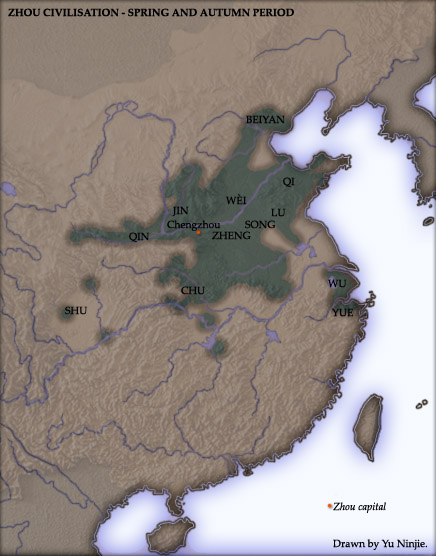
The Eastern Zhou (/dʒoʊ/; c. 770–256 BC) is a period in Chinese history comprising the latter half of the Zhou dynasty, following the Western Zhou era and the royal court's relocation eastward from Fenghao to Chengzhou (near present-day Luoyang). The Eastern Zhou was characterised by the weakened authority of the Ji family, the Zhou royal house. It is subdivided into two parts: the Spring and Autumn period (c. 770 – c. 481 or 476 BC), during which the ancient aristocracy still held power in a large number of separate polities, and the Warring States period (c. 481 or 476 – 221 BC), which saw the consolidation of territory and escalation of interstate warfare and administrative sophistication.
According to traditional historical texts such as the Records of the Grand Historian, the Zhou capital was moved from Haojing (Chang'an District in Xi'an) to Chengzhou (Luoyang) in 770 BC. With the death of King You, the last king of the Western Zhou Dynasty, Crown Prince Yijiu was proclaimed the new king by the nobles from the states of Zheng, Lü, Qin and the Marquess of Shen. He became King Ping. In the second year of his reign, he moved the capital east to Luoyi as Quanrong people invaded Haojing, spelling the end of the Western Zhou dynasty.
The recently discovered Xinian Manuscript has challenged this view. Of the beginning of the Eastern Zhou period, it says:
The rulers of the states and various officials thereupon established the younger brother of King You, Yuchen, at Guo: this was King Hui from Xie. Twenty-one years after his establishment, marquis Wen of Jin named Qiu killed King Hui at Guo. For nine years Zhou was without a king, and the rulers of the states and regional lords then for the first time ceased attending the Zhou court. Thereupon, marquis Wen of Jin greeted King Ping at Shao'e and established him at the Royal Capital. After three years, he relocated eastward, stopping at Chengzhou.
Instead of King Ping being immediately accepted by the regional lords after his father's death, the Xinian claims that his younger brother (elsewhere called his uncle) Yuchen was crowned as King Hui at Xie (somewhere in the state of Guo). After he was killed in 750 BC, there was no officially recognized king of Zhou for 9 more years, until marquis Wen of Jin brought Ping from Shao'e to the Royal Capital (almost certainly referring to Haojing) and enthroned him. Only three years after that in 738 BC did he move to Chengzhou.
The Xinian manuscript is controversial. Marquis Wen of Jin was thought to have reigned from 781 to 746 BC, and so he could not have proclaimed Ping as king in 741 BC nor move him to Chengzhou in 738 BC. However, the strongest argument in favor of the Xinian's telling of events about King Ping comes from a passage in the Zuo Zhuan, which reads in its entry for the 22nd year of Duke Xi (638 BC):
Earlier, when King Ping had moved the capital to the east, Xin You had gone to Yichuan and, upon seeing someone with unbound hair offering a sacrifice in the countryside, he said: "Within one hundred years this likely will be the Rong's [territory]! Ritual propriety had been lost already!" In autumn, Qin and Jin moved the Rong of Luhun to Yichuan.
The 'prophecies' in the Zuo Zhuan do not appear to have been made randomly and are usually precisely correct except in cases where state calendars differed slightly or when the prophecy was set to happen after the Zuo Zhuan was compiled. This prophecy is completely incorrect according to the traditional telling of King Ping's move east, but lines up perfectly with the Xinian's date.
Hub AI
Eastern Zhou AI simulator
(@Eastern Zhou_simulator)
Eastern Zhou
The Eastern Zhou (/dʒoʊ/; c. 770–256 BC) is a period in Chinese history comprising the latter half of the Zhou dynasty, following the Western Zhou era and the royal court's relocation eastward from Fenghao to Chengzhou (near present-day Luoyang). The Eastern Zhou was characterised by the weakened authority of the Ji family, the Zhou royal house. It is subdivided into two parts: the Spring and Autumn period (c. 770 – c. 481 or 476 BC), during which the ancient aristocracy still held power in a large number of separate polities, and the Warring States period (c. 481 or 476 – 221 BC), which saw the consolidation of territory and escalation of interstate warfare and administrative sophistication.
According to traditional historical texts such as the Records of the Grand Historian, the Zhou capital was moved from Haojing (Chang'an District in Xi'an) to Chengzhou (Luoyang) in 770 BC. With the death of King You, the last king of the Western Zhou Dynasty, Crown Prince Yijiu was proclaimed the new king by the nobles from the states of Zheng, Lü, Qin and the Marquess of Shen. He became King Ping. In the second year of his reign, he moved the capital east to Luoyi as Quanrong people invaded Haojing, spelling the end of the Western Zhou dynasty.
The recently discovered Xinian Manuscript has challenged this view. Of the beginning of the Eastern Zhou period, it says:
The rulers of the states and various officials thereupon established the younger brother of King You, Yuchen, at Guo: this was King Hui from Xie. Twenty-one years after his establishment, marquis Wen of Jin named Qiu killed King Hui at Guo. For nine years Zhou was without a king, and the rulers of the states and regional lords then for the first time ceased attending the Zhou court. Thereupon, marquis Wen of Jin greeted King Ping at Shao'e and established him at the Royal Capital. After three years, he relocated eastward, stopping at Chengzhou.
Instead of King Ping being immediately accepted by the regional lords after his father's death, the Xinian claims that his younger brother (elsewhere called his uncle) Yuchen was crowned as King Hui at Xie (somewhere in the state of Guo). After he was killed in 750 BC, there was no officially recognized king of Zhou for 9 more years, until marquis Wen of Jin brought Ping from Shao'e to the Royal Capital (almost certainly referring to Haojing) and enthroned him. Only three years after that in 738 BC did he move to Chengzhou.
The Xinian manuscript is controversial. Marquis Wen of Jin was thought to have reigned from 781 to 746 BC, and so he could not have proclaimed Ping as king in 741 BC nor move him to Chengzhou in 738 BC. However, the strongest argument in favor of the Xinian's telling of events about King Ping comes from a passage in the Zuo Zhuan, which reads in its entry for the 22nd year of Duke Xi (638 BC):
Earlier, when King Ping had moved the capital to the east, Xin You had gone to Yichuan and, upon seeing someone with unbound hair offering a sacrifice in the countryside, he said: "Within one hundred years this likely will be the Rong's [territory]! Ritual propriety had been lost already!" In autumn, Qin and Jin moved the Rong of Luhun to Yichuan.
The 'prophecies' in the Zuo Zhuan do not appear to have been made randomly and are usually precisely correct except in cases where state calendars differed slightly or when the prophecy was set to happen after the Zuo Zhuan was compiled. This prophecy is completely incorrect according to the traditional telling of King Ping's move east, but lines up perfectly with the Xinian's date.
Recent media