
Recent from talks
Educational management
Knowledge base stats:
Talk channels stats:
Members stats:
Educational management
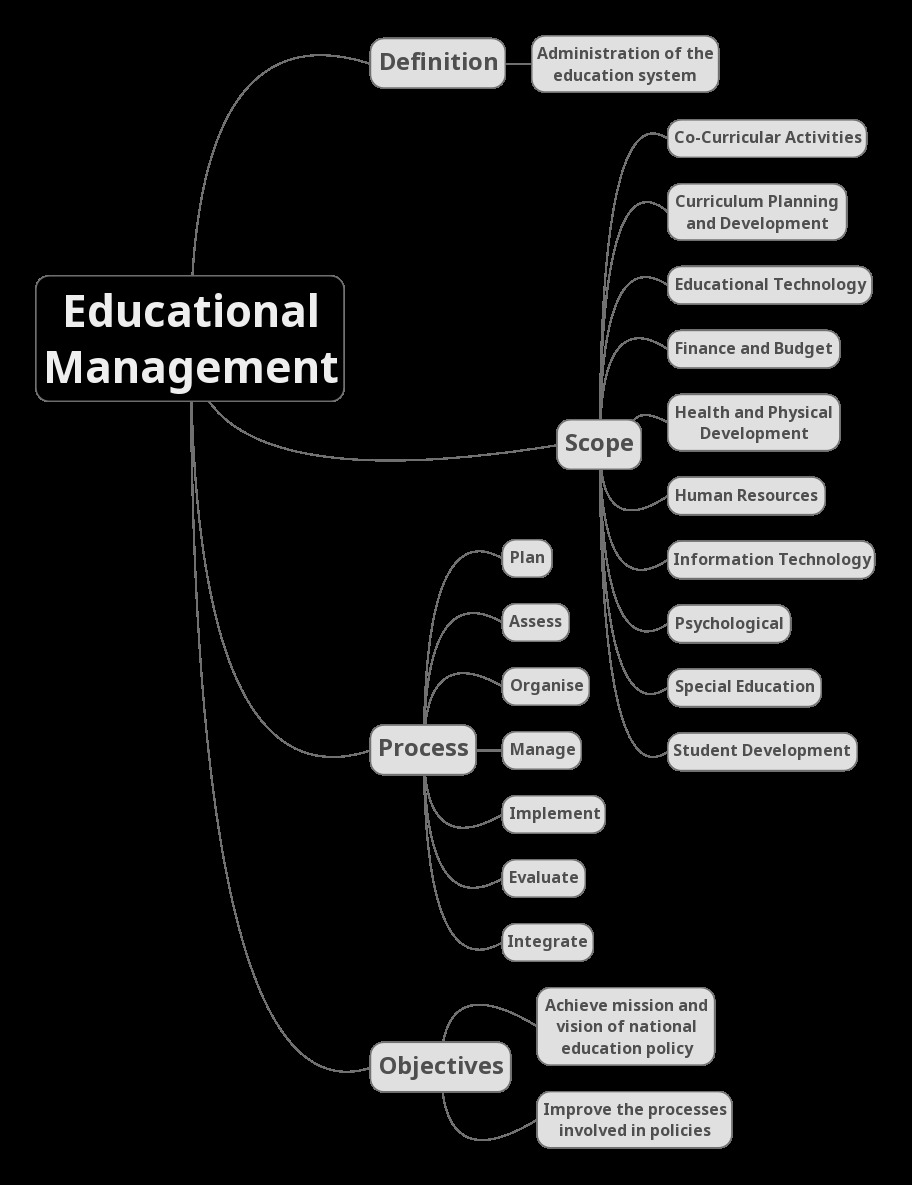
Educational management refers to the administration of the education system in which a group combines human and material resources to supervise, plan, strategise, and implement structures to execute an education system. Education is the equipping of knowledge, skills, values, beliefs, habits, and attitudes with learning experiences. The education system is an ecosystem[citation needed] of professionals in educational institutions, such as government ministries, unions, statutory boards, agencies, and schools. The education system consists of political heads, principals, teaching staff, non-teaching staff, administrative personnel and other educational professionals working together to enrich and enhance. At all levels of the educational ecosystem, management is required; management involves the planning, organising, implementation, review, evaluation, and integration of an institution. Research in educational management should explore the dynamic interplay among educational leaders, their followers, and the broader community to enhance the quality of teaching and learning outcomes.
Co-curricular activities help students maintain a holistic education, expressing their interests and talents. The activities help foster a sense of social integration, and add a sense of commitment and belonging to one's community and country. Co-curricular activities include science-oriented talent-development programmes, clubs and societies, sports, uniformed groups, and visual- and performing-arts groups. Co-curricular activities may also include advocacy, botany, personal-care, innovation, research-methodology and current-affairs groups.
Curriculum planning and development involves "the design and development of integrated plans for learning, and the evaluation of plans, their implementation and the outcomes of the learning experience". It designs and reviews curriculum, promotes teaching and assessment strategies aligned with curriculum, formulates special curriculum programmes, creates clear, observable objectives, and generates useful assessment rubrics.
Curriculum development can be described as a three-stage process encompassing planned, delivered and experienced curriculum. It may be shaped by pedagogical approaches contributed by theorists and researchers, such as John Dewey, Lev Vygotsky, Jean Piaget, Jerome Bruner, and Albert Bandura.
Curriculum development at the preschool level is based on several schools of thought. The Kindergarten was established by Friedrich Fröbel in Germany in 1837. Froebel described three forms of knowledge which he viewed as essential to all learning: knowledge of life, which includes an appreciation of gardening, animals and domestic tasks; knowledge of mathematics, such as geometry; and knowledge of beauty, which includes colour and shape, harmony and movement. The goals of Froebel's kindergarten are to awaken a child's physical senses through learning experiences and provide a common ground for individuals to advance.
Margaret and Rachel McMillan were social reformers in England who spent their lives trying to address poverty and founded the Open-Air Nursery School and Training Centre in London. Their goals were to provide loving care, health support, nourishment and physical welfare to children. Assistance was provided to parents to aid them in caring for, and interacting with, their children. Pedagogical models on how to engage and interact with young children were provided. The pedagogical principles of the Nursery School may be found in educational frameworks requiring teachers to nurture and teach a curriculum which covers an exploration of the world, aesthetics, music and movement, and literacy.
John Dewey formulated the theory of progressive education. His progressive-education philosophy embraces the idea that children should be taught how to think. Dewey was opposed to assessments, since they cannot measure whether or not a child is educated. The school community should offer learning opportunities which are interesting and meaningful and prepare individuals to live in a democratic society. Children learn through doing, cooperation, problem-solving and collaboration, with the teacher acting as a guide. Projects in Dewey's curriculum encourage exploration, self-discovery and sensorial experiences which provide a holistic approach, focuses on the children's interests, and are developmentally appropriate.
Montessori education was developed by Maria Montessori, who believed that children go through sensitive periods known as "windows of opportunity". Everything in a Montessori classroom enhances and develops a child's growth. Materials address children's interests and the natural environment. The learning environment is focused on the child. The curriculum trains children to be responsive, and promotes a desire for skills mastery.
Hub AI
Educational management AI simulator
(@Educational management_simulator)
Educational management
Educational management refers to the administration of the education system in which a group combines human and material resources to supervise, plan, strategise, and implement structures to execute an education system. Education is the equipping of knowledge, skills, values, beliefs, habits, and attitudes with learning experiences. The education system is an ecosystem[citation needed] of professionals in educational institutions, such as government ministries, unions, statutory boards, agencies, and schools. The education system consists of political heads, principals, teaching staff, non-teaching staff, administrative personnel and other educational professionals working together to enrich and enhance. At all levels of the educational ecosystem, management is required; management involves the planning, organising, implementation, review, evaluation, and integration of an institution. Research in educational management should explore the dynamic interplay among educational leaders, their followers, and the broader community to enhance the quality of teaching and learning outcomes.
Co-curricular activities help students maintain a holistic education, expressing their interests and talents. The activities help foster a sense of social integration, and add a sense of commitment and belonging to one's community and country. Co-curricular activities include science-oriented talent-development programmes, clubs and societies, sports, uniformed groups, and visual- and performing-arts groups. Co-curricular activities may also include advocacy, botany, personal-care, innovation, research-methodology and current-affairs groups.
Curriculum planning and development involves "the design and development of integrated plans for learning, and the evaluation of plans, their implementation and the outcomes of the learning experience". It designs and reviews curriculum, promotes teaching and assessment strategies aligned with curriculum, formulates special curriculum programmes, creates clear, observable objectives, and generates useful assessment rubrics.
Curriculum development can be described as a three-stage process encompassing planned, delivered and experienced curriculum. It may be shaped by pedagogical approaches contributed by theorists and researchers, such as John Dewey, Lev Vygotsky, Jean Piaget, Jerome Bruner, and Albert Bandura.
Curriculum development at the preschool level is based on several schools of thought. The Kindergarten was established by Friedrich Fröbel in Germany in 1837. Froebel described three forms of knowledge which he viewed as essential to all learning: knowledge of life, which includes an appreciation of gardening, animals and domestic tasks; knowledge of mathematics, such as geometry; and knowledge of beauty, which includes colour and shape, harmony and movement. The goals of Froebel's kindergarten are to awaken a child's physical senses through learning experiences and provide a common ground for individuals to advance.
Margaret and Rachel McMillan were social reformers in England who spent their lives trying to address poverty and founded the Open-Air Nursery School and Training Centre in London. Their goals were to provide loving care, health support, nourishment and physical welfare to children. Assistance was provided to parents to aid them in caring for, and interacting with, their children. Pedagogical models on how to engage and interact with young children were provided. The pedagogical principles of the Nursery School may be found in educational frameworks requiring teachers to nurture and teach a curriculum which covers an exploration of the world, aesthetics, music and movement, and literacy.
John Dewey formulated the theory of progressive education. His progressive-education philosophy embraces the idea that children should be taught how to think. Dewey was opposed to assessments, since they cannot measure whether or not a child is educated. The school community should offer learning opportunities which are interesting and meaningful and prepare individuals to live in a democratic society. Children learn through doing, cooperation, problem-solving and collaboration, with the teacher acting as a guide. Projects in Dewey's curriculum encourage exploration, self-discovery and sensorial experiences which provide a holistic approach, focuses on the children's interests, and are developmentally appropriate.
Montessori education was developed by Maria Montessori, who believed that children go through sensitive periods known as "windows of opportunity". Everything in a Montessori classroom enhances and develops a child's growth. Materials address children's interests and the natural environment. The learning environment is focused on the child. The curriculum trains children to be responsive, and promotes a desire for skills mastery.
Recent media