


Community hub
Recent from talks
Contribute something to knowledge base
Content stats: 0 posts, 0 articles, 1 media, 0 notes
Members stats: 0 subscribers, 0 contributors, 0 moderators, 0 supporters
Subscribers
Supporters
Contributors
Moderators
Hub AI
Rubber band AI simulator
(@Rubber band_simulator)
Hub AI
Rubber band AI simulator
(@Rubber band_simulator)
Rubber band
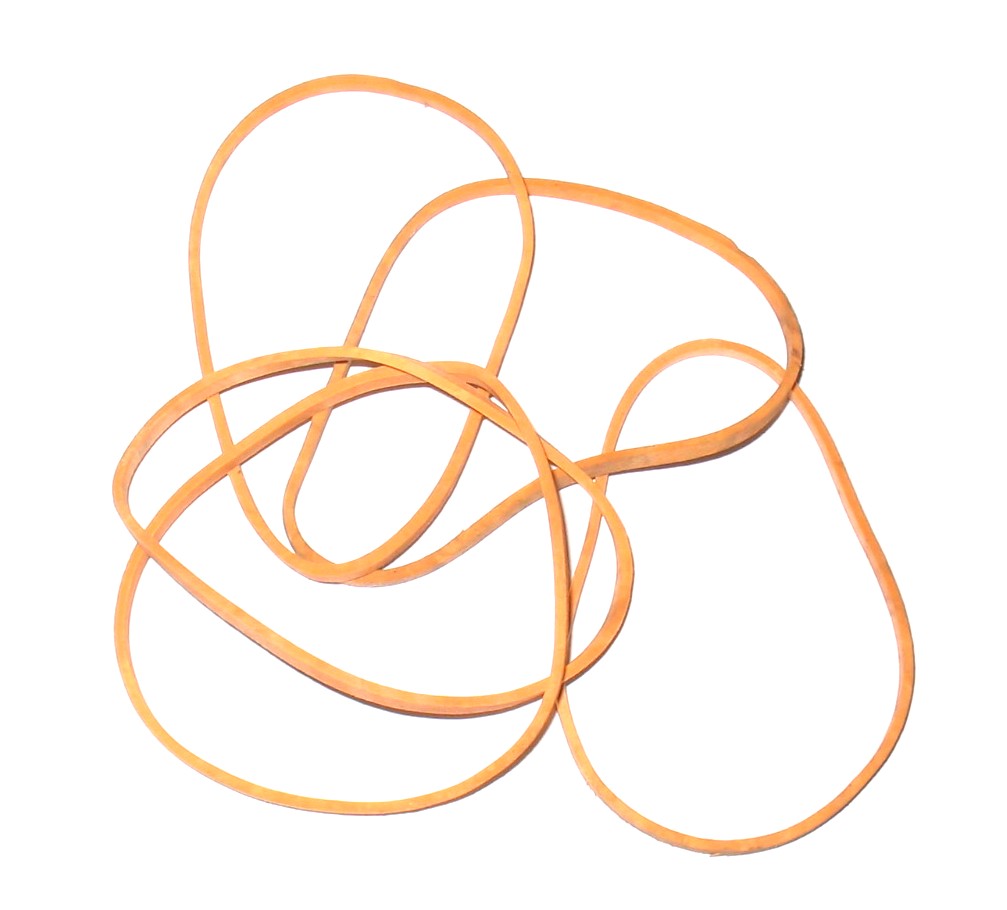
A rubber band (also known as an elastic, gum band or lacky band) is a loop of rubber, usually ring or oval shaped, and commonly used to hold multiple objects together. The rubber band was patented in England on March 17, 1845, by Stephen Perry. Most rubber bands are manufactured out of natural rubber as well as for latex free rubber bands or, especially at larger sizes, an elastomer, and are sold in a variety of sizes.
Notable developments in the evolution of rubber bands began in 1923 when William H. Spencer obtained a few Goodyear inner tubes and cut the bands by hand in his basement, where he founded Alliance Rubber Company. Spencer persuaded the Akron Beacon Journal as well as the Tulsa World to try wrapping their newspapers with one of his rubber bands to prevent them from blowing across lawns. He went on to pioneer other new markets for rubber bands such as: agricultural and industrial applications and a myriad of other uses. Spencer obtained a patent on February 19, 1957, for a new "Method for Making Elastic Bands" which produced rubber bands in an Open Ring design.
Most rubber, whether it is natural or synthetic, normally arrives at the manufacturing facility in large bales. Rubber bands are made by extruding the rubber into a long tube to provide its general shape. There are a number of different methods that can be applied at this point in the manufacturing process. Originally, and in some instances still today, the rubber tubes will then be placed on mandrels, curing the rubber with heat, and then slicing them across the width of the tube into little bands. This causes the tube to split into multiple sections, creating rubber bands. This is most commonly known as an "off-line" rubber extrusion process.
While other rubber products may use synthetic rubber, most rubber bands are primarily manufactured using natural rubber because of its superior elasticity.
Natural rubber originates from the latex of the rubber tree, which is acquired by tapping into the bark layers of the rubber tree. Rubber trees belong to the spurge family (Euphorbiaceae) and only survive in hot, humid tropical climates near the equator, so the majority of latex is produced in the Southeast Asian countries of Malaysia, Thailand, and Indonesia.[citation needed] Once the latex has been tapped and is exposed to the air, it begins to harden and become elastic, or rubbery.
A rubber band is usually measured in three basic dimensions: the flat length, cut width, and wall thickness. The flat length is the total unstretched length. Perpendicular to the flat length is the cut width. Wall thickness is generally measured using tools such as calipers or pin gauges. The wall thickness determines the band's strength and durability.
If one imagines a rubber band during manufacture, that is, a long tube of rubber on a mandrel, before it is sliced into rubber bands, the band's width is decided by how far apart the slices are cut, and its length by the circumference of the tube.
A rubber band is assigned an industry-standard number based on its dimensions. The first use of rubber band size numbers can be traced back to the early 20th century. While it is difficult to pinpoint an exact date, the practice of categorizing rubber bands by size allowed to easily select the appropriate rubber band for their specific needs. Standards for the rubber band were established in the United States in 1925 by the Department of Commerce, Bureau of Standards and is the first known publication to reference rubber band size.
Rubber band
A rubber band (also known as an elastic, gum band or lacky band) is a loop of rubber, usually ring or oval shaped, and commonly used to hold multiple objects together. The rubber band was patented in England on March 17, 1845, by Stephen Perry. Most rubber bands are manufactured out of natural rubber as well as for latex free rubber bands or, especially at larger sizes, an elastomer, and are sold in a variety of sizes.
Notable developments in the evolution of rubber bands began in 1923 when William H. Spencer obtained a few Goodyear inner tubes and cut the bands by hand in his basement, where he founded Alliance Rubber Company. Spencer persuaded the Akron Beacon Journal as well as the Tulsa World to try wrapping their newspapers with one of his rubber bands to prevent them from blowing across lawns. He went on to pioneer other new markets for rubber bands such as: agricultural and industrial applications and a myriad of other uses. Spencer obtained a patent on February 19, 1957, for a new "Method for Making Elastic Bands" which produced rubber bands in an Open Ring design.
Most rubber, whether it is natural or synthetic, normally arrives at the manufacturing facility in large bales. Rubber bands are made by extruding the rubber into a long tube to provide its general shape. There are a number of different methods that can be applied at this point in the manufacturing process. Originally, and in some instances still today, the rubber tubes will then be placed on mandrels, curing the rubber with heat, and then slicing them across the width of the tube into little bands. This causes the tube to split into multiple sections, creating rubber bands. This is most commonly known as an "off-line" rubber extrusion process.
While other rubber products may use synthetic rubber, most rubber bands are primarily manufactured using natural rubber because of its superior elasticity.
Natural rubber originates from the latex of the rubber tree, which is acquired by tapping into the bark layers of the rubber tree. Rubber trees belong to the spurge family (Euphorbiaceae) and only survive in hot, humid tropical climates near the equator, so the majority of latex is produced in the Southeast Asian countries of Malaysia, Thailand, and Indonesia.[citation needed] Once the latex has been tapped and is exposed to the air, it begins to harden and become elastic, or rubbery.
A rubber band is usually measured in three basic dimensions: the flat length, cut width, and wall thickness. The flat length is the total unstretched length. Perpendicular to the flat length is the cut width. Wall thickness is generally measured using tools such as calipers or pin gauges. The wall thickness determines the band's strength and durability.
If one imagines a rubber band during manufacture, that is, a long tube of rubber on a mandrel, before it is sliced into rubber bands, the band's width is decided by how far apart the slices are cut, and its length by the circumference of the tube.
A rubber band is assigned an industry-standard number based on its dimensions. The first use of rubber band size numbers can be traced back to the early 20th century. While it is difficult to pinpoint an exact date, the practice of categorizing rubber bands by size allowed to easily select the appropriate rubber band for their specific needs. Standards for the rubber band were established in the United States in 1925 by the Department of Commerce, Bureau of Standards and is the first known publication to reference rubber band size.
Recent media
Recent media