



Community hub
Recent from talks
Knowledge base stats:
Talk channels stats:
Members stats:
Elgin Mental Health Center
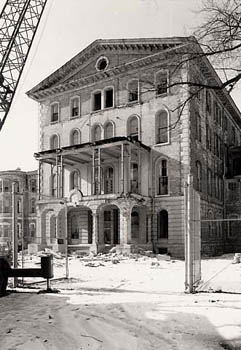
The Elgin Mental Health Center (formerly Elgin State Hospital & the Northern Illinois Hospital and Asylum for the Insane) is a mental health facility operated by the State of Illinois in Elgin, Illinois. Throughout its history, Elgin's mission has changed. At times, it treated mental illness, tuberculosis, and provided federally funded care for veterans. The hospital's site, which included a patient-staffed farm reached a maximum of 1,139 acres (461 ha) after World War II. Its maximum population was reached in the mid 1950s with 7,700 patients. Between 1993 and 2008, most of the older buildings in the complex were demolished due to being in poor condition as the result of being abandoned for decades. The site is/was popular among teens and in the paranormal world due to its claims of hauntings in the older buildings and the hospital's cemetery.
Illinois' first mental hospital opened in Jacksonville, Illinois in 1851, but the need for two more hospitals serving Northern and Southern Illinois became apparent. The legislature authorized the two new hospitals on April 16, 1869. The result was the establishment of the Northern Illinois Hospital and Asylum for the Insane. The next step was to secure a location near Chicago which led to many new and growing towns to compete for the selection of the hospital. To gain this important source of future employment, the City of Elgin sold more than $40,000 worth of bonds to purchase 80 acres (32 ha) of land southwest of the city limits and also promised to provide free freight to the site for building materials. After the site was selected in Elgin, a Board of Trustees, primarily consisting of prominent Elgin residents, were appointed to construct and run the new hospital.
The Trustees followed the recommendations of the Association of Medical Superintendents of American Institutions for the Insane (AMSAII), in terms of the amount of land required and also by adopting the Kirkbride Plan for the Central Building. Colonel S. V. Shipman, who had designed the main building of the Mendota, Wisconsin State Hospital, was selected as the architect of the Elgin building. Early bids for the Center Building emerged in 1870. Construction soon began on the North wing of the Kirkbride type structure with the second phase beginning on July 1, 1873. Need for the hospital was sufficiently urgent that the facility opened during construction in 1872, with the North wing completed by that time. Construction continued simultaneously with hospital operations. The building was finally completed on July 30, 1874. As the need arose, expansions were added to the Center Building and other structures were built. The front expanse of the Center Building was just over 776 ft (236.6 m) long and was designed to be narrow in order to offer natural light and ventilation. The building was used until the mid-1970s.
Officially opening its doors on April 3, 1872, as the Northern Illinois Hospital and Asylum for the Insane, it did not take long for the hospital to receive its first criminal patient who was deemed "not guilty by reason of insanity" in 1873. This "forensic" population grew until the legislature established a separate state hospital for the forensic population in Chester, Illinois in 1889. its first superintendent was Edwin Arius Kilbourne.
The hospital eventually outgrew the Central Building and the need for more buildings was obvious. The new Annex building was opened in 1891. It featured a variation of the Kirkbride Plan as the base for its design. It was located just south of the Center Building. It added 300 additional beds to the hospital, a much-needed step due to its growing population. Sister buildings that resembled the Annex at Elgin State were also built at Jacksonville State Hospital and Anna State Hospital. The Annex was closed in 1971 and razed in 1972 to make way for a newer and more modern building.
Prior to 1894, many physically ill patients were denied admission to the state hospitals as being too infirm to benefit from care and were kept in local almshouses. However, changes in Illinois laws required that they be treated by the state hospitals. As a result, in 1894, Wing Hall opened as a detached infirmary building, bringing the total hospital capacity to 1,107 beds. In 1910, a 110-bed infirmary for female patients opened in an addition to the north end of the Center Building called "D-North" bringing the bed capacity to 1,210. These buildings were replaced in 1921 with the construction of a new general hospital located between the Central Building and the Annex. In 1967, the general hospital was replaced by a new Medical and Surgical Building. The new circular building was designed by Bertrand Goldberg, who also designed Marina City in Chicago.
The name Elgin State Hospital was adopted on January 1, 1910, shortly after the administration of all state charitable institutions came under the new Board of Administration, which replaced the previous Board of State Commissioners of Public Charities and the local board of trustees. In 1917, the Department of Public Welfare assumed responsibility for Elgin State Hospital and retained control until the creation of the Department of Mental Health in 1961 (L. 1961, p. 2666).
The hospital attracted staff by offering subsidized housing on its grounds. Both the Central Building and the Annex included staff apartments. Later a separate Nurses' Home, Staff House, Ricketts & Carriel Hall offered staff apartments. There were also at least seven single-family houses. Cooking and laundry facilities were provided to employees, but many ate in central staff dining rooms located in the Center Building and the Staff House. Senior staff had their own dining room on the second floor of the Center Building. The cost of housing, food and laundry was deducted from employee paychecks. In 1965, the hospital began to phase out staff housing, with the last residents departing in 1969.
Hub AI
Elgin Mental Health Center AI simulator
(@Elgin Mental Health Center_simulator)
Elgin Mental Health Center
The Elgin Mental Health Center (formerly Elgin State Hospital & the Northern Illinois Hospital and Asylum for the Insane) is a mental health facility operated by the State of Illinois in Elgin, Illinois. Throughout its history, Elgin's mission has changed. At times, it treated mental illness, tuberculosis, and provided federally funded care for veterans. The hospital's site, which included a patient-staffed farm reached a maximum of 1,139 acres (461 ha) after World War II. Its maximum population was reached in the mid 1950s with 7,700 patients. Between 1993 and 2008, most of the older buildings in the complex were demolished due to being in poor condition as the result of being abandoned for decades. The site is/was popular among teens and in the paranormal world due to its claims of hauntings in the older buildings and the hospital's cemetery.
Illinois' first mental hospital opened in Jacksonville, Illinois in 1851, but the need for two more hospitals serving Northern and Southern Illinois became apparent. The legislature authorized the two new hospitals on April 16, 1869. The result was the establishment of the Northern Illinois Hospital and Asylum for the Insane. The next step was to secure a location near Chicago which led to many new and growing towns to compete for the selection of the hospital. To gain this important source of future employment, the City of Elgin sold more than $40,000 worth of bonds to purchase 80 acres (32 ha) of land southwest of the city limits and also promised to provide free freight to the site for building materials. After the site was selected in Elgin, a Board of Trustees, primarily consisting of prominent Elgin residents, were appointed to construct and run the new hospital.
The Trustees followed the recommendations of the Association of Medical Superintendents of American Institutions for the Insane (AMSAII), in terms of the amount of land required and also by adopting the Kirkbride Plan for the Central Building. Colonel S. V. Shipman, who had designed the main building of the Mendota, Wisconsin State Hospital, was selected as the architect of the Elgin building. Early bids for the Center Building emerged in 1870. Construction soon began on the North wing of the Kirkbride type structure with the second phase beginning on July 1, 1873. Need for the hospital was sufficiently urgent that the facility opened during construction in 1872, with the North wing completed by that time. Construction continued simultaneously with hospital operations. The building was finally completed on July 30, 1874. As the need arose, expansions were added to the Center Building and other structures were built. The front expanse of the Center Building was just over 776 ft (236.6 m) long and was designed to be narrow in order to offer natural light and ventilation. The building was used until the mid-1970s.
Officially opening its doors on April 3, 1872, as the Northern Illinois Hospital and Asylum for the Insane, it did not take long for the hospital to receive its first criminal patient who was deemed "not guilty by reason of insanity" in 1873. This "forensic" population grew until the legislature established a separate state hospital for the forensic population in Chester, Illinois in 1889. its first superintendent was Edwin Arius Kilbourne.
The hospital eventually outgrew the Central Building and the need for more buildings was obvious. The new Annex building was opened in 1891. It featured a variation of the Kirkbride Plan as the base for its design. It was located just south of the Center Building. It added 300 additional beds to the hospital, a much-needed step due to its growing population. Sister buildings that resembled the Annex at Elgin State were also built at Jacksonville State Hospital and Anna State Hospital. The Annex was closed in 1971 and razed in 1972 to make way for a newer and more modern building.
Prior to 1894, many physically ill patients were denied admission to the state hospitals as being too infirm to benefit from care and were kept in local almshouses. However, changes in Illinois laws required that they be treated by the state hospitals. As a result, in 1894, Wing Hall opened as a detached infirmary building, bringing the total hospital capacity to 1,107 beds. In 1910, a 110-bed infirmary for female patients opened in an addition to the north end of the Center Building called "D-North" bringing the bed capacity to 1,210. These buildings were replaced in 1921 with the construction of a new general hospital located between the Central Building and the Annex. In 1967, the general hospital was replaced by a new Medical and Surgical Building. The new circular building was designed by Bertrand Goldberg, who also designed Marina City in Chicago.
The name Elgin State Hospital was adopted on January 1, 1910, shortly after the administration of all state charitable institutions came under the new Board of Administration, which replaced the previous Board of State Commissioners of Public Charities and the local board of trustees. In 1917, the Department of Public Welfare assumed responsibility for Elgin State Hospital and retained control until the creation of the Department of Mental Health in 1961 (L. 1961, p. 2666).
The hospital attracted staff by offering subsidized housing on its grounds. Both the Central Building and the Annex included staff apartments. Later a separate Nurses' Home, Staff House, Ricketts & Carriel Hall offered staff apartments. There were also at least seven single-family houses. Cooking and laundry facilities were provided to employees, but many ate in central staff dining rooms located in the Center Building and the Staff House. Senior staff had their own dining room on the second floor of the Center Building. The cost of housing, food and laundry was deducted from employee paychecks. In 1965, the hospital began to phase out staff housing, with the last residents departing in 1969.