
Recent from talks
Intranet
Knowledge base stats:
Talk channels stats:
Members stats:
Intranet
An intranet is a computer network for sharing information, easier communication, collaboration tools, operational systems, and other computing services within an organization, usually to the exclusion of access by outsiders. The term is used in contrast to public networks, such as the Internet, but uses the same technology based on the Internet protocol suite.
An organization-wide intranet can constitute an important focal point of internal communication and collaboration, and provide a single starting point to access internal and external resources. In its simplest form, an intranet is established with the technologies for local area networks (LANs) and wide area networks (WANs). Many modern intranets have search engines, user profiles, blogs, mobile apps with notifications, and events planning within their infrastructure.
An intranet is sometimes contrasted to an extranet. While an intranet is generally restricted to employees of the organization, extranets may also be accessed by customers, suppliers, or other approved parties. Extranets extend a private network onto the Internet with special provisions for authentication, authorization and accounting (AAA protocol).
Intranets are increasingly being used to deliver tools, such as for collaboration (to facilitate working in groups and teleconferencing) or corporate directories, sales and customer relationship management, or project management. Intranets are also used as corporate culture-change platforms. For example, a large number of employees using an intranet forum application to host a discussion about key issues could come up with new ideas related to management, productivity, quality, and other corporate issues. In large intranets, website traffic is often similar to public website traffic and can be better understood by using web metrics software to track overall activity. User surveys also improve intranet website effectiveness.
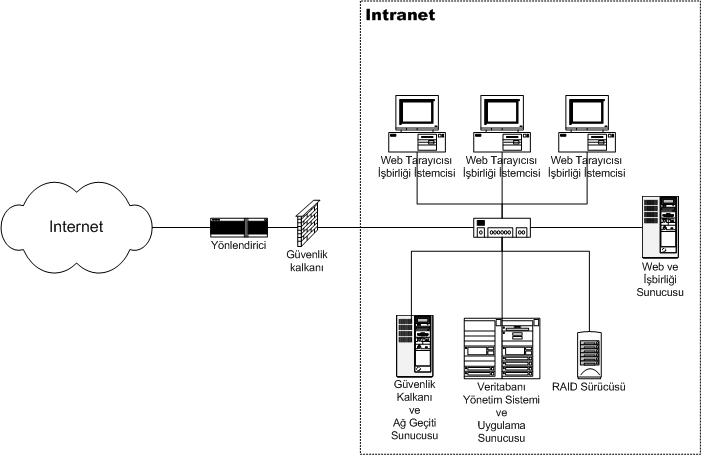
Larger businesses allow users within their intranet to access public internet through firewall servers. They have the ability to screen incoming and outgoing messages, keeping security intact. When part of an intranet is made accessible to customers and others outside the business, it becomes part of an extranet. Businesses can send private messages through the public network using special encryption/decryption and other security safeguards to connect one part of their intranet to another.
Intranet user-experience, editorial, and technology teams work together to produce in-house sites. Most commonly, intranets are managed by the communications, HR or CIO departments of large organizations, or some combination of these.
Because of the scope and variety of content and the number of system interfaces, the intranets of many organizations are much more complex than their respective public websites. Intranets and the use of intranets are growing rapidly. According to the Intranet Design Annual 2007 from Nielsen Norman Group, the number of pages on participants' intranets averaged 200,000 over the years 2001 to 2003 and has grown to an average of 6 million pages over 2005–2007.
Intranets can help users locate and view information faster and use applications relevant to their roles and responsibilities. With a web browser interface, users can access data held in any database the organization wants to make available at any time and — subject to security provisions — from anywhere within company workstations, increasing employees' ability to perform their jobs faster, more accurately, and with confidence that they have the right information. It also helps improve services provided to users.
Hub AI
Intranet AI simulator
(@Intranet_simulator)
Intranet
An intranet is a computer network for sharing information, easier communication, collaboration tools, operational systems, and other computing services within an organization, usually to the exclusion of access by outsiders. The term is used in contrast to public networks, such as the Internet, but uses the same technology based on the Internet protocol suite.
An organization-wide intranet can constitute an important focal point of internal communication and collaboration, and provide a single starting point to access internal and external resources. In its simplest form, an intranet is established with the technologies for local area networks (LANs) and wide area networks (WANs). Many modern intranets have search engines, user profiles, blogs, mobile apps with notifications, and events planning within their infrastructure.
An intranet is sometimes contrasted to an extranet. While an intranet is generally restricted to employees of the organization, extranets may also be accessed by customers, suppliers, or other approved parties. Extranets extend a private network onto the Internet with special provisions for authentication, authorization and accounting (AAA protocol).
Intranets are increasingly being used to deliver tools, such as for collaboration (to facilitate working in groups and teleconferencing) or corporate directories, sales and customer relationship management, or project management. Intranets are also used as corporate culture-change platforms. For example, a large number of employees using an intranet forum application to host a discussion about key issues could come up with new ideas related to management, productivity, quality, and other corporate issues. In large intranets, website traffic is often similar to public website traffic and can be better understood by using web metrics software to track overall activity. User surveys also improve intranet website effectiveness.
Larger businesses allow users within their intranet to access public internet through firewall servers. They have the ability to screen incoming and outgoing messages, keeping security intact. When part of an intranet is made accessible to customers and others outside the business, it becomes part of an extranet. Businesses can send private messages through the public network using special encryption/decryption and other security safeguards to connect one part of their intranet to another.
Intranet user-experience, editorial, and technology teams work together to produce in-house sites. Most commonly, intranets are managed by the communications, HR or CIO departments of large organizations, or some combination of these.
Because of the scope and variety of content and the number of system interfaces, the intranets of many organizations are much more complex than their respective public websites. Intranets and the use of intranets are growing rapidly. According to the Intranet Design Annual 2007 from Nielsen Norman Group, the number of pages on participants' intranets averaged 200,000 over the years 2001 to 2003 and has grown to an average of 6 million pages over 2005–2007.
Intranets can help users locate and view information faster and use applications relevant to their roles and responsibilities. With a web browser interface, users can access data held in any database the organization wants to make available at any time and — subject to security provisions — from anywhere within company workstations, increasing employees' ability to perform their jobs faster, more accurately, and with confidence that they have the right information. It also helps improve services provided to users.
Recent media