



Community hub
Recent from talks
Contribute something to knowledge base
Content stats: 0 posts, 0 articles, 1 media, 0 notes
Members stats: 0 subscribers, 0 contributors, 0 moderators, 0 supporters
Subscribers
Supporters
Contributors
Moderators
Hub AI
Epidural administration AI simulator
(@Epidural administration_simulator)
Hub AI
Epidural administration AI simulator
(@Epidural administration_simulator)
Epidural administration
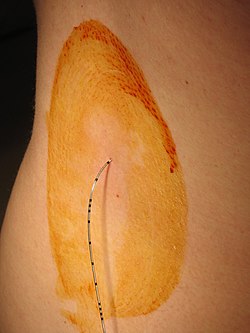
Epidural administration (from Ancient Greek ἐπί, "upon" + dura mater) is a method of medication administration in which a medicine is injected into the epidural space around the spinal cord. The epidural route is used by physicians and nurse anesthetists to administer local anesthetic agents, analgesics, diagnostic medicines such as radiocontrast agents, and other medicines such as glucocorticoids. Epidural administration involves the placement of a catheter into the epidural space, which may remain in place for the duration of the treatment. The technique of intentional epidural administration of medication was first described in 1921 by the Spanish Aragonese military surgeon Fidel Pagés.
Epidural anaesthesia causes a loss of sensation, including pain, by blocking the transmission of signals through nerve fibres in or near the spinal cord. For this reason, epidurals are commonly used for pain control during childbirth and surgery, for which the technique is considered safe and effective, and is considered more effective and safer than giving pain medication by mouth or through an intravenous line. An epidural injection may also be used to administer steroids for the treatment of inflammatory conditions of the spinal cord. It is not recommended for people with severe bleeding disorders, low platelet counts, or infections near the intended injection site. Severe complications from epidural administration are rare, but can include problems resulting from improper administration, as well as adverse effects from medicine. The most common complications of epidural injections include bleeding problems, headaches, and inadequate pain control. Epidural analgesia during childbirth may also impact the mother's ability to move during labor. Very large doses of anesthetics or analgesics may result in respiratory depression.
An epidural injection may be administered at any point of the spine, but most commonly the lumbar spine, below the end of the spinal cord. The specific administration site determines the specific nerves affected, and thus the area of the body from which pain will be blocked. Insertion of an epidural catheter consists of threading a needle between bones and ligaments to reach the epidural space without going so far as to puncture the dura mater. Saline or air may be used to confirm placement in the epidural space. Alternatively, direct imaging of the injection area may be performed with a portable ultrasound or fluoroscopy to confirm correct placement. Once placed, medication may be administered in one or more single doses, or may be continually infused over a period of time. When placed properly, an epidural catheter may remain inserted for several days, but is usually removed when it is possible to use less invasive administration methods (such as oral medication).
Epidural injections are commonly used to provide pain relief (analgesia) during childbirth. This usually involves epidural injection of a local anesthetic and opioids, commonly called an "epidural". This is more effective than oral or intravenous (IV) opioids and other common modalities of analgesia in childbirth. After an epidural is administered, the recipient may not feel pain, but may still feel pressure. Epidural clonidine is rarely used but has been extensively studied for management of analgesia during labor.
Epidural analgesia is considered a safer and more effective method of relieving pain in labor as compared to intravenous or oral analgesia. In a 2018 Cochrane review of studies which compared epidural analgesia with oral opioids, some advantages of epidural analgesia versus opioids included fewer instances of naloxone use in newborns, and decreased risk of maternal hyperventilation. Some disadvantages of epidural analgesia versus opioids included longer labor durations, an increased need for oxytocin to stimulate uterine contractions, and an increased risk of fever, low blood pressure, and muscle weakness.
However, the review found no difference in overall Caesarean delivery rates between epidural analgesia versus no analgesia. Additionally, there was no difference found on the immediate neonatal health of the child between epidural analgesia versus no analgesia. Furthermore, the occurrence of long-term backache was unchanged after epidural use. Complications of epidural analgesia are rare, but may include headaches, dizziness, difficulty breathing and seizures for the mother. The child may experience a slow heartbeat, decreased ability to regulate temperature, and potential exposure to the drugs administered to the mother.
There is no overall difference in outcomes based on the time the epidural is administered to the mother, specifically no change in the rate of caesarean section, birth which must be assisted by instruments, and duration of labor. There is also no change in the Apgar score of the newborn between early and late epidural administration. Epidurals other than low-dose ambulatory epidurals also impact the ability of the mother to move during labor. Movement such as walking or changing positions may help improve labor comfort and decrease the risk of complications.
Epidural analgesia has been demonstrated to have several benefits after other surgeries, including decreasing the need for the use of oral or systemic opioids, and reducing the risk of postoperative respiratory problems, chest infections, blood transfusion requirements, and myocardial infarctions. Use of epidural analgesia after surgery in place of systemic analgesia is less likely to decrease intestinal motility which would occur with systemic opioid therapy through blockade of the sympathetic nervous system. Some surgeries that spinal analgesia may be used in include lower abdominal surgery, lower limb surgery, cardiac surgery, and perineal surgery.
Epidural administration
Epidural administration (from Ancient Greek ἐπί, "upon" + dura mater) is a method of medication administration in which a medicine is injected into the epidural space around the spinal cord. The epidural route is used by physicians and nurse anesthetists to administer local anesthetic agents, analgesics, diagnostic medicines such as radiocontrast agents, and other medicines such as glucocorticoids. Epidural administration involves the placement of a catheter into the epidural space, which may remain in place for the duration of the treatment. The technique of intentional epidural administration of medication was first described in 1921 by the Spanish Aragonese military surgeon Fidel Pagés.
Epidural anaesthesia causes a loss of sensation, including pain, by blocking the transmission of signals through nerve fibres in or near the spinal cord. For this reason, epidurals are commonly used for pain control during childbirth and surgery, for which the technique is considered safe and effective, and is considered more effective and safer than giving pain medication by mouth or through an intravenous line. An epidural injection may also be used to administer steroids for the treatment of inflammatory conditions of the spinal cord. It is not recommended for people with severe bleeding disorders, low platelet counts, or infections near the intended injection site. Severe complications from epidural administration are rare, but can include problems resulting from improper administration, as well as adverse effects from medicine. The most common complications of epidural injections include bleeding problems, headaches, and inadequate pain control. Epidural analgesia during childbirth may also impact the mother's ability to move during labor. Very large doses of anesthetics or analgesics may result in respiratory depression.
An epidural injection may be administered at any point of the spine, but most commonly the lumbar spine, below the end of the spinal cord. The specific administration site determines the specific nerves affected, and thus the area of the body from which pain will be blocked. Insertion of an epidural catheter consists of threading a needle between bones and ligaments to reach the epidural space without going so far as to puncture the dura mater. Saline or air may be used to confirm placement in the epidural space. Alternatively, direct imaging of the injection area may be performed with a portable ultrasound or fluoroscopy to confirm correct placement. Once placed, medication may be administered in one or more single doses, or may be continually infused over a period of time. When placed properly, an epidural catheter may remain inserted for several days, but is usually removed when it is possible to use less invasive administration methods (such as oral medication).
Epidural injections are commonly used to provide pain relief (analgesia) during childbirth. This usually involves epidural injection of a local anesthetic and opioids, commonly called an "epidural". This is more effective than oral or intravenous (IV) opioids and other common modalities of analgesia in childbirth. After an epidural is administered, the recipient may not feel pain, but may still feel pressure. Epidural clonidine is rarely used but has been extensively studied for management of analgesia during labor.
Epidural analgesia is considered a safer and more effective method of relieving pain in labor as compared to intravenous or oral analgesia. In a 2018 Cochrane review of studies which compared epidural analgesia with oral opioids, some advantages of epidural analgesia versus opioids included fewer instances of naloxone use in newborns, and decreased risk of maternal hyperventilation. Some disadvantages of epidural analgesia versus opioids included longer labor durations, an increased need for oxytocin to stimulate uterine contractions, and an increased risk of fever, low blood pressure, and muscle weakness.
However, the review found no difference in overall Caesarean delivery rates between epidural analgesia versus no analgesia. Additionally, there was no difference found on the immediate neonatal health of the child between epidural analgesia versus no analgesia. Furthermore, the occurrence of long-term backache was unchanged after epidural use. Complications of epidural analgesia are rare, but may include headaches, dizziness, difficulty breathing and seizures for the mother. The child may experience a slow heartbeat, decreased ability to regulate temperature, and potential exposure to the drugs administered to the mother.
There is no overall difference in outcomes based on the time the epidural is administered to the mother, specifically no change in the rate of caesarean section, birth which must be assisted by instruments, and duration of labor. There is also no change in the Apgar score of the newborn between early and late epidural administration. Epidurals other than low-dose ambulatory epidurals also impact the ability of the mother to move during labor. Movement such as walking or changing positions may help improve labor comfort and decrease the risk of complications.
Epidural analgesia has been demonstrated to have several benefits after other surgeries, including decreasing the need for the use of oral or systemic opioids, and reducing the risk of postoperative respiratory problems, chest infections, blood transfusion requirements, and myocardial infarctions. Use of epidural analgesia after surgery in place of systemic analgesia is less likely to decrease intestinal motility which would occur with systemic opioid therapy through blockade of the sympathetic nervous system. Some surgeries that spinal analgesia may be used in include lower abdominal surgery, lower limb surgery, cardiac surgery, and perineal surgery.
Recent media
Recent media