


Community hub
Recent from talks
Contribute something to knowledge base
Content stats: 0 posts, 0 articles, 1 media, 0 notes
Members stats: 0 subscribers, 0 contributors, 0 moderators, 0 supporters
Subscribers
Supporters
Contributors
Moderators
Hub AI
Solution concept AI simulator
(@Solution concept_simulator)
Hub AI
Solution concept AI simulator
(@Solution concept_simulator)
Solution concept
In game theory, a solution concept is a formal rule for predicting how a game will be played. These predictions are called "solutions", and describe which strategies will be adopted by players and, therefore, the result of the game. The most commonly used solution concepts are equilibrium concepts, most famously Nash equilibrium.
Many solution concepts, for many games, will result in more than one solution. This puts any one of the solutions in doubt, so a game theorist may apply a refinement to narrow down the solutions. Each successive solution concept presented in the following improves on its predecessor by eliminating implausible equilibria in richer games.
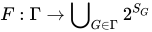
Let be the class of all games and, for each game , let be the set of strategy profiles of . A solution concept is an element of the direct product i.e., a function such that for all




In this solution concept, players are assumed to be rational and so strictly dominated strategies are eliminated from the set of strategies that might feasibly be played. A strategy is strictly dominated when there is some other strategy available to the player that always has a higher payoff, regardless of the strategies that the other players choose. (Strictly dominated strategies are also important in minimax game-tree search.) For example, in the (single period) prisoners' dilemma (shown below), cooperate is strictly dominated by defect for both players because either player is always better off playing defect, regardless of what his opponent does.
A Nash equilibrium is a strategy profile (a strategy profile specifies a strategy for every player, e.g. in the above prisoners' dilemma game (cooperate, defect) specifies that prisoner 1 plays cooperate and prisoner 2 plays defect) in which every strategy played by every agent (agent i) is a best response to every other strategy played by all the other opponents (agents j for every j≠i) . A strategy by a player is a best response to another player's strategy if there is no other strategy that could be played that would yield a higher pay-off in any situation in which the other player's strategy is played.
In some games, there are multiple Nash equilibria, but not all of them are realistic. In dynamic games, backward induction can be used to eliminate unrealistic Nash equilibria. Backward induction assumes that players are rational and will make the best decisions based on their future expectations. This eliminates noncredible threats, which are threats that a player would not carry out if they were ever called upon to do so.
For example, consider a dynamic game with an incumbent firm and a potential entrant to the industry. The incumbent has a monopoly and wants to maintain its market share. If the entrant enters, the incumbent can either fight or accommodate the entrant. If the incumbent accommodates, the entrant will enter and gain profit. If the incumbent fights, it will lower its prices, run the entrant out of business (incurring exit costs), and damage its own profits.
The best response for the incumbent if the entrant enters is to accommodate, and the best response for the entrant if the incumbent accommodates is to enter. This results in a Nash equilibrium. However, if the incumbent chooses to fight, the best response for the entrant is to not enter. If the entrant does not enter, it does not matter what the incumbent chooses to do. Hence, fight can be considered a best response for the incumbent if the entrant does not enter, resulting in another Nash equilibrium.
Solution concept
In game theory, a solution concept is a formal rule for predicting how a game will be played. These predictions are called "solutions", and describe which strategies will be adopted by players and, therefore, the result of the game. The most commonly used solution concepts are equilibrium concepts, most famously Nash equilibrium.
Many solution concepts, for many games, will result in more than one solution. This puts any one of the solutions in doubt, so a game theorist may apply a refinement to narrow down the solutions. Each successive solution concept presented in the following improves on its predecessor by eliminating implausible equilibria in richer games.
Let be the class of all games and, for each game , let be the set of strategy profiles of . A solution concept is an element of the direct product i.e., a function such that for all
In this solution concept, players are assumed to be rational and so strictly dominated strategies are eliminated from the set of strategies that might feasibly be played. A strategy is strictly dominated when there is some other strategy available to the player that always has a higher payoff, regardless of the strategies that the other players choose. (Strictly dominated strategies are also important in minimax game-tree search.) For example, in the (single period) prisoners' dilemma (shown below), cooperate is strictly dominated by defect for both players because either player is always better off playing defect, regardless of what his opponent does.
A Nash equilibrium is a strategy profile (a strategy profile specifies a strategy for every player, e.g. in the above prisoners' dilemma game (cooperate, defect) specifies that prisoner 1 plays cooperate and prisoner 2 plays defect) in which every strategy played by every agent (agent i) is a best response to every other strategy played by all the other opponents (agents j for every j≠i) . A strategy by a player is a best response to another player's strategy if there is no other strategy that could be played that would yield a higher pay-off in any situation in which the other player's strategy is played.
In some games, there are multiple Nash equilibria, but not all of them are realistic. In dynamic games, backward induction can be used to eliminate unrealistic Nash equilibria. Backward induction assumes that players are rational and will make the best decisions based on their future expectations. This eliminates noncredible threats, which are threats that a player would not carry out if they were ever called upon to do so.
For example, consider a dynamic game with an incumbent firm and a potential entrant to the industry. The incumbent has a monopoly and wants to maintain its market share. If the entrant enters, the incumbent can either fight or accommodate the entrant. If the incumbent accommodates, the entrant will enter and gain profit. If the incumbent fights, it will lower its prices, run the entrant out of business (incurring exit costs), and damage its own profits.
The best response for the incumbent if the entrant enters is to accommodate, and the best response for the entrant if the incumbent accommodates is to enter. This results in a Nash equilibrium. However, if the incumbent chooses to fight, the best response for the entrant is to not enter. If the entrant does not enter, it does not matter what the incumbent chooses to do. Hence, fight can be considered a best response for the incumbent if the entrant does not enter, resulting in another Nash equilibrium.
Recent media
Recent media