Hubbry Logo
Long-eared jerboaLong-eared jerboaMain
Open search
Long-eared jerboa
Community hub
Long-eared jerboa
logo
8 pages, 0 posts
0 subscribers
Be the first to start a discussion here.
Long-eared jerboa
Long-eared jerboa
from Wikipedia

Long-eared jerboa
Scientific classification Edit this classification
Kingdom: Animalia
Phylum: Chordata
Class: Mammalia
Order: Rodentia
Family: Dipodidae
Subfamily: Euchoreutinae
Lyon, 1901
Genus: Euchoreutes
W. L. Sclater, 1891
Species:
E. naso
Binomial name
Euchoreutes naso

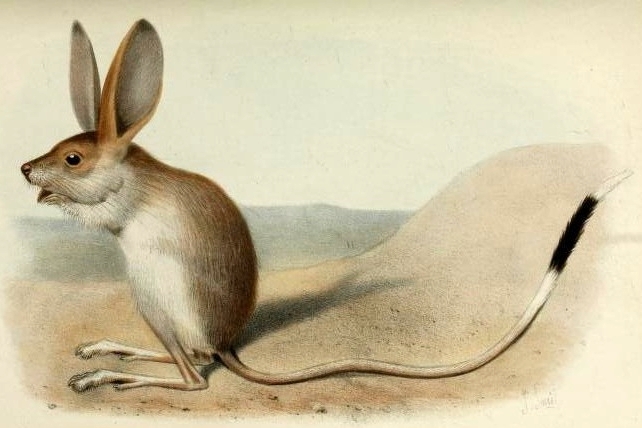
The long-eared jerboa (Euchoreutes naso)[2] is a nocturnal mouse-like rodent with a long tail, long hind legs for jumping, and exceptionally large ears. It is distinct enough that authorities consider it to be the only member of both its genus, Euchoreutes, and subfamily, Euchoreutinae.

Long-eared jerboas are found in the Palearctic ecozone. The specific palearctic ecozone areas they are found in are southernmost Mongolia to the Takla-Makan Desert, Mengxin, Aerijin Mountain, and Qinghai-Tibet Plateau regions of north western China. Long-eared jerboas in most cases are nocturnal,[3] The long-eared jerboa's fur according to the book 100 animals to see before they die "is reddish yellow to pale russet with white underparts."[4] Very little is known about the species.

Description

[edit]

The long-eared jerboa's head and body length measures 70 to 90 mm (2.8 to 3.5 in) while its tail is double this size, between 150 and 162 mm (5.9 and 6.4 in). Like its disproportionately long tail, its hind feet are also large, helping it to jump high, measuring between 40 and 46 mm (1.6 and 1.8 in).[3] It weighs 24 to 38 g (0.85 to 1.34 oz).[4] Long-eared jerboas usually eat insects. They use sound to locate and capture them by performing fast leaps into the air. According to animal diversity web, "The two lateral digits are shorter than the three central ones. The central metatarsals are fused for a small distance. The feet are covered with tufts of bristly hairs. Long-eared jerboas have ears that are 1/3 longer than their heads. The incisors are thin and white. A small premolar can be found on each side of the upper jaw. Females have eight mammae."[3] Their fur is light reddish/brown with a white underside. Their tails are covered in fine hairs the same color as their body and have a black and white tuft on the end.

Conservation

[edit]

The long-eared jerboa was identified as one of the top-10 "focal species" in 2007 by the Evolutionarily Distinct and Globally Endangered (EDGE) project.[5]

In 2007 Zoological Society of London EDGE of Existence Programme sent a researcher to study human impact on its environment. The study returned with video footage that has been noted as the "first time" the creature has been "recorded on camera".[6] This has helped to start a campaign to protect them.[7]

References

[edit]
[edit]
Revisions and contributorsEdit on WikipediaRead on Wikipedia
from Grokipedia
The long-eared jerboa (Euchoreutes naso) is a small, nocturnal in the family Dipodidae, renowned for its disproportionately large ears—measuring about one-third longer than its head—long hind legs for bipedal hopping, and a roughly twice the length of its body, which aids in balance and sensory functions. With a body length of 70–90 mm, a of 150–162 mm, and hind feet of 40–46 mm, it features reddish-yellow fur on the upper parts, a white underbelly, and a distinctive white-and-black tuft at the 's end; females have eight mammae, and all individuals possess five digits on their hind feet with fused central metatarsals. Native to the , this species is distributed across southern and , including the Takla-Makan Desert, Mengxin region, Aerijin Mountain, and the Qing-Zang Plateau, where it thrives in arid desert and semi-desert environments with sandy valleys and low shrub cover at high elevations. Primarily insectivorous, it specializes in capturing flying through acute hearing and agile leaps, and it constructs multiple burrows—temporary ones for shelter and more permanent ones for breeding or winter . Behaviorally solitary and elusive, the long-eared jerboa is active at night to avoid predators and extreme daytime heat, relying on its oversized ears not only for acute hearing to detect prey but also for by dissipating body heat in its harsh . Classified as Least Concern on the , its population faces potential threats from habitat degradation due to human activities such as and , though its wide distribution and adaptability mitigate immediate risks. First described in 1891 from syntypes collected near Yarkand in , , this unique dipodid exemplifies specialized adaptations to extreme arid conditions.

Taxonomy

Classification

The long-eared jerboa, Euchoreutes naso, belongs to the kingdom Animalia, phylum Chordata, class Mammalia, order Rodentia, and family Dipodidae, which encompasses various jumping rodents known as jerboas. Within the family Dipodidae, it is placed in the subfamily Euchoreutinae, a monotypic subfamily containing only this species, underscoring its unique morphological and evolutionary divergence from other jerboas. The Euchoreutes is also monotypic, comprising solely E. naso, which highlights the ' distinct lineage within the Dipodidae. This taxonomic isolation reflects specialized adaptations that set it apart from congeners in related subfamilies, such as Dipodinae. The was first described by British zoologist William Lutley Sclater in 1891, based on specimens collected from . The original description appeared in the Proceedings of the Zoological Society of , establishing Euchoreutes naso as a novel and within the rodent family Dipodidae.
Taxonomic RankName
KingdomAnimalia
PhylumChordata
ClassMammalia
OrderRodentia
FamilyDipodidae
SubfamilyEuchoreutinae
GenusEuchoreutes
SpeciesE. naso

Phylogenetic position

The long-eared jerboa (Euchoreutes naso) is classified in the monogeneric subfamily Euchoreutinae within the family Dipodidae, distinguishing it from other jerboas through its highly specialized bipedal morphology, including elongated hindlimbs and partially fused metatarsals that enhance saltatorial locomotion in arid environments. This subfamily represents a unique evolutionary lineage, having diverged early from the main radiation of bipedal jerboas, with adaptations such as oversized ears and five-toed feet reflecting independent specialization for desert life. The separation of Euchoreutinae is supported by morphological traits like middle ear anatomy, which show affinities to basal groups but differ markedly from the digging-oriented Allactaginae or the acoustic-specialized Dipodinae. Molecular phylogenetic analyses, drawing on sequences from four nuclear genes (IRBP, GHR, , and ), position Euchoreutinae in an unresolved trichotomy with the subfamilies Dipodinae (three-toed s) and Allactaginae (five-toed jerboas), following the basal Cardiocraniinae within Dipodidae. This placement underscores the limited availability of genetic data for E. naso due to its rarity and nocturnal habits. These genetic insights link Euchoreutinae's basal position in the core jerboa radiation to the expansion of open arid habitats, where evolved convergently to facilitate efficient movement and resource exploitation in desert ecosystems.

Physical characteristics

Morphology

The long-eared jerboa (Euchoreutes naso) is a diminutive characterized by a compact body structure. Its head-body length measures 70–90 mm, while the tail extends 150–162 mm, nearly twice the body length and aiding in balance. Adults weigh 24–38 g, with an average around 30 g. The ears are disproportionately large, reaching 40–60 mm in length—up to three-quarters the head-body length—and are thinly covered in fine hairs. The fur is soft and dense, providing insulation in arid environments. Dorsally, it is sandy yellow to light reddish, blending with desert sands for camouflage, while the ventral side is stark white. The tail is covered in long, silky hairs, terminating in a distinctive black-and-white tuft that enhances its visual appeal and functional utility. Limb morphology reflects its specialized locomotion. The hind limbs are elongated, approximately twice the head-body length, with hind feet measuring 40–46 mm; they feature five toes, including three central ones that are longer and partially fused at the metatarsals, plus two shorter lateral digits. In contrast, the forelimbs are short and robust, with the inner toe bearing a curved claw for grooming. The soles of the hind feet are fringed with stiff, bristly hairs. Females have eight mammae.

Adaptations

The long-eared jerboa's oversized pinnae serve dual critical functions in its arid habitat, facilitating and sensory acuity. The expansive surface area of the ears promotes heat dissipation through increased blood flow to superficial vessels, allowing the animal to release excess body heat into the surrounding air during nocturnal activity in hot conditions. Additionally, the large ears enhance auditory sensitivity, enabling detection of sounds produced by flying , which form a primary food source. To cope with extreme , the long-eared jerboa exhibits remarkable physiological adaptations for conservation, relying entirely on metabolic derived from its insectivorous diet without needing free-standing sources. Its kidneys are highly efficient at producing hyper-concentrated , a trait common among that minimizes loss by maximizing in the , thereby maintaining hydration in environments where is minimal. Burrowing represents another key for survival, with the long-eared 's robust incisors and foreclaws enabling the excavation of complex, multi-chambered underground systems that provide refuge and from predators. These structures typically include shallow temporary burrows for daytime rest and deeper permanent ones with chambers for nesting, sealed with plugs to regulate humidity and temperature. The specialized and morphology facilitate rapid digging through sandy substrates, essential for escaping diurnal heat and nocturnal threats in open desert landscapes.

Distribution and habitat

Geographic range

The long-eared jerboa (Euchoreutes naso) is native to the arid zones of southern and northwestern China, where it inhabits desert and semi-desert landscapes. Its range spans the in southern Mongolia and extends into China's Uyghur Autonomous Region, including the , as well as the Nei Mongol Autonomous Region, , , and Hui Autonomous Region, including specific areas such as the Mengxin region, Aerijin Mountain, and parts of the Qing-Zang Plateau. Populations are also documented in the foothills of the and the Dzungarian Basin, reflecting adaptation to these expansive, low-elevation arid environments. The overall geographic extent of the species covers approximately 141,000 km², concentrated in extreme arid ecosystems with limited . Within this range, the distribution is patchy, confined to suitable sandy and gravelly substrates, though the species is considered widely distributed and stable across its core areas. No comprehensive global population estimates exist, but local observations indicate persistent presence without evidence of widespread decline.

Habitat preferences

The long-eared jerboa inhabits desert ecosystems consisting of sandy or gravelly plains with sparse vegetation, primarily within arid and semi-arid regions such as the Gobi and Taklamakan Deserts. These habitats support low plant diversity adapted to extreme and occur from lowland deserts at approximately 900 m to high-elevation areas over 3000 m on the Qing-Zang Plateau. Within these ecosystems, the species shows a preference for microhabitats in sandy valleys featuring loose sand substrates and scattered low-growing shrubs, such as (Saxaul trees), which provide minimal cover and foraging opportunities. It avoids rocky terrains or areas with dense vegetation on dunes, favoring open, flat expanses that facilitate its bipedal locomotion and burrowing. Burrows are excavated in the loose sand near these shrubs, serving as essential refuges; temporary burrows are used for short-term daytime and nighttime shelter, while permanent burrows are constructed for extended seasonal occupancy. Seasonal adaptations include deeper permanent burrows in winter for hibernation to maintain thermal stability, and shallower permanent burrows in summer for rapid access during active periods and reproduction.

Behavior and ecology

Activity patterns

The long-eared jerboa (Euchoreutes naso) exhibits a strictly nocturnal lifestyle, emerging from its burrows at to and retreating at dawn to avoid diurnal predators and extreme daytime temperatures in its desert habitat. This pattern aligns with the behavior of most Dipodidae family members, allowing the jerboa to exploit cooler nighttime conditions while minimizing exposure to heat and visual hunters. During the active season, the jerboa's is finely tuned to environmental cues, including lunar cycles, which influence activity levels to enhance predator avoidance; related species reduce surface activity on brighter moonlit nights to balance foraging needs with risk. Its solitary nature further supports this low-profile nocturnal routine, with individuals rarely interacting outside of brief encounters. In winter, the long-eared jerboa enters within deep permanent burrows, a state of prolonged where its body temperature approaches ambient levels to conserve energy amid cold desert conditions and food scarcity. This seasonal , common among cold-desert jerboas, halts most physiological processes until spring warming triggers emergence and breeding.

Locomotion and social structure

The long-eared employs bipedal hopping as its primary mode of locomotion, relying on its disproportionately long hind legs to navigate arid environments efficiently. This saltatorial adaptation allows it to execute horizontal leaps of up to 3 meters in a single bound, facilitating rapid escape from predators. During such movements, it can achieve speeds of up to 24 km/h, enhancing its survival in open, sandy habitats. The elongated tail plays a crucial role in maintaining balance during these high-speed hops and serves as a prop when the animal pauses upright. Socially, the long-eared jerboa is solitary, with adults maintaining independent lifestyles and exhibiting minimal interaction except during brief breeding encounters. While precise home range sizes remain undocumented, observations indicate non-territorial habits with limited overlap among individuals outside the reproductive period, reducing competition in resource-scarce areas. Communication among long-eared jerboas occurs mainly through chemical means, such as to deposit scent marks that signal presence or status to conspecifics. Their exceptionally keen hearing further suggests the potential use of acoustic signals or vibrations, though specific vocalizations have not been well-characterized.

Diet and foraging

Food sources

The long-eared jerboa (Euchoreutes naso) maintains a predominantly insectivorous diet, with insects accounting for approximately 95% of its food intake in Mongolian populations. This includes a range of arthropods such as beetles, grasshoppers, and flying insects like moths, which provide essential nutrients in the arid desert environment. The species' exceptional hearing aids in detecting these prey items, particularly those that are airborne. Opportunistically, long-eared jerboas supplement their diet with plant matter during periods of scarcity or seasonal variation, consuming items such as fresh green leaves after rainfall, roots, succulent shoots, and dry seeds. This omnivorous flexibility supports survival in fluctuating conditions, where availability shifts with and . The high-protein content of their primarily insect-based diet fulfills nutritional requirements for rapid growth and metabolic demands in juveniles and adults alike. Notably, long-eared jerboas derive all necessary moisture from their food sources, requiring no free-standing water intake, which is an to their water-scarce habitats.

Foraging techniques

The long-eared jerboa (Euchoreutes naso) primarily relies on auditory cues for , utilizing its disproportionately large ears—which are about one-third longer than its head—to detect the subtle sounds of flying insects in the nocturnal desert environment. This keen of hearing enables precise localization of prey, such as beetles and moths, even in complete . Upon detection, the jerboa executes rapid vertical leaps to intercept and capture the insects mid-air, showcasing its specialized bipedal locomotion adapted for such predatory maneuvers. In addition to aerial pursuits, the engages in ground-based , employing its elongated, hog-like to probe and excavate shallow depressions in the sandy . This technique uncovers buried or hidden , supplementing its insectivorous diet while minimizing energy expenditure in the arid landscape. The jerboa's short forelimbs assist in these digging efforts, allowing efficient access to subsurface prey without extensive burrowing. To mitigate predation risks during , the operates in open expanses but maintains vigilance through its exceptional auditory sensitivity, which alerts it to approaching nocturnal predators like or foxes. Upon sensing a threat, it swiftly abandons foraging and retreats to nearby burrows, leveraging its camouflaged fur and rapid hopping speed for evasion. This strategy ensures survival in exposed habitats where cover is scarce.

Reproduction and development

Breeding biology

The long-eared jerboa (Euchoreutes naso) breeds seasonally, with females typically producing two litters during the summer period from May to , immediately following emergence from . This timing aligns with the brief active season in their arid , maximizing reproductive opportunities within the constraints of environmental conditions and availability. The system is inferred to be polygynous, similar to that observed in closely related species within the family Dipodidae, where males with multiple females but provide minimal post-copulatory investment. Adults are solitary outside of breeding encounters, converging briefly for before separating. The period lasts 25 to 35 days, after which females give birth to litters of 2 to 6 young. Sexual maturity is attained at approximately 5 months of age, allowing individuals to participate in breeding during their second active season post-hibernation. Many details of for this species are inferred from closely related jerboas due to limited direct studies.

Life cycle stages

The long-eared jerboa (Euchoreutes_naso) pups are born blind and hairless following a period of 25 to 35 days, typically in litters of 2 to 6 individuals raised within permanent summer burrows. These neonates are entirely dependent on maternal and protection, with females providing exclusive care during this initial phase. In the neonatal stage, pups remain helpless and burrow-bound, with mothers providing care until the young begin to explore. During the juvenile growth phase, morphological changes occur to support the development of bipedal hopping locomotion. Juveniles eventually achieve independence and establish their own territories. This period is marked by vulnerability to predation by nocturnal desert predators. The overall lifespan of the long-eared jerboa is estimated at 2 to 3 years in the wild.

Conservation

Status and threats

The long-eared jerboa (Euchoreutes naso) is classified as Least Concern on the IUCN Red List, with the assessment conducted in 2016. This status reflects its widespread distribution across arid and semi-arid regions of Mongolia and northern China, where it occupies a presumed large but unquantified population. The species' overall population trend is unknown. It is also assessed as Least Concern in China's national Red List (2015). Although no major threats are identified at a global scale, localized risks include degradation from by and expansion of , which can reduce suitable desert shrubland. contributes to , potentially exacerbating loss through increased droughts and shifts in arid ecosystems. Human disturbance, such as activities, poses additional pressure in specific areas. Population trends show localized declines in heavily grazed regions, but the species' extensive range across diverse desert habitats buffers against overall vulnerability. This wide distribution helps maintain stability despite regional pressures.

Protection measures

The long-eared jerboa inhabits several protected areas across its range in the deserts of and , where efforts aim to safeguard its specialized dune ecosystems. In , approximately 44% of the species' range falls within designated protected zones, including Gobi Gurvansaikhan and the Great Gobi Strictly Protected Area (Sections A and B), as well as smaller reserves like Sharga and Mankhan. These areas enforce restrictions on human activities to preserve the arid landscapes essential for the jerboa's . In , the species occurs in the Uyghur Autonomous Region, particularly in the , where it benefits from broader desert nature reserves protecting arid biodiversity. Research initiatives have played a key role in advancing conservation knowledge since 2007, when the Zoological Society of London's Evolutionarily Distinct and Globally Endangered (EDGE) program initiated monitoring of the species. EDGE Fellows conducted the first field studies in the , employing to document behavior, distribution, and ecology—yielding the inaugural wild footage and revealing nocturnal activity patterns previously unknown. Subsequent surveys in Mongolian protected areas, such as the Small Gobi Strictly Protected Area, have continued to track and use, informing targeted interventions despite challenges from the jerboa's elusive . Management strategies emphasize sustainable land use and enforcement within protected zones to counter habitat pressures like overgrazing. Community-based initiatives in Mongolia promote grazing regulations, involving local herders in rotational practices to reduce degradation in key dune habitats, supported by projects like the German Technical Cooperation's efforts in southern Gobi protected areas. Anti-poaching patrols operate routinely in these reserves to prevent illegal activities, though the jerboa's primary threats stem from environmental factors rather than direct exploitation. While no established captive breeding programs exist due to the species' sensitivity to captivity, research highlights potential for such efforts to bolster populations if breeding protocols from related jerboa species are adapted. Future strategies focus on expanding monitoring and integrating climate resilience into protected area management.

References

Add your contribution
Related Hubs
User Avatar
No comments yet.