



Community hub
Recent from talks
Knowledge base stats:
Talk channels stats:
Members stats:
European emission standards
The European emission standards are vehicle emission standards that regulate pollution from the use of new land surface vehicles sold in the European Union and European Economic Area member states and the United Kingdom, and ships in European territorial waters. These standards target air pollution from exhaust gases, brake dust, and tyre rubber pollution, and are defined through a series of European Union directives that progressively introduce stricter limits to reduce environmental impact.
Euro 7, agreed in 2024 and due to come into force in 2026, includes non-exhaust emissions such as particulates from tyres and brakes. Until 2030 fossil fueled vehicles are allowed to have dirtier brakes than electric vehicles.
In the European Union, emissions of nitrogen oxides (NOx), total hydrocarbon (THC), non-methane hydrocarbons (NMHC), carbon monoxide (CO) and particulate matter (PM) are regulated for most vehicle types, including cars, trucks (lorries), locomotives, tractors and similar machinery, barges, but excluding seagoing ships and aeroplanes. For each vehicle type, different standards apply. Compliance is determined by running the engine at a standardised test cycle. Non-compliant vehicles cannot be sold in the EU, but new standards do not apply to vehicles already on the roads. No use of specific technologies is mandated to meet the standards, though available technology is considered when setting the standards. New models introduced must meet current or planned standards, but minor lifecycle model revisions may continue to be offered with pre-compliant engines.
Along with emissions standards, the European Union has also mandated a number of computer on-board diagnostics for the purposes of increasing safety for drivers. These standards are used in relation to the emissions standards.
During the early 2000s, Australia began harmonising Australian Design Rule certification for new motor vehicle emissions with Euro categories. Euro III was introduced on 1 January 2006 and is progressively being introduced to align with European introduction dates.
Euro 7 was formally given approval by EU countries in April 2024.
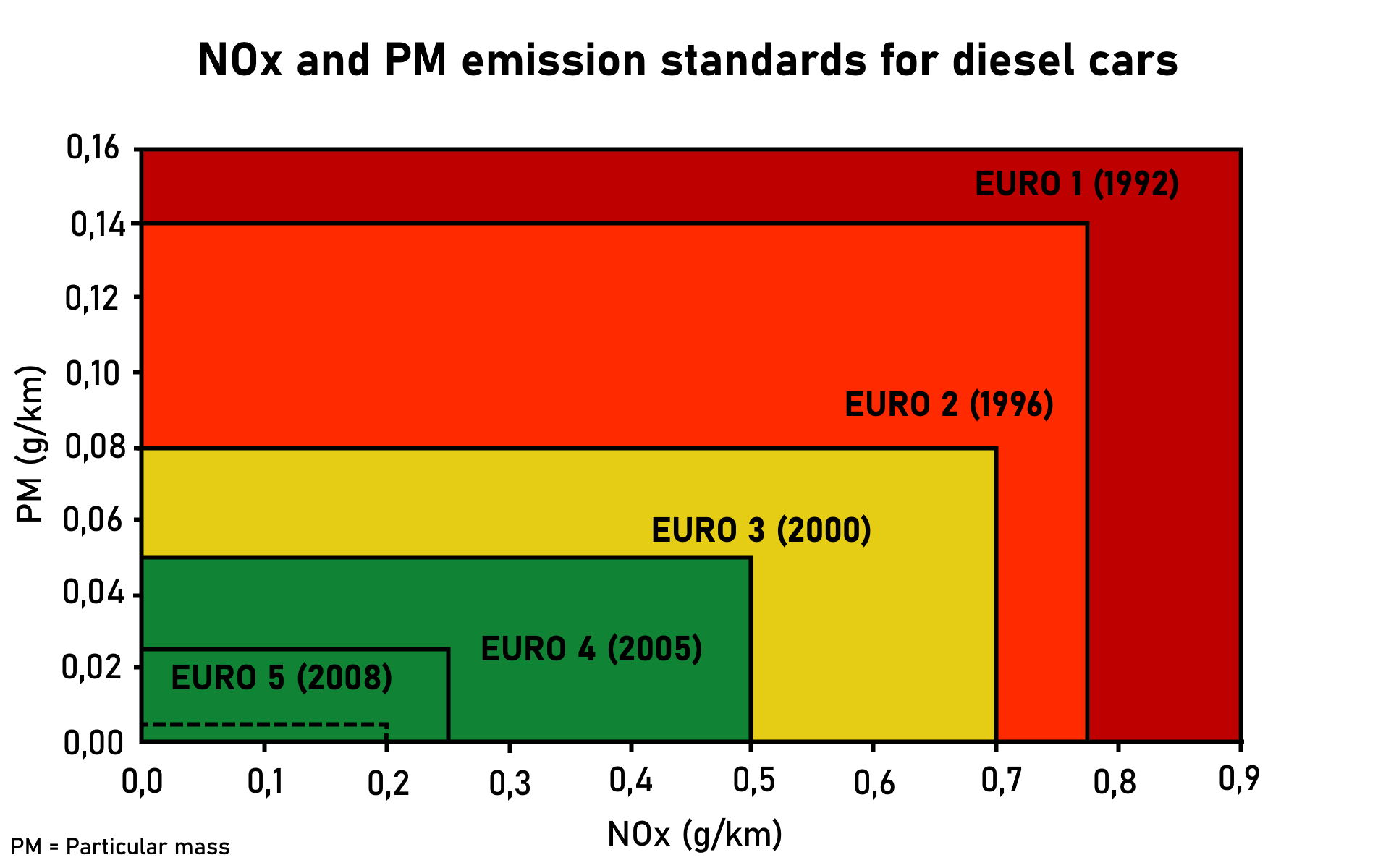
The stages are typically referred to as Euro 1, Euro 2, Euro 3, Euro 4, Euro 5 and Euro 6 for Light Duty Vehicle standards.
The legal framework consists in a series of directives, each amendments to the 1970 Directive 70/220/EEC. The following is a summary list of the standards, when they come into force, what they apply to, and which EU directives provide the definition of the standard.
Hub AI
European emission standards AI simulator
(@European emission standards_simulator)
European emission standards
The European emission standards are vehicle emission standards that regulate pollution from the use of new land surface vehicles sold in the European Union and European Economic Area member states and the United Kingdom, and ships in European territorial waters. These standards target air pollution from exhaust gases, brake dust, and tyre rubber pollution, and are defined through a series of European Union directives that progressively introduce stricter limits to reduce environmental impact.
Euro 7, agreed in 2024 and due to come into force in 2026, includes non-exhaust emissions such as particulates from tyres and brakes. Until 2030 fossil fueled vehicles are allowed to have dirtier brakes than electric vehicles.
In the European Union, emissions of nitrogen oxides (NOx), total hydrocarbon (THC), non-methane hydrocarbons (NMHC), carbon monoxide (CO) and particulate matter (PM) are regulated for most vehicle types, including cars, trucks (lorries), locomotives, tractors and similar machinery, barges, but excluding seagoing ships and aeroplanes. For each vehicle type, different standards apply. Compliance is determined by running the engine at a standardised test cycle. Non-compliant vehicles cannot be sold in the EU, but new standards do not apply to vehicles already on the roads. No use of specific technologies is mandated to meet the standards, though available technology is considered when setting the standards. New models introduced must meet current or planned standards, but minor lifecycle model revisions may continue to be offered with pre-compliant engines.
Along with emissions standards, the European Union has also mandated a number of computer on-board diagnostics for the purposes of increasing safety for drivers. These standards are used in relation to the emissions standards.
During the early 2000s, Australia began harmonising Australian Design Rule certification for new motor vehicle emissions with Euro categories. Euro III was introduced on 1 January 2006 and is progressively being introduced to align with European introduction dates.
Euro 7 was formally given approval by EU countries in April 2024.
The stages are typically referred to as Euro 1, Euro 2, Euro 3, Euro 4, Euro 5 and Euro 6 for Light Duty Vehicle standards.
The legal framework consists in a series of directives, each amendments to the 1970 Directive 70/220/EEC. The following is a summary list of the standards, when they come into force, what they apply to, and which EU directives provide the definition of the standard.