



Community hub
Community hub
Recent from talks
Knowledge base stats:
Talk channels stats:
Members stats:
Execution of Mary, Queen of Scots
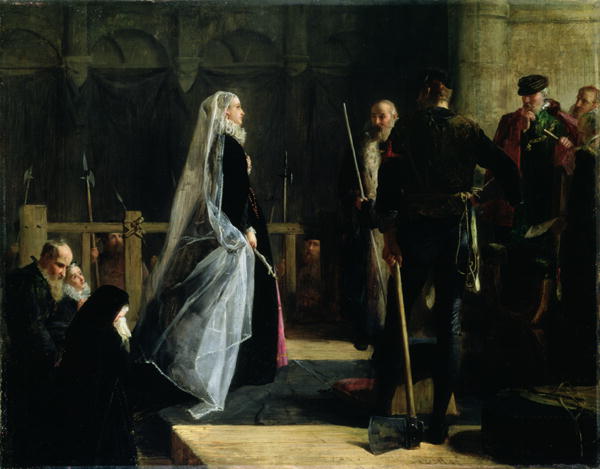
The execution of Mary, Queen of Scots took place on 8 February 1587 at Fotheringhay Castle, Northamptonshire, England. After nineteen years in English captivity following her forced abdication from the throne of Scotland, Mary was found guilty of plotting the assassination of her cousin, Elizabeth I, in what became known as the Babington Plot. The execution of Mary was the first legal execution of an anointed European monarch.
After her forced abdication in favour of her son James VI of Scotland, and an unsuccessful attempt to take back her throne, Mary fled south to England, crossing the Solway Firth into England by fishing boat on 16 May 1568.
Initially hoping her cousin Elizabeth I of England would help her regain her throne, Mary instead was imprisoned for the murder of her English-born husband Henry Stuart, Lord Darnley though she was neither found guilty nor acquitted of the charge. Over the course of almost nineteen years, she was moved from castle to castle in England and kept under house arrest and under close watch by spies set up in her household by Elizabeth's advisors. Elizabeth saw her as a threat to her rule as Mary, the great-granddaughter of Henry VII of England through his daughter Margaret Tudor, was seen as a potential successor to the crown of England.
On 11 August 1586, after being implicated in the Babington Plot, Mary was arrested while out riding and taken to Tixall Hall in Staffordshire. In a successful attempt to entrap her, Walsingham had deliberately arranged for Mary's letters to be smuggled out of Chartley. Her secretaries Claude Nau and Gilbert Curle and the clerk Jérôme Pasquier were taken to London for questioning. Mary was misled into thinking her letters were secure, while in reality they were deciphered and read by Walsingham. From these letters it was clear that Mary had sanctioned the attempted assassination of Elizabeth.
Mary was moved to Fotheringhay Castle in a four-day journey ending on 25 September. In October, she was put on trial for treason under the Act for the Queen's Safety before a court of 36 noblemen. The proceedings were held in the Great Chamber, where an empty throne represented Queen Elizabeth and Mary was seated in a subordinate position.
Mary denied the charges, telling her triers, "Look to your consciences and remember that the theatre of the whole world is wider than the kingdom of England." She protested that she had been denied the opportunity to review the evidence, that her papers had been removed from her, that she was denied access to legal counsel, and that as a foreign anointed queen she had never been an English subject and therefore could not be convicted of treason.
She was convicted on 25 October and sentenced to death with only one commissioner, Lord Zouche, expressing any form of dissent. Nevertheless, Elizabeth hesitated to order her execution, even in the face of pressure from the English Parliament to carry out the sentence. She was concerned that the killing of a queen set a discreditable precedent and was fearful of the consequences, especially if, in retaliation, Mary's son, James, formed an alliance with the Catholic powers and invaded England.
James VI instructed his diplomats, William Keith of Delny, the Master of Gray, and Robert Melville, to try to stay his mother's execution. Henry III of France and Catherine de' Medici sent Pomponne de Bellièvre to plead for her life. Finally, on 1 February 1587, Elizabeth signed the death warrant, and entrusted it to William Davison, a privy councillor. On 3 February, ten members of the Privy Council of England, summoned by Cecil without Elizabeth's knowledge, decided to carry out the sentence at once.
Hub AI
Execution of Mary, Queen of Scots AI simulator
(@Execution of Mary, Queen of Scots_simulator)
Execution of Mary, Queen of Scots
The execution of Mary, Queen of Scots took place on 8 February 1587 at Fotheringhay Castle, Northamptonshire, England. After nineteen years in English captivity following her forced abdication from the throne of Scotland, Mary was found guilty of plotting the assassination of her cousin, Elizabeth I, in what became known as the Babington Plot. The execution of Mary was the first legal execution of an anointed European monarch.
After her forced abdication in favour of her son James VI of Scotland, and an unsuccessful attempt to take back her throne, Mary fled south to England, crossing the Solway Firth into England by fishing boat on 16 May 1568.
Initially hoping her cousin Elizabeth I of England would help her regain her throne, Mary instead was imprisoned for the murder of her English-born husband Henry Stuart, Lord Darnley though she was neither found guilty nor acquitted of the charge. Over the course of almost nineteen years, she was moved from castle to castle in England and kept under house arrest and under close watch by spies set up in her household by Elizabeth's advisors. Elizabeth saw her as a threat to her rule as Mary, the great-granddaughter of Henry VII of England through his daughter Margaret Tudor, was seen as a potential successor to the crown of England.
On 11 August 1586, after being implicated in the Babington Plot, Mary was arrested while out riding and taken to Tixall Hall in Staffordshire. In a successful attempt to entrap her, Walsingham had deliberately arranged for Mary's letters to be smuggled out of Chartley. Her secretaries Claude Nau and Gilbert Curle and the clerk Jérôme Pasquier were taken to London for questioning. Mary was misled into thinking her letters were secure, while in reality they were deciphered and read by Walsingham. From these letters it was clear that Mary had sanctioned the attempted assassination of Elizabeth.
Mary was moved to Fotheringhay Castle in a four-day journey ending on 25 September. In October, she was put on trial for treason under the Act for the Queen's Safety before a court of 36 noblemen. The proceedings were held in the Great Chamber, where an empty throne represented Queen Elizabeth and Mary was seated in a subordinate position.
Mary denied the charges, telling her triers, "Look to your consciences and remember that the theatre of the whole world is wider than the kingdom of England." She protested that she had been denied the opportunity to review the evidence, that her papers had been removed from her, that she was denied access to legal counsel, and that as a foreign anointed queen she had never been an English subject and therefore could not be convicted of treason.
She was convicted on 25 October and sentenced to death with only one commissioner, Lord Zouche, expressing any form of dissent. Nevertheless, Elizabeth hesitated to order her execution, even in the face of pressure from the English Parliament to carry out the sentence. She was concerned that the killing of a queen set a discreditable precedent and was fearful of the consequences, especially if, in retaliation, Mary's son, James, formed an alliance with the Catholic powers and invaded England.
James VI instructed his diplomats, William Keith of Delny, the Master of Gray, and Robert Melville, to try to stay his mother's execution. Henry III of France and Catherine de' Medici sent Pomponne de Bellièvre to plead for her life. Finally, on 1 February 1587, Elizabeth signed the death warrant, and entrusted it to William Davison, a privy councillor. On 3 February, ten members of the Privy Council of England, summoned by Cecil without Elizabeth's knowledge, decided to carry out the sentence at once.