



Community hub
Recent from talks
Knowledge base stats:
Talk channels stats:
Members stats:
Abdominal external oblique muscle
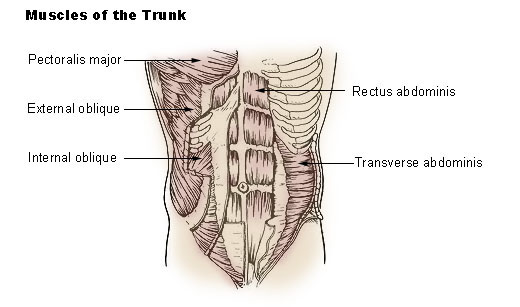
The abdominal external oblique muscle (also external oblique muscle or exterior oblique or musculus obliquus abdominis externus) is the largest and outermost of the three flat abdominal muscles of the lateral anterior abdomen.
The external oblique is situated on the lateral and anterior parts of the abdomen. It is broad, thin, and irregularly quadrilateral, its muscular portion occupying the side, its aponeurosis the anterior wall of the abdomen. In most humans, the oblique is not visible, due to subcutaneous fat deposits and the small size of the muscle.
It arises from eight fleshy digitations, each from the external surfaces and inferior borders of the fifth to twelfth ribs (lower eight ribs). These digitations are arranged in an oblique line which runs inferiorly and anteriorly, with the upper digitations being attached close to the cartilages of the corresponding ribs, the lowest to the apex of the cartilage of the last rib, the intermediate ones to the ribs at some distance from their cartilages.
The five superior serrations increase in size from above downward, and are received between corresponding processes of the serratus anterior muscle; the three lower ones diminish in size from above downward and receive between them corresponding processes from the latissimus dorsi. From these attachments the fleshy fibers proceed in various directions. Its posterior fibers from the ribs to the iliac crest form a free posterior border.
Those from the lowest ribs pass nearly vertically downward, and are inserted into the anterior half of the outer lip of the iliac crest; the middle and upper fibers, directed downward (inferiorly) and forward (anteriorly), become aponeurotic at approximately the midclavicular line and form the anterior layer of the rectus sheath. This aponeurosis formed from fibres from either side of the external oblique decussates at the linea alba.
The aponeurosis of the external oblique muscle forms the inguinal ligament. The muscle also contributes to the inguinal canal.
The internal oblique muscle is just deep to the external oblique muscle.
The external oblique muscle is supplied by ventral branches of the lower six thoracoabdominal nerves and the subcostal nerve on each side.
Hub AI
Abdominal external oblique muscle AI simulator
(@Abdominal external oblique muscle_simulator)
Abdominal external oblique muscle
The abdominal external oblique muscle (also external oblique muscle or exterior oblique or musculus obliquus abdominis externus) is the largest and outermost of the three flat abdominal muscles of the lateral anterior abdomen.
The external oblique is situated on the lateral and anterior parts of the abdomen. It is broad, thin, and irregularly quadrilateral, its muscular portion occupying the side, its aponeurosis the anterior wall of the abdomen. In most humans, the oblique is not visible, due to subcutaneous fat deposits and the small size of the muscle.
It arises from eight fleshy digitations, each from the external surfaces and inferior borders of the fifth to twelfth ribs (lower eight ribs). These digitations are arranged in an oblique line which runs inferiorly and anteriorly, with the upper digitations being attached close to the cartilages of the corresponding ribs, the lowest to the apex of the cartilage of the last rib, the intermediate ones to the ribs at some distance from their cartilages.
The five superior serrations increase in size from above downward, and are received between corresponding processes of the serratus anterior muscle; the three lower ones diminish in size from above downward and receive between them corresponding processes from the latissimus dorsi. From these attachments the fleshy fibers proceed in various directions. Its posterior fibers from the ribs to the iliac crest form a free posterior border.
Those from the lowest ribs pass nearly vertically downward, and are inserted into the anterior half of the outer lip of the iliac crest; the middle and upper fibers, directed downward (inferiorly) and forward (anteriorly), become aponeurotic at approximately the midclavicular line and form the anterior layer of the rectus sheath. This aponeurosis formed from fibres from either side of the external oblique decussates at the linea alba.
The aponeurosis of the external oblique muscle forms the inguinal ligament. The muscle also contributes to the inguinal canal.
The internal oblique muscle is just deep to the external oblique muscle.
The external oblique muscle is supplied by ventral branches of the lower six thoracoabdominal nerves and the subcostal nerve on each side.