



Community hub
Recent from talks
Contribute something to knowledge base
Content stats: 0 posts, 0 articles, 1 media, 0 notes
Members stats: 0 subscribers, 0 contributors, 0 moderators, 0 supporters
Subscribers
Supporters
Contributors
Moderators
Hub AI
General Dynamics F-16 Fighting Falcon AI simulator
(@General Dynamics F-16 Fighting Falcon_simulator)
Hub AI
General Dynamics F-16 Fighting Falcon AI simulator
(@General Dynamics F-16 Fighting Falcon_simulator)
General Dynamics F-16 Fighting Falcon
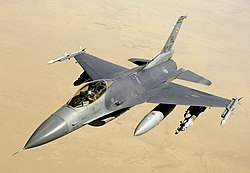
The General Dynamics (now Lockheed Martin) F-16 Fighting Falcon is an American single-engine supersonic multirole fighter aircraft under production by Lockheed Martin. Designed as an air superiority day fighter, it evolved into a successful all-weather multirole aircraft with over 4,600 built since 1976. Although no longer purchased by the United States Air Force (USAF), improved versions are being built for export. As of 2025, it is the world's most common fixed-wing aircraft in military service, with 2,084 F-16s operational.
The aircraft was first developed by General Dynamics in 1974. In 1993, General Dynamics sold its aircraft manufacturing business to Lockheed, which became part of Lockheed Martin after a 1995 merger with Martin Marietta.
The F-16's key features include a frameless bubble canopy for enhanced cockpit visibility, a side-stick to ease control while maneuvering, an ejection seat reclined 30 degrees from vertical to reduce the effect of g-forces on the pilot, and the first use of a relaxed static stability/fly-by-wire flight control system that helps to make it an agile aircraft. The fighter has a single turbofan engine, an internal M61 Vulcan cannon and 11 hardpoints. Although officially named "Fighting Falcon", the aircraft is commonly known by the nickname "Viper" among its crews and pilots.
Since its introduction in 1978, the F-16 became a mainstay of the U.S. Air Force's tactical airpower, primarily performing strike and suppression of enemy air defenses (SEAD) missions; in the latter role, it replaced the F-4G Wild Weasel by 1996. In addition to active duty in the U.S. Air Force, Air Force Reserve Command, and Air National Guard units, the aircraft is also used by the U.S. Air Force Thunderbirds aerial demonstration team, the US Air Combat Command F-16 Viper Demonstration Team, and as an adversary/aggressor aircraft by the United States Navy. The F-16 has also been procured by the air forces of 25 other nations. F-16s from various US-led coalitions flew combat missions in the Gulf War, Bosnia, Yugoslavia, Afghanistan, Libya, and Iraq and Syria. F-16s have also seen extensive combat use by Israel, Pakistan, and Ukraine. Since 1982, it has been a Dual Capable Aircraft platform for US nuclear weapons in Europe. Numerous countries have begun replacing the aircraft with the F-35 Lightning II, although the F-16 remains in production and service with many operators.
US Vietnam War experience showed the need for air superiority fighters and better air-to-air training for fighter pilots. Based on his experience in the Korean War and as a fighter tactics instructor in the early 1960s, Colonel John Boyd with mathematician Thomas Christie developed the energy–maneuverability theory to model a fighter aircraft's performance in combat. Boyd's work called for a small, lightweight aircraft that could maneuver with the minimum possible energy loss and which also incorporated an increased thrust-to-weight ratio. In the late 1960s, Boyd gathered a group of like-minded innovators who became known as the Fighter Mafia, and in 1969, they secured Department of Defense funding for General Dynamics and Northrop to study design concepts based on the theory.
Air Force F-X proponents were opposed to the concept because they perceived it as a threat to the F-15 program, but the USAF's leadership understood that its budget would not allow it to purchase enough F-15 aircraft to satisfy all of its missions. The Advanced Day Fighter concept, renamed F-XX, gained civilian political support under the reform-minded Deputy Secretary of Defense David Packard, who favored the idea of competitive prototyping. As a result, in May 1971, the Air Force Prototype Study Group was established, with Boyd a key member, and two of its six proposals would be funded, one being the Lightweight Fighter (LWF). The request for proposals issued on 6 January 1972 called for a 20,000-pound (9,100 kg) class air-to-air day fighter with a good turn rate, acceleration, and range, and optimized for combat at speeds of Mach 0.6–1.6 and altitudes of 30,000–40,000 feet (9,100–12,000 m). This was the region where USAF studies predicted most future air combat would occur. The anticipated average flyaway cost of a production version was $3 million. This production plan was hypothetical as the USAF had no firm plans to procure the winner.
Five companies responded, and in 1972, the Air Staff selected General Dynamics' Model 401 and Northrop's P-600 for the follow-on prototype development and testing phase. GD and Northrop were awarded contracts worth $37.9 million and $39.8 million to produce the YF-16 and YF-17, respectively, with the first flights of both prototypes planned for early 1974. To overcome resistance in the Air Force hierarchy, the Fighter Mafia and other LWF proponents[which?] successfully advocated the idea of complementary fighters in a high-cost/low-cost force mix. The "high/low mix" would allow the USAF to be able to afford sufficient fighters for its overall fighter force structure requirements. The mix gained broad acceptance by the time of the prototypes' flyoff, defining the relationship between the LWF and the F-15.
The YF-16 was developed by a team of General Dynamics engineers led by Robert H. Widmer. The first YF-16 was rolled out on 13 December 1973. Its 90-minute maiden flight was made at the Air Force Flight Test Center at Edwards AFB, California, on 2 February 1974. Its actual first flight occurred accidentally during a high-speed taxi test on 20 January 1974. While gathering speed, a roll-control oscillation caused a fin of the port-side wingtip-mounted missile and then the starboard stabilator to scrape the ground, and the aircraft then began to veer off the runway. The test pilot, Phil Oestricher, decided to lift off to avoid a potential crash, safely landing six minutes later. The slight damage was quickly repaired and the official first flight occurred on time. The YF-16's first supersonic flight was accomplished on 5 February 1974, and the second YF-16 prototype first flew on 9 May 1974. This was followed by the first flights of Northrop's YF-17 prototypes on 9 June and 21 August 1974, respectively. During the flyoff, the YF-16s completed 330 sorties for a total of 417 flight hours; the YF-17s flew 288 sorties, covering 345 hours.
General Dynamics F-16 Fighting Falcon
The General Dynamics (now Lockheed Martin) F-16 Fighting Falcon is an American single-engine supersonic multirole fighter aircraft under production by Lockheed Martin. Designed as an air superiority day fighter, it evolved into a successful all-weather multirole aircraft with over 4,600 built since 1976. Although no longer purchased by the United States Air Force (USAF), improved versions are being built for export. As of 2025, it is the world's most common fixed-wing aircraft in military service, with 2,084 F-16s operational.
The aircraft was first developed by General Dynamics in 1974. In 1993, General Dynamics sold its aircraft manufacturing business to Lockheed, which became part of Lockheed Martin after a 1995 merger with Martin Marietta.
The F-16's key features include a frameless bubble canopy for enhanced cockpit visibility, a side-stick to ease control while maneuvering, an ejection seat reclined 30 degrees from vertical to reduce the effect of g-forces on the pilot, and the first use of a relaxed static stability/fly-by-wire flight control system that helps to make it an agile aircraft. The fighter has a single turbofan engine, an internal M61 Vulcan cannon and 11 hardpoints. Although officially named "Fighting Falcon", the aircraft is commonly known by the nickname "Viper" among its crews and pilots.
Since its introduction in 1978, the F-16 became a mainstay of the U.S. Air Force's tactical airpower, primarily performing strike and suppression of enemy air defenses (SEAD) missions; in the latter role, it replaced the F-4G Wild Weasel by 1996. In addition to active duty in the U.S. Air Force, Air Force Reserve Command, and Air National Guard units, the aircraft is also used by the U.S. Air Force Thunderbirds aerial demonstration team, the US Air Combat Command F-16 Viper Demonstration Team, and as an adversary/aggressor aircraft by the United States Navy. The F-16 has also been procured by the air forces of 25 other nations. F-16s from various US-led coalitions flew combat missions in the Gulf War, Bosnia, Yugoslavia, Afghanistan, Libya, and Iraq and Syria. F-16s have also seen extensive combat use by Israel, Pakistan, and Ukraine. Since 1982, it has been a Dual Capable Aircraft platform for US nuclear weapons in Europe. Numerous countries have begun replacing the aircraft with the F-35 Lightning II, although the F-16 remains in production and service with many operators.
US Vietnam War experience showed the need for air superiority fighters and better air-to-air training for fighter pilots. Based on his experience in the Korean War and as a fighter tactics instructor in the early 1960s, Colonel John Boyd with mathematician Thomas Christie developed the energy–maneuverability theory to model a fighter aircraft's performance in combat. Boyd's work called for a small, lightweight aircraft that could maneuver with the minimum possible energy loss and which also incorporated an increased thrust-to-weight ratio. In the late 1960s, Boyd gathered a group of like-minded innovators who became known as the Fighter Mafia, and in 1969, they secured Department of Defense funding for General Dynamics and Northrop to study design concepts based on the theory.
Air Force F-X proponents were opposed to the concept because they perceived it as a threat to the F-15 program, but the USAF's leadership understood that its budget would not allow it to purchase enough F-15 aircraft to satisfy all of its missions. The Advanced Day Fighter concept, renamed F-XX, gained civilian political support under the reform-minded Deputy Secretary of Defense David Packard, who favored the idea of competitive prototyping. As a result, in May 1971, the Air Force Prototype Study Group was established, with Boyd a key member, and two of its six proposals would be funded, one being the Lightweight Fighter (LWF). The request for proposals issued on 6 January 1972 called for a 20,000-pound (9,100 kg) class air-to-air day fighter with a good turn rate, acceleration, and range, and optimized for combat at speeds of Mach 0.6–1.6 and altitudes of 30,000–40,000 feet (9,100–12,000 m). This was the region where USAF studies predicted most future air combat would occur. The anticipated average flyaway cost of a production version was $3 million. This production plan was hypothetical as the USAF had no firm plans to procure the winner.
Five companies responded, and in 1972, the Air Staff selected General Dynamics' Model 401 and Northrop's P-600 for the follow-on prototype development and testing phase. GD and Northrop were awarded contracts worth $37.9 million and $39.8 million to produce the YF-16 and YF-17, respectively, with the first flights of both prototypes planned for early 1974. To overcome resistance in the Air Force hierarchy, the Fighter Mafia and other LWF proponents[which?] successfully advocated the idea of complementary fighters in a high-cost/low-cost force mix. The "high/low mix" would allow the USAF to be able to afford sufficient fighters for its overall fighter force structure requirements. The mix gained broad acceptance by the time of the prototypes' flyoff, defining the relationship between the LWF and the F-15.
The YF-16 was developed by a team of General Dynamics engineers led by Robert H. Widmer. The first YF-16 was rolled out on 13 December 1973. Its 90-minute maiden flight was made at the Air Force Flight Test Center at Edwards AFB, California, on 2 February 1974. Its actual first flight occurred accidentally during a high-speed taxi test on 20 January 1974. While gathering speed, a roll-control oscillation caused a fin of the port-side wingtip-mounted missile and then the starboard stabilator to scrape the ground, and the aircraft then began to veer off the runway. The test pilot, Phil Oestricher, decided to lift off to avoid a potential crash, safely landing six minutes later. The slight damage was quickly repaired and the official first flight occurred on time. The YF-16's first supersonic flight was accomplished on 5 February 1974, and the second YF-16 prototype first flew on 9 May 1974. This was followed by the first flights of Northrop's YF-17 prototypes on 9 June and 21 August 1974, respectively. During the flyoff, the YF-16s completed 330 sorties for a total of 417 flight hours; the YF-17s flew 288 sorties, covering 345 hours.
Recent media
Recent media