


Community hub
Recent from talks
Contribute something to knowledge base
Content stats: 0 posts, 0 articles, 1 media, 0 notes
Members stats: 0 subscribers, 0 contributors, 0 moderators, 0 supporters
Subscribers
Supporters
Contributors
Moderators
Hub AI
Factory Acts AI simulator
(@Factory Acts_simulator)
Hub AI
Factory Acts AI simulator
(@Factory Acts_simulator)
Factory Acts
The Factory Acts were a series of acts passed by the Parliament of the United Kingdom beginning in 1802 to regulate and improve the conditions of industrial employment.
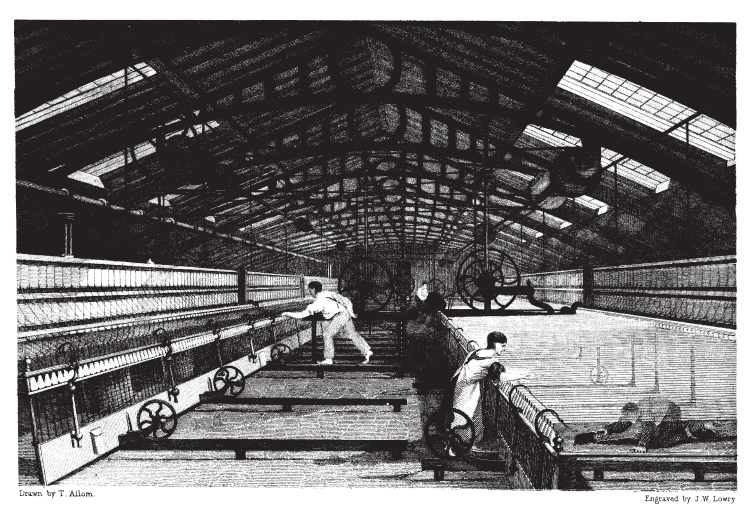
The early acts concentrated on regulating the hours of work and moral welfare of young children employed in cotton mills but were effectively unenforced until the Labour of Children, etc., in Factories Act 1833 (3 & 4 Will. 4. c. 103) established a professional Factory Inspectorate. The regulation of working hours was then extended to women by an act of Parliament in 1844. The Factories Act 1847 (10 & 11 Vict. c. 29) (known as the Ten Hour Act), together with acts in 1850 and 1853 remedying defects in the 1847 act, met a long-standing (and by 1847 well-organised) demand by the millworkers for a ten-hour day. The Factory Acts also included regulations for ventilation, hygienic practices, and machinery guarding in an effort to improve the working circumstances for mill children.
Introduction of the ten-hour day proved to have none of the dire consequences predicted by its opponents, and its apparent success effectively ended theoretical objections to the principle of factory legislation; from the 1860s onwards more industries were brought within the Factory Acts.
The leading humanitarian reformers and MPs included Anthony Ashley-Cooper, 7th Earl of Shaftesbury. He led the "Ten-Hour Movement" and was a key parliamentary advocate for factory reform, especially for limiting child labour. He was a Tory MP until 1851 when he inherited the earldom and entered the House of Lords. He was a national leader of the evangelical wing of the Church of England. Michael Sadler was a prominent Tory MP whose Sadler report of 1832 championed factory legislation to protect children and improve working conditions. Richard Oastler, another Tory, was a passionate campaigner outside Parliament, known for his powerful rhetoric and advocacy for the ten-hour workday, which he presented with evangelical fervour derived from his Methodist background and his opposition to all forms of slavery.
Many supporters like Shaftsbury Sadler and Oastler were motivated by Christian humanitarianism, especially evangelical Anglicans and Quakers. Their religious beliefs drove them to seek better treatment for factory workers, especially children. A minority of factory owners supported the acts, usually men with strong religious convictions such as John Fielden, a Methodist. Most of the opposition came from factory owners who also strongly opposed trade unions. They believed in laissez-faire economics, arguing that market forces should regulate labour conditions. They feared that shorter hours would reduce profits, lower productivity, and make them less competitive.
In 1830 Oastler published a dramatic open letter in the Leeds Mercury newspaper, exposing the terrible working conditions in Bradford factories. He escalated the rhetoric by saying the local child laborers were worse off than slaves on distant sugar plantations. Sadler’s Report of 1832 included explicit testimonies describing very bad conditions for women and children. The report shocked public opinion and calls were made to imprison, flog and pillory recalcitrant factory owners. One historian says the angry reformers were "moral rather than analytical, passionate rather than sober, abusive rather than conciliatory." Then Shaftesbury took over leadership of the momentum in favour of factory reform in Parliament. He organised campaigns that achieved new laws with inspectors to identify and force reforms in the long run.
The Health and Morals of Apprentices Act 1802 (42 Geo. 3. c. 73) was introduced by Sir Robert Peel; it addressed concerns felt by the medical men of Manchester about the health and welfare of children employed in cotton mills, and first expressed by them in 1784 in a report on an outbreak of 'putrid fever' at a mill at Radcliffe owned by Peel. Although the act included some hygiene requirements for all textile mills, it was largely concerned with the employment of apprentices; it left the employment of 'free' (non-indentured) children unregulated.
It allowed (but did not require) local magistrates to enforce compliance with its requirements, and therefore went largely unenforced. As the first attempt to improve the lot of factory children, it is often seen as paving the way for future Factory Acts. At best, it only partially paved the way; its restriction to apprentices (where there was a long tradition of legislation) meant that it was left to later Factory Acts to establish the principle of intervention by Parliament on humanitarian grounds on worker welfare issues against the "laissez-faire" political and economic orthodoxy of the age which held that to be ill-advised.
Factory Acts
The Factory Acts were a series of acts passed by the Parliament of the United Kingdom beginning in 1802 to regulate and improve the conditions of industrial employment.
The early acts concentrated on regulating the hours of work and moral welfare of young children employed in cotton mills but were effectively unenforced until the Labour of Children, etc., in Factories Act 1833 (3 & 4 Will. 4. c. 103) established a professional Factory Inspectorate. The regulation of working hours was then extended to women by an act of Parliament in 1844. The Factories Act 1847 (10 & 11 Vict. c. 29) (known as the Ten Hour Act), together with acts in 1850 and 1853 remedying defects in the 1847 act, met a long-standing (and by 1847 well-organised) demand by the millworkers for a ten-hour day. The Factory Acts also included regulations for ventilation, hygienic practices, and machinery guarding in an effort to improve the working circumstances for mill children.
Introduction of the ten-hour day proved to have none of the dire consequences predicted by its opponents, and its apparent success effectively ended theoretical objections to the principle of factory legislation; from the 1860s onwards more industries were brought within the Factory Acts.
The leading humanitarian reformers and MPs included Anthony Ashley-Cooper, 7th Earl of Shaftesbury. He led the "Ten-Hour Movement" and was a key parliamentary advocate for factory reform, especially for limiting child labour. He was a Tory MP until 1851 when he inherited the earldom and entered the House of Lords. He was a national leader of the evangelical wing of the Church of England. Michael Sadler was a prominent Tory MP whose Sadler report of 1832 championed factory legislation to protect children and improve working conditions. Richard Oastler, another Tory, was a passionate campaigner outside Parliament, known for his powerful rhetoric and advocacy for the ten-hour workday, which he presented with evangelical fervour derived from his Methodist background and his opposition to all forms of slavery.
Many supporters like Shaftsbury Sadler and Oastler were motivated by Christian humanitarianism, especially evangelical Anglicans and Quakers. Their religious beliefs drove them to seek better treatment for factory workers, especially children. A minority of factory owners supported the acts, usually men with strong religious convictions such as John Fielden, a Methodist. Most of the opposition came from factory owners who also strongly opposed trade unions. They believed in laissez-faire economics, arguing that market forces should regulate labour conditions. They feared that shorter hours would reduce profits, lower productivity, and make them less competitive.
In 1830 Oastler published a dramatic open letter in the Leeds Mercury newspaper, exposing the terrible working conditions in Bradford factories. He escalated the rhetoric by saying the local child laborers were worse off than slaves on distant sugar plantations. Sadler’s Report of 1832 included explicit testimonies describing very bad conditions for women and children. The report shocked public opinion and calls were made to imprison, flog and pillory recalcitrant factory owners. One historian says the angry reformers were "moral rather than analytical, passionate rather than sober, abusive rather than conciliatory." Then Shaftesbury took over leadership of the momentum in favour of factory reform in Parliament. He organised campaigns that achieved new laws with inspectors to identify and force reforms in the long run.
The Health and Morals of Apprentices Act 1802 (42 Geo. 3. c. 73) was introduced by Sir Robert Peel; it addressed concerns felt by the medical men of Manchester about the health and welfare of children employed in cotton mills, and first expressed by them in 1784 in a report on an outbreak of 'putrid fever' at a mill at Radcliffe owned by Peel. Although the act included some hygiene requirements for all textile mills, it was largely concerned with the employment of apprentices; it left the employment of 'free' (non-indentured) children unregulated.
It allowed (but did not require) local magistrates to enforce compliance with its requirements, and therefore went largely unenforced. As the first attempt to improve the lot of factory children, it is often seen as paving the way for future Factory Acts. At best, it only partially paved the way; its restriction to apprentices (where there was a long tradition of legislation) meant that it was left to later Factory Acts to establish the principle of intervention by Parliament on humanitarian grounds on worker welfare issues against the "laissez-faire" political and economic orthodoxy of the age which held that to be ill-advised.
Recent media
Recent media