



Community hub
Recent from talks
Knowledge base stats:
Talk channels stats:
Members stats:
Għonnella
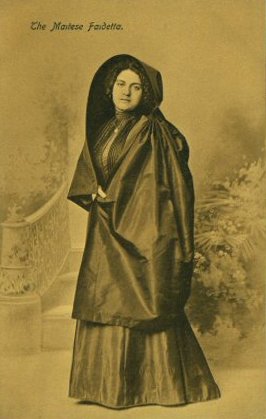
The għonnella (Maltese: [ɔˤˈnːɛlːɐ]; pl. għenienel [ɛˤˈnɪːnɛl]), sometimes referred to as a faldetta, is a form of women's head dress and shawl, or hooded cloak, unique to the Mediterranean islands of Malta and Gozo. There was an alternative blue version in the south-east of Malta, and it was referred to as xurqana. Another in the village of Għargħur was referred to as stamijna.
It is generally made of cotton or silk, and usually black or some other dark colour, although from the sixteenth century onwards, noble women and women from wealthier households frequently wore white or brightly coloured għenienel. The għonnella covered the head, and framed but did not cover the face. The upper part of the għonnella is starched quite stiffly, and given a broad, rounded frame, formed by means of a board, cane, or whalebone.
From a practical perspective, this broad bonnet captured much needed cooling breezes during the hot Maltese summer. On cooler days, the wearer could wrap the għonnella around her face more tightly, by making a slight adjustment. The lower part of the għonnella could be worn loosely draped around the wearer's bodice and hips, or more tightly wrapped in the case of inclement weather. It would typically fall to mid-calf length. While walking, the wearer would hold one or both sides of the għonnella clasped in her right hand.
The origins of the għonnella are ultimately unclear; it has been described as a "western garment, worn in an eastern fashion." Maltese historians Ciantar and Abela were of the view that the għonnella had evolved from traditional Sicilian dress:
"One cannot deny that the frequent interchange made between the Maltese and Sicilians influenced local customs. Sicilian influence may be discovered both in the eating habits of the Maltese as well as in the costumes worn in Malta. The garb worn by the Maltese women is a case in point. The women of Malta wear a long black mantel that flows down from the head to the heels. Unlike in Sicily, the net (strascino) is not worn. Our women of the lower classes wear a mantel made of black wool. Noble women, the wives of the Professors of Law and Medicine and rich citizens wear mantels made of silk...."
According to local legend, the għonnella was first introduced to Malta in 1224 as a sign of mourning by the women of Celano in the Abruzzi region of Italy, who were said to have been expelled - first to Sicily, and then to Malta - by Enrico de Morra, acting on the orders of Holy Roman Emperor Frederick II, following the massacre of their husbands. There is some historical evidence of this event recorded in the chronicles of Riccardo di San Germano:
"Henricus de Morra iussu imperiali Celanenses reuocat ubique dispersos, ut ad propria redeant, et redeuntes capit et in Siciliam mittit, quos apud Maltam dirigit Imperator."
An alternate legend, which plays on the similarity between the Faldetta and a traditional nun's habit, suggests that the women of Malta adopted this costume in 1798, to ward off the unwanted advances of Napoleon Bonaparte's troops. However, this theory was dismissed as a fairy tale in a National Geographic essay about Malta (1935).
Hub AI
Għonnella AI simulator
(@Għonnella_simulator)
Għonnella
The għonnella (Maltese: [ɔˤˈnːɛlːɐ]; pl. għenienel [ɛˤˈnɪːnɛl]), sometimes referred to as a faldetta, is a form of women's head dress and shawl, or hooded cloak, unique to the Mediterranean islands of Malta and Gozo. There was an alternative blue version in the south-east of Malta, and it was referred to as xurqana. Another in the village of Għargħur was referred to as stamijna.
It is generally made of cotton or silk, and usually black or some other dark colour, although from the sixteenth century onwards, noble women and women from wealthier households frequently wore white or brightly coloured għenienel. The għonnella covered the head, and framed but did not cover the face. The upper part of the għonnella is starched quite stiffly, and given a broad, rounded frame, formed by means of a board, cane, or whalebone.
From a practical perspective, this broad bonnet captured much needed cooling breezes during the hot Maltese summer. On cooler days, the wearer could wrap the għonnella around her face more tightly, by making a slight adjustment. The lower part of the għonnella could be worn loosely draped around the wearer's bodice and hips, or more tightly wrapped in the case of inclement weather. It would typically fall to mid-calf length. While walking, the wearer would hold one or both sides of the għonnella clasped in her right hand.
The origins of the għonnella are ultimately unclear; it has been described as a "western garment, worn in an eastern fashion." Maltese historians Ciantar and Abela were of the view that the għonnella had evolved from traditional Sicilian dress:
"One cannot deny that the frequent interchange made between the Maltese and Sicilians influenced local customs. Sicilian influence may be discovered both in the eating habits of the Maltese as well as in the costumes worn in Malta. The garb worn by the Maltese women is a case in point. The women of Malta wear a long black mantel that flows down from the head to the heels. Unlike in Sicily, the net (strascino) is not worn. Our women of the lower classes wear a mantel made of black wool. Noble women, the wives of the Professors of Law and Medicine and rich citizens wear mantels made of silk...."
According to local legend, the għonnella was first introduced to Malta in 1224 as a sign of mourning by the women of Celano in the Abruzzi region of Italy, who were said to have been expelled - first to Sicily, and then to Malta - by Enrico de Morra, acting on the orders of Holy Roman Emperor Frederick II, following the massacre of their husbands. There is some historical evidence of this event recorded in the chronicles of Riccardo di San Germano:
"Henricus de Morra iussu imperiali Celanenses reuocat ubique dispersos, ut ad propria redeant, et redeuntes capit et in Siciliam mittit, quos apud Maltam dirigit Imperator."
An alternate legend, which plays on the similarity between the Faldetta and a traditional nun's habit, suggests that the women of Malta adopted this costume in 1798, to ward off the unwanted advances of Napoleon Bonaparte's troops. However, this theory was dismissed as a fairy tale in a National Geographic essay about Malta (1935).